






Director Maryam Keshavarz’s dramedy The Persian Version just won the 2023 Audience Award: US Dramatic at Sundance. Here, award-winning re-recording mixer Mathew Waters talks about his approach to this complex mix, which had overlapping lines of dialogue, subjective POVs, and emotional and jubilant scenes that needed sonic support.
 New ReleaseNOVA by Mattia CellottoWATCH VIDEO →
Six-time Emmy Award-winning re-recording mixer Mathew Waters is no stranger to complex mixes, having mixed series like HBO’s Game of Thrones and Amazon Studios’ The Underground Railroad. He knows that getting the right balance takes time. But when the budget doesn’t allow for the necessary time, as is typically the case with indie films – like Director Maryam Keshavarz’s dramedy The Persian Version (that just won the US Dramatic Competition Audience Award at Sundance 2023) – then it’s time to think outside the Hollywood studio box.
Here, Waters talks about some of the complexities in the mix on The Persian Version – like overlapping lines of dialogue in the big family gathering scenes and mixing subjective POVs – and how pre-mixing in Colombia helped them to afford much-needed time on a professional stage.
What were director Maryam Keshavarz’s goals for the mix on The Persian Version? And what were your creative ideas on how to mix this film to support this story in the best way?
Mathew Waters (MW): I don’t want to speak for Maryam, but I think the goal she had for the mix was to be as true as possible. This is kind of her autobiography, or her family’s biography; it’s her story and her mom’s story. Her goal is always to make a fun, true film. I’ve worked with her before (on all of her films actually) and that’s always the same goal.
This particular film features her large family, with eight brothers, I think. There’s a lot of dialogue on top of dialogue on top of dialogue. There are a lot of people talking at the same time. It was really a fun challenge to make sure that you heard what she wanted you to hear, the lines that she wanted you to hear.
The production mixer did a great job of recording the lines, but it’s kind of a zoo in some scenes. Like, who do we want to hear? They’re all talking! So that was really fun.
Every scene has its own challenge. There’s never a scene that just goes down like, “Oh, that was easy. That was fun.” But probably one of the most important scenes for Maryam was a scene where her mom, when she was younger, goes to the well. I don’t want to give away too much for those who haven’t seen the film, but that was a very important scene for Maryam. We had to get that right because it was a big scene in her mom’s life. We took a lot of care on that scene and we wanted to make sure that it played intelligently and played real and heartfelt. We didn’t want to overdo anything or make it seem like anything that it wasn’t. It was a very important time in her mom’s history, which obviously shaped Maryam’s history as well. So that was a big deal.
Because you’re dealing with so many overlapping lines of dialogue, did you move any into the front left or front right speakers, to give them some room so they’re not all bunched up in the center channel?
MW: I did a hair of that but not a lot because anything that takes an audience member out of the world doesn’t help the story. Sometimes when you take the dialogue off the center and then bounce it back to the center, or have it go from right to left, it just becomes too much for someone to take in. They can’t just sit and enjoy the film. So, I didn’t do a lot of that.
What are director Keshavarz’s tastes for the level of ambiences in the surrounds for the exterior scenes?
MW: She lets me handle that pretty much, and I love surrounds when we’re outside. I don’t do a lot of surrounds when we’re inside, but I really like the exteriors to pop. So if I make the inside scenes a little bit more upfront, then all of a sudden you come outside and it’s very immersive.
Maryam likes having fun with the surrounds so long as it doesn’t take away from her story.
What scene went through the most evolution mix-wise? What were some options you’d tried? And ultimately, what worked the best?
MW: I’d say it was the well scene with her mother as a young woman. We tried that a few ways. We went really minimal, and it wasn’t effective. We went the other way, and it was too much. We had to dial it back until we found a place that was respectful of the situation and tells the story. In that scene, there was no music. It was just effects. It had a starkness, a rawness. The audience is just with her. It’s a beautiful scene.
There’s a lot of great music in the film that works well for emotion. And this film is sometimes in Iran, so you have some great instruments and cultural instrumentation. For instance, they dance at a wedding and that was fun.
If you had more time to mix this film, is there anything you’d want to revisit?
MW: No; I think we got the storytelling correct. More time just gets more detail and sometimes you can ruin it. You can literally overthink it. Sometimes you just have to go with your instincts and let the chips fall where they may. But I was really happy with the way it ended up and the way it came out, and I’m excited for people to check it out.
That being said, more time does get more detail. You can do a little more experimentation – try this and try that. I can always use more time; that’s a no-brainer. But, I was really happy with the way this came out.
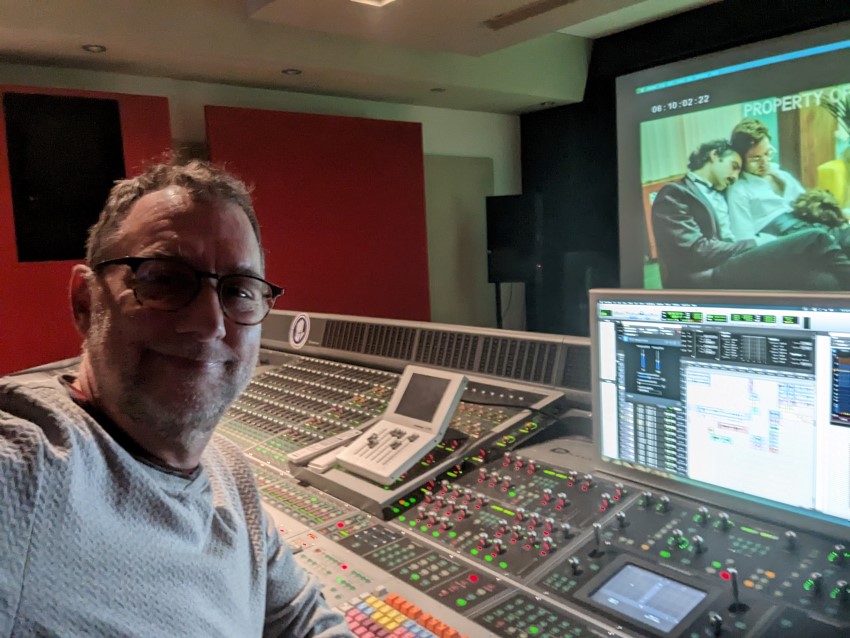
One interesting thing about this film is that I did a mix pass to clean up the dialogue, do some EQ, and spread out the backgrounds (it was essentially a pre-mix) and I did it in a studio in Bogota, Colombia. I spent six days down there and when we came back to L.A., everything was in place. We worked out all the technical aspects of the mix in Bogota and so we were able to spend time on the creative aspects in L.A. I had never done that before and it really worked out well.
This film needed it – with all the characters talking at the same time. There were a lot of transitions and a lot of subjective moments of going into people’s heads. So, we needed the time to work through that and we got it by going to Bogota.
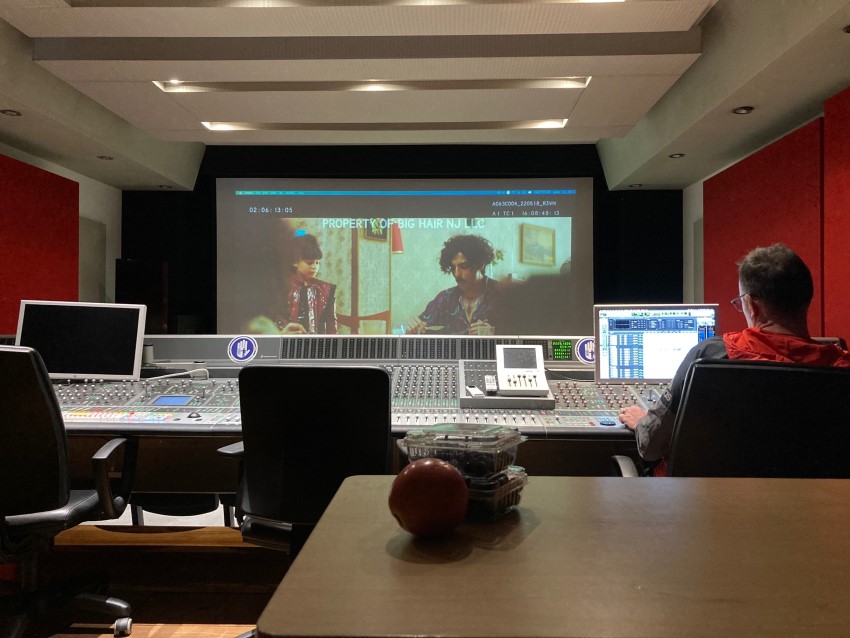
The stage was in the Ático Center at JAVERIANA UNIVERSITY (it’s a studio and a university). It was a very good mixing stage. I had played some of the mixes I had done in L.A. for a group of students down there (that’s how we came up with this idea for The Persian Version), and wow, the stages sounded really good. They’re professional stages.
I was able to spend six days down there, getting The Persian Version in a really good place, and when I came back to L.A. and hit play on the stage here, it translated perfectly. Doing this really helped with a tighter budget. When you have budget issues but need time to work out a complex mix like this one (and you don’t want to work on the film in a garage somewhere), this is a viable option.