






MPSE Award-winning Re-recording Mixer/Sound Designer/Supervising Sound Editor David W. Collins, known for his work on Star Wars series such as The Mandalorian, The Bad Batch, Visions, The Book of Boba Fett, Lego Star Wars Terrifying Tales, and more — dives deep into the sound of Star Wars: Maul – Shadow Lord — now streaming on Disney+.
Find out how pot lids were worked into the sound design for Spybot, how the sounds for each character’s lightsaber are unique, why loop group is key for creating a ‘real’ feeling for the animated world, how Collins helped the localization team recreate all the voice processing, what classic Star Wars droid inspired the sound of Two-Boots, and much more!
 New ReleaseNOVA by Mattia CellottoWATCH VIDEO →
Star Wars: Maul – Shadow Lord | Streaming on Disney+
What was your first ‘encounter’ with Darth Maul? Was it in Lego Star Wars II: The Original Trilogy (2006)?
David W. Collins (DC): Actually, it goes back further than that. I started at Skywalker Sound as an intern in 1999, the same month that The Phantom Menace was released. I was working on the scoring stage there as an intern, throwing cables, adjusting mics, doing that whole thing. During my first week, they screened The Phantom Menace at the Stag Theater at The Ranch. And I couldn’t believe I was there and that all of that was happening.
I moved to LucasArts about a year later, and my first video game with Darth Maul was actually an Xbox launch title called Star Wars: Obi-Wan. And you actually fight Darth Maul at the end of that game.
Lego Star Wars was fun, but Episodes 1, 2, and 3 were actually not made by LucasArts. I did work on Episodes 4, 5, and 6, mostly just doing mumble voiceover — a lot of mumbling and yelling. The whole sound department got involved, and we’d record each other in the studio, just trying to make each other laugh. Then we submitted all those sounds to TT games, who was making the game. They took it and ran with it, but their cinematics were hilarious. So we did our best to double down on all their gags. That was a really fun game to work on.
But the next time I worked on anything with Maul was Star Wars: The Force Unleashed, a game which ironically starred actor Sam Witwer (who voiced Darth Maul in the series The Clone Wars, Maul – Shadow Lord, and Rebels), and one where I played a sidekick droid while handling audio efforts, just like we did for Maul – Shadow Lord this year. The character I was voicing was named PROXY, a training droid and comic relief that could look and fight like any other character. And so at one point, when PROXY is trying to kill Sam’s character (because that’s his programming), he turns into a hologram of Darth Maul. I humbly voiced Maul at the time because we were down to the very last minute, and we’re like, “Hey, we don’t have any Maul efforts. We didn’t think of this. Collins, get in there!” So I got into the booth and basically just growled for the entire fight.
Maul seems to be the thing that keeps coming back. Sam Witwer and I have been friends since he was in college with my best buddy growing up. We’d known each other since 2000 or 2001. Finally, I was able to get him a few auditions, but the one that really stuck — the one he was just perfect for — was as Starkiller in The Force Unleashed. That’s when Dave Filoni saw it and brought him into The Clone Wars, first as Mortis, and then again as Maul in 2012. So it’s a nice, poetic bookend, from starting in the spring of ’99 all the way to doing this show in 2026.
How has your perception of Darth Maul’s signature sound changed since then? Have you tried to make him less evil and cooler?
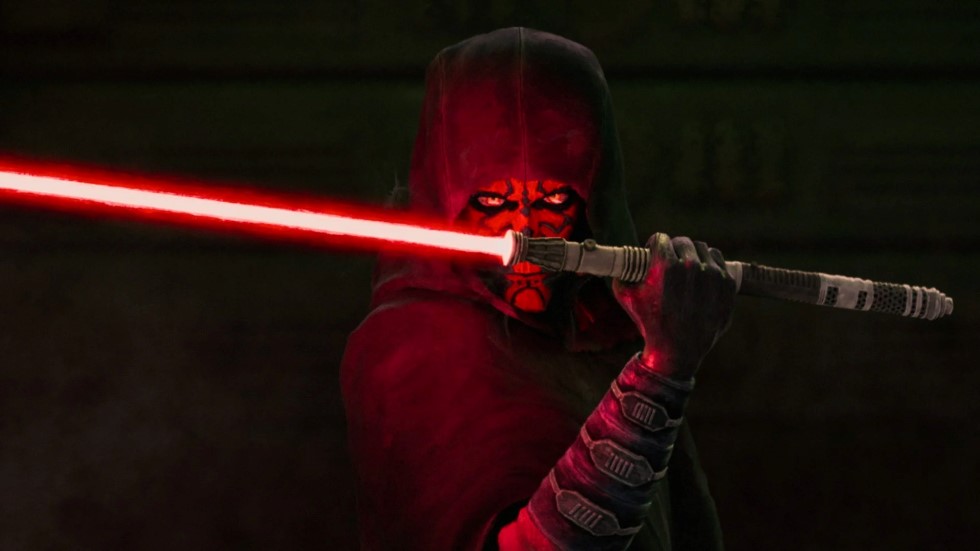
DC: No, he’s still a villain. We try to be very clear about that. But villains are the heroes of their own story. So getting a chance to get inside his psychology and see what his goals are, what makes him tick, and maybe even go as far as to say, potentially, some of the reasons why he is the way he is in this show for me sound-wise, is one of the greatest experiences I’ve had.
One of the best experiences I had was cataloging all the sound effects for Episode 1 into our LucasArts Sound Library, as they were delivered from Matt Wood, who is now my boss. I got to go through every single sound that Ben Burtt and his team made for that movie, including Maul’s lightsaber sounds. When it came time to do this show, it was really important to me to preserve Ben Burtt’s work for the lightsabers, in particular, a lot of the impact sounds and a lot of that classic and prequel trilogy soundscape. I took all of Ben Burtt’s “lightsaber swing” files for Maul and ran them through some software to add this high-end sizzle, because in the temp, I noticed the picture department was adding a lot of high-end, sizzly sound, almost like that Kylo Ren lightsaber effect. It really reflected the painterly style the artists were aiming for. And so I did a slight frequency refresh on the high end, just to honor the blades’ jagged look. But I really wanted to make sure that it sounded like Maul, that it was the same pitch, tone, and enveloping, if you will, of the actual Ben Burtt “Darth Maul” files, particularly when he starts windmilling the double-bladed saber. It’s really important to make sure that comes through. And maybe it’s been given a little bit of something extra.
Additionally, I Doppler-effected a lot of Sam’s screams, and in certain key moments, for certain hard swings that Maul does, you actually hear a Doppler scream in the background. I think of that as something happening through the force, that this is Maul’s world and maybe in looking at this world with this new art style, maybe Maul’s not the most reliable narrator. So I wanted to experiment with a few things, and the team, again, really reacted to this, bringing more of the dark side into Maul’s scenes, either through the music or through adding in whispering and loop group as well.
So I did add some extra sweeteners, but the core of Maul stays exactly the same.
Star Wars: Maul – Shadow Lord | Step Into the Shadows | Streaming on Disney+
Star Wars: Maul – Shadow Lord is an animated series. Did that change how you’d approach the sound of the show versus if it had been a live-action series?
DC: We try to treat everything exactly the same. I was the sound designer on Skeleton Crew and The Mandalorian for a season, so I’ve worked on live-action projects. The process is really the same in almost every way except for working with production sound. We actually have an advantage in animation: we get pristine recordings from LA studios, where the cast records (or wherever the cast is). Sometimes they have to record in London or remotely. We get these beautiful-sounding dialogue tracks.
We spend a lot of time in live-action doing production sound cleanup or phase-matching the shotgun and lav microphones in order to get that high-end and low-end mixed together. Our dialogue editors at Skywalker Sound are just geniuses at that.
And then, of course, ADR is a huge part of it as well. We still do ADR in animation, and we have been doing loop group recently, as well. That was a huge part of the soundscape, bringing in actors to make the police bullpens sound vibrant. You’re hearing noises off-camera as people are taking calls. The marketplace is another great one. You’re hearing all these alien languages being spoken. If you don’t have that, then you have to rely on a recording of a marketplace somewhere around the world, and that becomes a little too familiar-sounding, or terrestrial. It doesn’t sound like Star Wars.
The advantage there, too, is that it’s a powerful storytelling tool. We’ve been working with Brad Rau and the team for many years now. We did all of The Bad Batch together. There’s a wonderful sense of trust and empowerment that they gave me as a supervising sound editor and a mixer on this show — probably more than any other show that I’ve worked on. They’re always wonderful, but on this one, they said, “Hey, go ahead and write some police radio dialogue. Go ahead and write some Imperial PA announcements. Go ahead and write that stuff.” And I did. We performed it, and it’s in the show.
I think part of that is because I’m also playing Spybot, and so I’m in very early on the cast records. I see the cuts and the scripts much earlier than I would’ve if I were just on the post-production side of things. So it’s been a great experience having almost a calendar year to think about what I’m going to do sound-wise. I see things so much earlier than I have in the past, and that’s been hugely advantageous to the sound of the show. There’s the opportunity for ideas to come to you at the weirdest time. You’ll be at your kids’ game or something, thinking, “What if I did this?” At one point, somewhere in my journey years ago, I put the sound of an aluminum bat pitched down into a blaster. You just think of things in the strangest times, and it ends up really affecting the show in a great way.
So you voiced Spybot? What else went into Spybot’s sound?
DC: Yeah, I voiced Spybot in the show. I trained as an actor in college. I was an actor and a musician, and I did amateur touring of musicals all over California and at some international venues. I went to school for theater and music, and it wasn’t until later at Berklee College of Music that I really got into sound and recording studios. It was really Star Wars that motivated me to do sound design. And so when I left Skywalker for a little bit, I was doing a lot of voiceover in LA. I got the call to come back and start working in animation about eight or nine years ago. At the same time, I was being called to do a lot of loop groups. So I’ve been doing voices in Star Wars for many years, but particularly since 2015 with The Force Awakens. From then on, I’ve been just doing a ton of voices for different characters.
At one point, I did one for Dave Filoni in Ahsoka Season One. Then he cast me again in Star Wars: Tales of the Underworld, which he directed. And so when they were trying to figure out what to do with Spybot — because they weren’t sure if he was all sound effects or was vocal — it was Dave who said to Brad and Matt Michnovitz (head writer), “You should have Collins do it. He’ll figure it out. He’s a voice actor, but he’s also a sound designer on your show.”
And so I got the call to do that. In the script, it said things like, “Say something like this English line, or just say the English line.” And what I quickly realized was that it needed to function differently from, say, R2D2. You might think he doesn’t have a voice, but he does. And that voice is C-3PO. C-3PO is the audience’s foil for R2. You get the other side of the conversation because C-3PO is telling you what R2 is saying, so we are in on the gag; we’re in on the jokes. It’s true with Chopper, too. In Star Wars Rebels, he’s interacting with the whole crew. They’re all talking to him and he’s also much more vocally expressive. Spybot is almost always alone and he while he does talk to Rook Kast, or he does talk to Maul, they generally don’t talk back to him.
So stylistically, just by the nature of what he is, he’s constantly hanging out as this fixture, spying on what’s going on and communicating back. He has a lot of moments almost entirely alone. I tried the sound-effect-only route. I tried the gibberish route, and we actually mixed the first episode that way, and it just wasn’t good enough. It’s hard to describe unless you saw it, but once I got into the second and third episodes, I started voicing comedic reactions, and everyone in the room laughed. I started getting positive feedback with my Looney Tunes antics, so I went back and started adding more English dialogue. They let me come up with that as well. So, I would improvise against the cut until I found something, and I would present it along with the mix, saying, “By the way, I’m trying something new with Spybot. Let me know what you think.”
In my Pro Tools session, I had all these options muted out and stacked up so that I could audition things for them. I was very worried since I’m pitching new dialogue during the mix. That is crazy. But again, Brad and I have worked together for almost 10 years now, and he just laughed and kept most of it. The only time he didn’t is when he was already in love with something that we already had.
So there’s some gibberish. But it’s mostly English. It’s me doing a Peter Lorre growl in the back of my throat, almost like a noir homage.
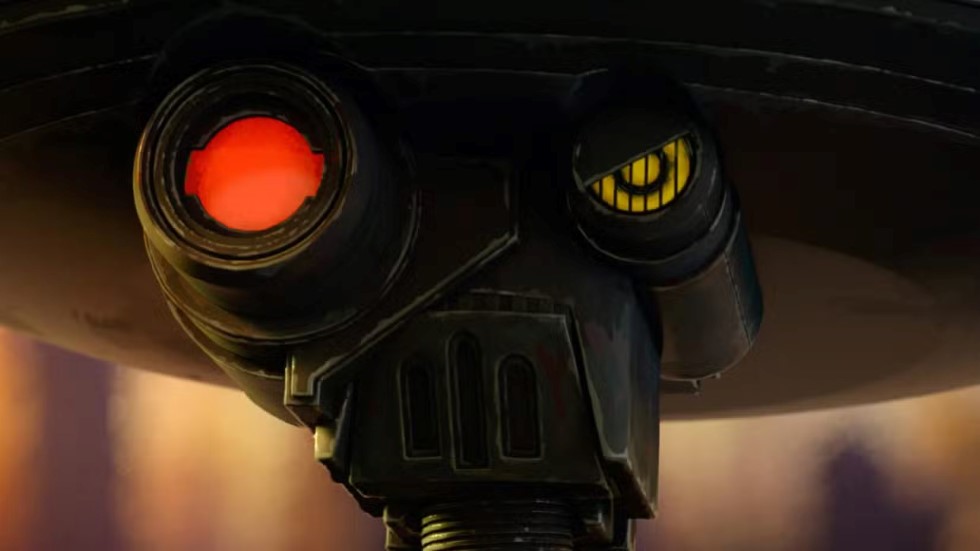
For the actual sound effects, there’s a boiling pot lid that comes on and off when his head opens and closes, along with other mechanical sounds. For his hover sound, I took a wine glass, filled it about halfway with water, and rubbed the rim to create that beautiful resonance. I recorded that and then filtered and processed it. I did some ring modulation on it, multi-effects like pitching and layering, and that became the basis of his steady-hover sound. Then I took some sort of garbled radio gibberish I had made and laid that in as well. And that is his steady sound. And I just Doppler-effected or pitch-ramped that steady for his passbys.
Something I’ve been doing ever since I did BB-8 and Star Wars Resistance is that I’ll create a Kontakt instrument and set the pitch wheel to ±12 cents so I can really perform some of those pitch bends. Sometimes, if I just need to do it quickly, I’ll do a pitch ramp in Pitch ’n Time Pro, or I’ll use a Doppler plugin and create really fast Dopplers depending on the animation in the scene and what the best tool is for the job.
There are some other mechanical sounds and our incredible foley crew: Frank Rinella and Margie O’Malley, and quite a few others that come in to walk as well. Frank’s been supervising Star Wars foley for years, and I’ve been working with him for almost 20 years. They added tremendous foley detail to droids, Spybot’s little claws, and things like that. So it’s a combination of many different things for him.
Foley really adds so much to animated projects. The human performance of foley gives the world a ‘real’ feeling…
DC: Yeah, and they’re so good. They take care of all of it. Frank is a turnkey solution. He gets picture when I get picture, and every once in a while I’ll say, “Hey, can for this one shot, can we get a little extra sauce here or there?” I’ll request something. But most of the time, most of the conversations are, “What do we think that surface sounds like?” Other than that, he spots it, they walk it, he cuts it, and he delivers it. I just fly it in, and it’s perfect. I immediately start panning.
As a mixer, I really love perspective shifts on camera. On my Avid S6, I have a custom fader map of a graphic EQ with a high-pass and low-pass filter on it, so it’s easy to do when I’m pre-mixing dialogue and foley. And I’ve got sends in front of me for my reverbs and delays, and shot-per-shot, because Frank has it checkerboarded out really nicely in Pro Tools. I’m constantly adding perspective shifts to things because I feel it makes it sound so cinematic.
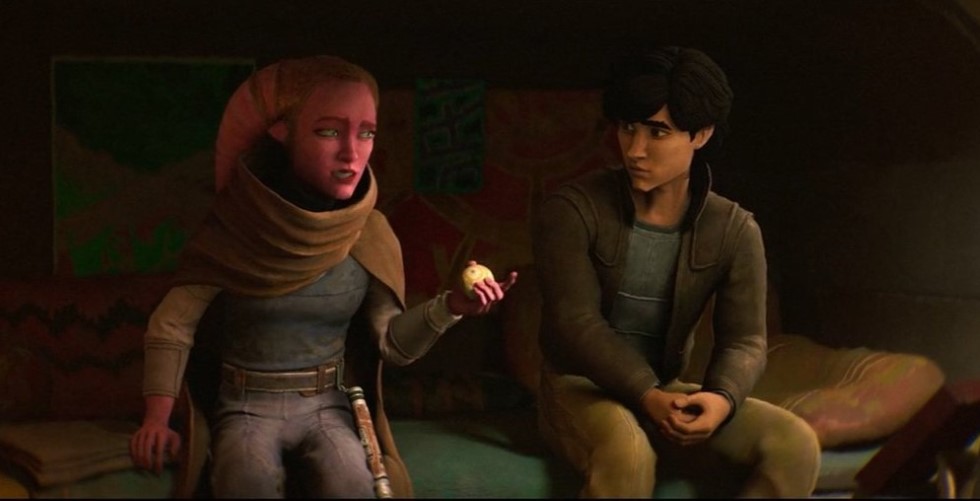
If you look at the fifth episode of the show, the scene where Rylee and Devon are in Rylee’s bedroom, I spent a ridiculous amount of time doing filter writing on the dialogue because Charlie and Gideon, the voice actors, are delivering their lines into these beautiful Neumann U 87 mics. For me, every time the actor turns his head away from the camera, I imagine there’s a boom mic there, and I want to hear a slightly off-mic sound, so I filter it and slightly duck the dialogue every time he turns his head away from camera. It’s subtle, but it makes a big difference in the weight and reality of the characters in that space, and you can really hear it in that scene; it actually makes the line funnier, like he feels like he’s talking to himself a little bit while he’s cleaning up his room and he’s nervous.
So there’s a story reason to do this, too. You feel like you’re marrying what the voice actor did to what the animators did by just honoring the physical truth of the scene. That stuff is really important for foley and dialogue. It helps your brain relate to these sounds, and hopefully fools your ear into thinking it was all just captured by a fly-on-the-wall documentary crew. It’s natural sounding, something you hear every day. It’s important to add those perspective shifts in, to make the show sound real and not like a classic cartoon or a radio play. It’s not supposed to be perfect. Matthew Wood, my boss, told me that George Lucas’s ethos is to push the tools, not be so focused on strict rules or perfect technical presentation, and to use the mixing board like an instrument. This is something Ben Burtt was really good at. He would think outside the box so much, and that’s what George Lucas would teach that generation, and that’s what Matt talks to me about a lot. You want to push things, push the mix, push the reality of something. And I will say these are some of the most challenging yet most fun mixes I’ve ever done, to help the animation feel really grounded in reality. I love that so much. I enjoy doing it.
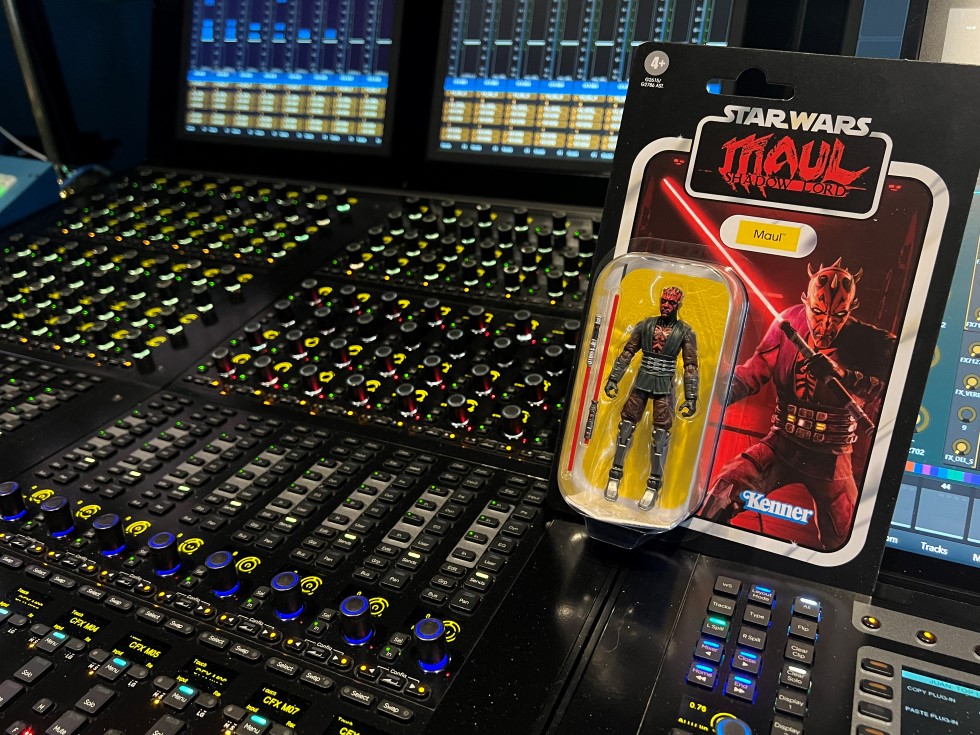
What were some challenges in sound designing and mixing the chase sequence in Ep. 2? Can you talk about your sound work for the different vehicles? What went into the ‘force’ sound for Daki?
DC: For chase sequences and big action sequences, you live and die by a really clean sound edit. These things have to be moment-to-moment. I think it was Walter Murch that said that the human ear can only really hear two-and-a-half things at once, and that’s being generous.
You’re listening to the thing you’re focused on. You could hear another thing, and then you’re vaguely aware of maybe a third thing in the background, which means that it’s a constant matter of who’s carrying the melody. It’s like an orchestra, you’re passing the melody between sections.
Who has it now? Is it this car or that car? Is it Daki? Is it the music? Is the rhythm of the music or the melody taking it now? Am I pulling out for dialogue? It’s like a concerto, but one for sound effects, dialogue, foley, and music. That’s how I think about it because otherwise you put it all together and it’s just mud.
So even while I’m cutting, I’m clip-gaining and pre-mixing stuff, knowing what is or maybe isn’t going to be the hero of the shot. This is the hero of this moment. This is the hero of that moment. I try to do myself favors that way. It’s using all the different parameters. It’s using positioning through space. We’re mixing in 7.1.2 Dolby Atmos. It’s using frequency and using depth. And it’s using volume. We’re trying to use all the tools at our disposal as sound artists to bring clarity to the story. Story is the most important thing. So you get a sequence like that, and you start getting inside it. You start deciding what the rhythm of this scene is. And the Kiners (composers Kevin Kiner, Sean Kiner, and Deana Kiner) are so good with their music about understanding the momentum of a cut and the temporal nature of how things are cut together, so a real sort of rhythm starts to emerge. If you’re fighting that rhythm, then you know you’re not on the right track. If you suddenly are in sync with it, it pops off the screen.
I will say it was an advantage to cut and mix the show because I had no one else to blame but me. A great mix is only good if you have a great edit, and a great edit’s only good in a great mix. Those things are symbiotic, to quote Star Wars.
There are a lot of elements in this big chase/action scene, and one of the things I tried to do in the show was make sure all the lightsabers sound different. Because I’d seen the cut so early, I knew if I made Maul’s saber sound like this, then Devin needed to sound like that. And if Devin sounds like that, then Daki needs to sound different from those, and then the Inquisitors need to sound different from the others. That way, you’re doing yourself a favor by not having frequency stacks on top of each other when you’re trying to mix because they’re all kind of living in their own space.
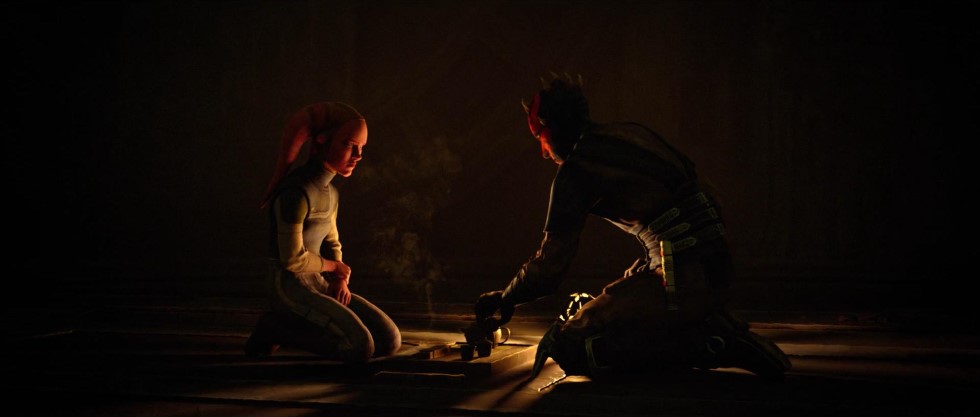
In Ep. 3, Devon squares off against Maul. The room is dark, only lit by the lightsaber in Devon’s hand. Maul’s voice bounces around, making it impossible for Devon to know exactly where he is. This sounds so cool in Dolby Atmos. Can you talk about your mix on this sequence?
DC: It was incredible dialogue performances by both Gideon and Sam. I did what I call the Poltergeist trick, which is that classic ’80s reverse reverb, reverse delay, or reverse cymbal swells on classic albums and things. I took Sam’s vocal, and I reversed it, and then I ran it through a delay and reverb. I printed that verb, and then I reversed the print. Then, I re-reversed the dialogue. So you have this wonderful fade-in of what he says. I’ve always loved that sound ever since I was a kid. So it’s a reverse reverb and reverse delay basically.
And because you don’t know where he is, it was a great opportunity to pan and position the dialogue. Since I have all that wonderful reverb and delay on its own discrete track, I’m able to wet/dry things when I really want to laser-focus that Maul is right there.
There’s one shot where he appears over her shoulder, and I dry everything up and position it really hard to the right so that you know that he was there, and then it’s gone.
Bouncing that around the room was really fun, and it helped me justify the animation in terms of Devon’s head turns. I would anticipate the head turn by positioning the voice over there. And so on the mix stage, it sounded really cool. Even in the stereo mixes, it still really works. It’s one of those things where the question of “do you ever stray from the center channel in a dialogue mix?” Well, if the story requires it, absolutely. I pushed it as hard as I could while maintaining intelligibility, which is a challenge.
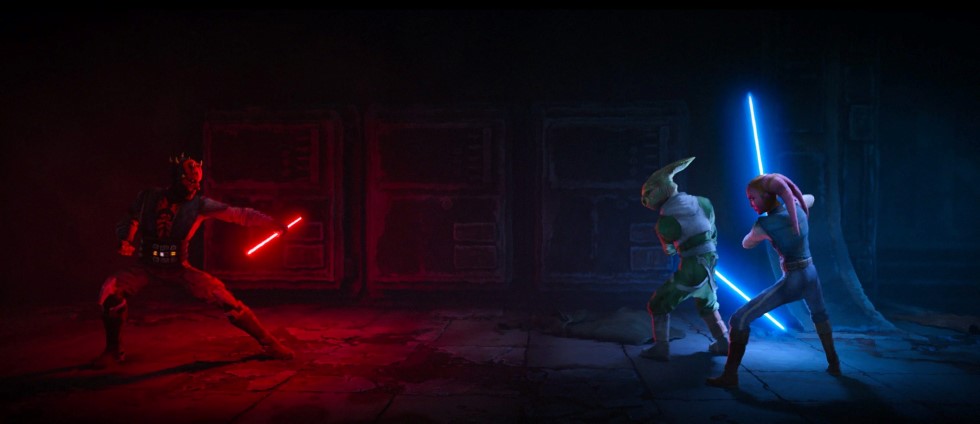
You mentioned making every lightsaber sound different. There are some key fights where that effort really shines, like the fight with Daki and Devon against Maul in Ep. 4. Can you describe an aspect of each lightsaber that sets it apart from the others?
DC: What I’ll say is that for this show, I spent the majority of my design time (making new material) on trying to establish the sound of planet Janix and trying to establish the sounds for Brander Lawson.
When I looked at the first four episodes of the season, there were new police cars, sirens, even telephone rings, communicators, droids, and all kinds of stuff. It was really important to me that the show feel anchored in Star Wars. I set my ego aside and thought, “Boy, I really want Ben Burtt’s lightsabers here. I really want classic-sounding lightsabers for Daki because he represents the Jedi tradition that’s now been all but wiped out.”
Devon is really a combination of work that David Acord, who’s such a talented sound designer, did on Ahsoka and on Rebels. So, carrying the Ahsoka/Shin Hati tradition of sabers, that’s Devon’s base.
For Marrok, I wanted him to sound like a classic Rebels Inquisitor and use those sounds. But if he did that, then the other Inquisitor, Crow, I went with more of the classic Kylo Ren saber. There’s a ton of sounds in the Skywalker library of Kylo Ren saber iterations. And I’ve used them a few times, because they’re so cool. I’ve used them in Star Wars: Visions and I used them again for Crow.
If they’re all going to be around and fighting, I want you to be able to track, from a story perspective, who is who and what’s happening. There’s a reason why Daki sounds like it’s such a classic saber.
Probably the biggest thing I wanted to add to the saber fights was on the impact. I really hit the saber impacts hard with a “boom,” so it’s not just that high-end sizzle. If you listen to the series, you’ll hear stuff I sourced from all the way back to The Empire Strikes Back. I really love the sounds of that dry ice sort of squeakiness, and all of those classic Ben Burtt electric sizzles, and there’s a pop on each one. I really wanted to feel the rhythm of bam-bam-bam. Then, of course, the whispers and the saber screams were where I added something unique to the show. But in order to do that, I really felt strongly about having a Star Wars anchor in the show, and before the Empire shows up, the lightsabers are that anchor.
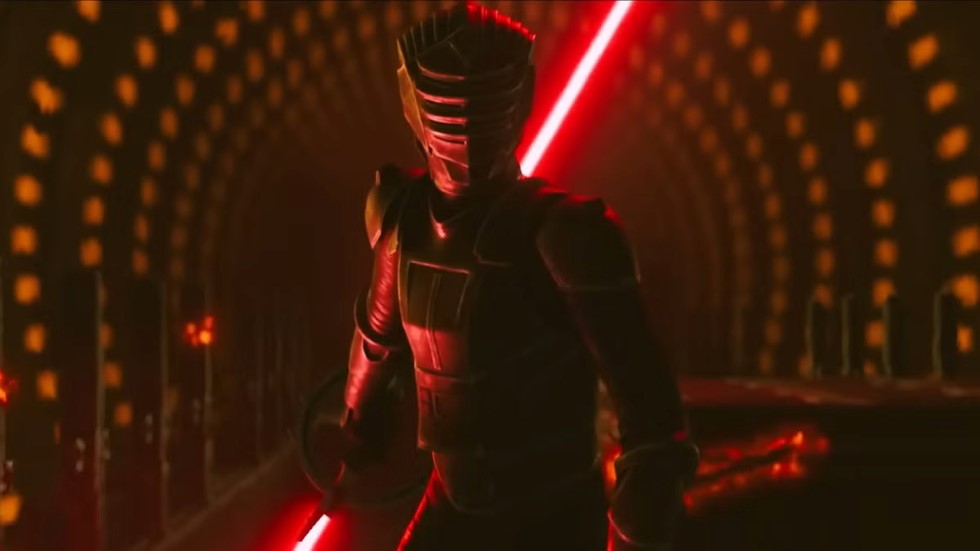
There’s a lot of vocal processing in the show, across all the different alien races, droids, and holograms/comms. Did you have a favorite vocal process you created? What went into it?
DC: If I said Spybot, everyone would probably roll their eyes. But I did use a vocoder for him.
I think sometimes less is more with processing. Marrok was a really interesting one. A.J. LoCascio is the voice actor for Marrok, and he’s great. We had done one or two loop group lines in Ahsoka Season One as Marrok, and Bonnie Wild had processed that.
When AJ got the part, I went back to the Ahsoka session and added a metallic resonance and a little bit of pitch. Intelligibility just starts going out the window when you do too much. And so I actually had Marrok on two different tracks. I had a pitch track and a light track, and I would go syllable-by-syllable to make him almost dive-bomb some syllables into a scary depth, but keep some up just to make sure he stayed intelligible and true to AJ’s performance. That technique worked really well.
More than any other show, our poor localization team had to get pages of documentation from me on how to duplicate that processing. It’s “create this track, then create this track, then print this, then reverse reverb that, and then add that.” I was taking screenshots and inserting them, all for a light touch of processing. A light touch sometimes requires more effort than doing something heavy.
So, I would say Marrokk and Spybot are probably my two favorite processes in the show.
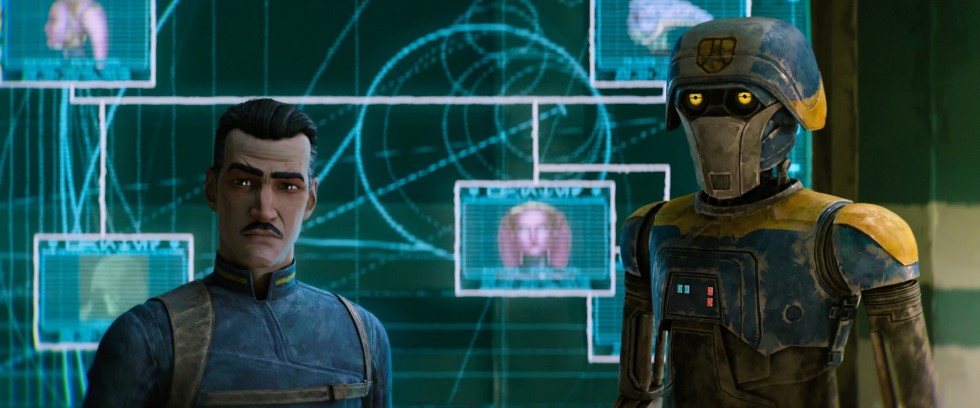
I’m happy that you talked about localization because so much thought goes into it. It’s not just dubbed in a different language. All the handcrafted care you’ve put into the vocal processing these other teams have to recreate…
DC: They do. And what’s interesting is they ask me for plugin presets, and of course, I always give them. And sometimes when that’s not enough, I do give Pro Tools sessions and Word docs with screenshots. So much of processing relies on what’s carrying that processing. Meaning, the vocal performance across all territories/languages might not have the same timbre or register.
Part of the process is casting, and Disney is so on top of it. They have a whole studio set up at Shepparton in the UK. They’re so good at it that I never question it. But in the documentation, I try to say, “Do what you have to do.” This is going to sound different for every actor in every territory. If they feel like they can’t understand what the actor is saying, or that it’s not working with the performance, then do the best to make it their own for each territory and make it work for that cast.
So that’s another reason to go “less is more.” Otherwise, it becomes an effect and I throw it in the M&E. But if it has to be discernible English, then yeah, I try not to overdo it.
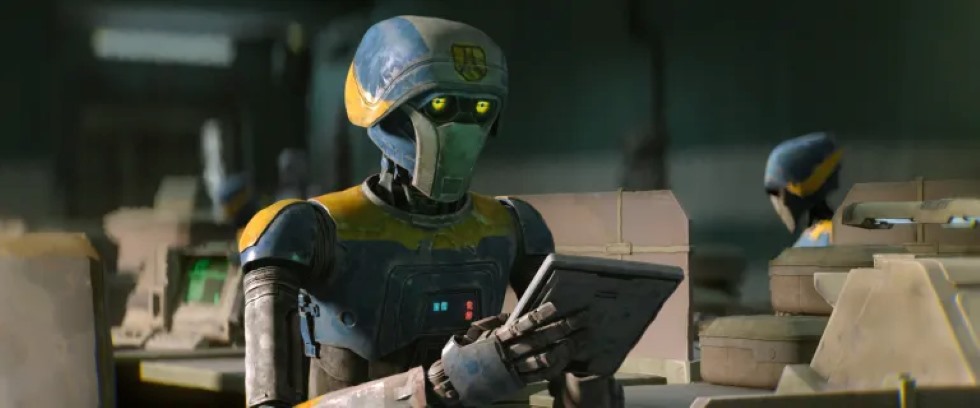
What went into the sounds for Two-Boots (2B0T)?
DC: Two-Boots has a bit more of a rickety sound as opposed to the other droids, who have a much slicker, servo sound. Other than creating his eye blinks, I used some pitched and processed servos from our Star Wars library for him.
I did spend a lot of time choosing how to put together his walk cycle. It’s a lot more rickety than the other droids. There was a real question as to whether or not his shoes should sound like shoes or metal. The funny thing is that ends up becoming distracting unless the camera is looking directly at the shoes. If you’re just putting cloppy footsteps or metal footsteps in there, it ends up distracting from the scene.
Two-Boots does blink a lot. I went back and listened to C-3PO and was amazed at how noisy 3PO is. Especially in Return of the Jedi, he’s very noisy. Every time he moves, there’s something going on. So Two-Boots has that going on, which is very labor-intensive to cut, but once it’s in, it just feels very Star Wars.
So really, voice actor Richard Ayoade is doing all the work. Again, very light vocal processing on Richard because you really want to hear that voice.
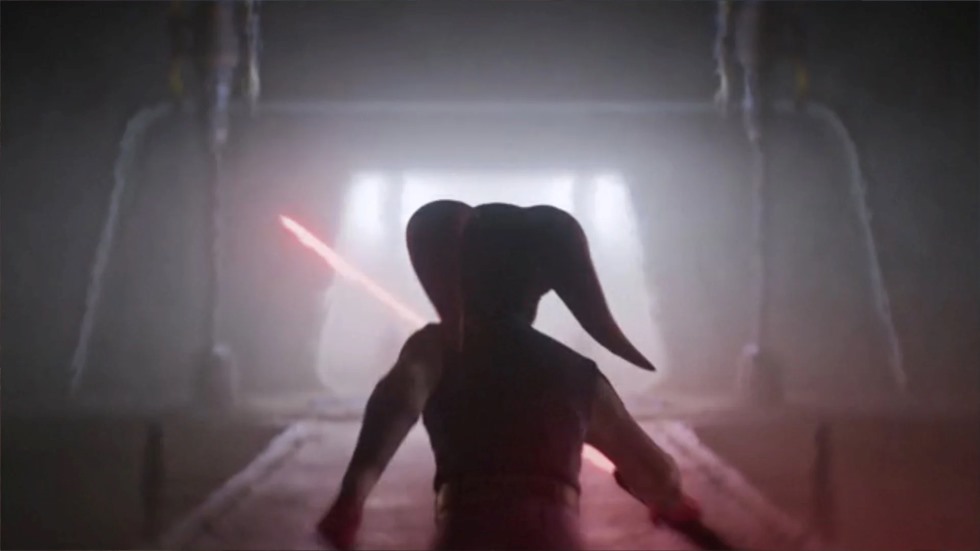
Can you talk about your sound work on the fight with Devon, Marrok, and Maul on the tram? It sounded incredible!
DC: That scene was very challenging to mix and very challenging to edit. I’m halftime panning (panning in slow motion), and I still can’t get the joystick over fast enough. I have to go in and mouse things because they’re moving so fast, and you’re trying to make it clear.
I did see one comment that pertains to sound design, which I think is interesting. The trains were really difficult to come up with because you want it to sound somewhat familiar, but you also want it to feel like it’s in Star Wars, in that galaxy far, far away. And I ran into this when I worked on The Mandalorian. Jon Favreau’s advice was that when we had a train in that show, if you’re going to do Strangers on a Train, then do Strangers on a Train. If you’re going to do Murder on the Orient Express, then do Murder on the Orient Express. In other words, it needs to feel like a train. It needs to feel emotionally grounded for people. They need to register it and forget it. And so I saw someone say that the train wouldn’t be clacking like that since it’s floating. And they’re absolutely right. It would not be going clack-clack-clack.
They’re absolutely right, except they’re not. And here’s why. When you put just a floating sound in there, it’s not as strong a choice. And if you work to make it more interesting, if you get really designy with it, it becomes distracting. It’s not the hero of the scene. It’s not important. Sometimes I’ll have one shot that lasts maybe a second and a half to establish an important story point. For instance, when the camera lingers on the rods that tie the train cars together, which Devon eventually cuts, the camera is down there at one point, and I have to basically let the audience know as fast as possible where they are on the train by going “de-dum de-dum, de-dum de-dum.” And you get that emotional feeling of, “Oh, I get it. I’m on a train now.” You don’t have to think about it. Had the camera gone under the train and established that the repulsor lifts are basically keeping this thing going, then I could have done some crazy, cool design that I established at the top of the train station in the fifth episode.
But I didn’t have that. What I had was a train pulling in. I want to make something immediately recognizable so we can move on and focus the ear on what’s important in the story. And the great thing about Star Wars is there’s no train track, but for all we know, those repulsor engines are hitting sensors every hundred meters down the line, and it resets some self-powered fusion generator or whatever that keeps the train going at 200 kilometers an hour or whatever.
So, why does the train clack like it’s on tracks? The answer is: I don’t know, but it feels right. One of the most storied and famous movie vehicles and dramatic devices in the history of cinema, dating back to the silent films, is the train. If you’re going to put a train in your show, it’s hard to make a train that doesn’t sound like a train. In fact, you lose something if you do that. It goes back to that George Lucas ethos of sometimes you have to break the rules. You have to do what’s emotionally right for a scene rather than be so literal all the time. And that’s a great example of that. With the design and sound design, you have to make those kinds of choices, and they have to be artistic and story-driven first before you get too much into the weeds on the world-building.
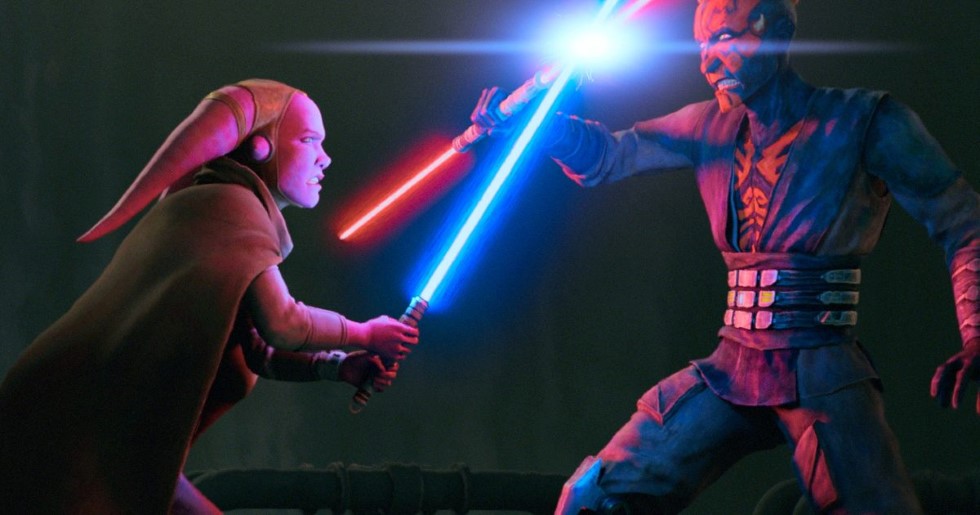
What have you learned while working on the sound of Maul – Shadow Lord?
DC: I’ve learned that I’m going to be on a learning curve for the rest of my career. I’ve learned that you can continually push yourself harder. I’ve been working on Star Wars for a long time, and what feels best is constantly pushing myself to new heights. I’ve been very lucky to call Sam a good friend of mine for 26 years, and it’s inspiring to watch the cast do what they do and give it their all behind the mic. There’s a real spirit on the team at Lucasfilm Animation of pushing themselves. They completely re-upped their pipeline and their look and feel of the show. And that made me really want to step up, to work harder. To continue to have that is such a gift. The show was really a gift, and it made me realize how much more I could push myself. It makes me excited about Season Two.
A big thanks to David W. Collins for giving us a behind-the-scenes look at the sound of Star Wars: Maul – Shadow Lord and to Jennifer Walden for the interview!