



Here, they share how their collaboration – and their very different approach to sound – inspires them, and how it makes them hear, design and use sound in new ways:
Cover photo by Adam Lyberth
Hi Peter and Jacob, please introduce yourselves:
Peter Albrechtsen (PA): My name is Peter Albrechtsen and I’m a Danish sound designer and sound re-recording mixer. I’ve worked on both fiction films and documentaries and both Danish and international productions. Recently I’ve worked on the Danish horror movie What We Become, the Israeli drama Mountain and the Finnish movie The Happiest Day in the Life of Olli Mäki, which won Un Certain Regard at this year’s Cannes Film Festival. I love telling stories with sound and exploring the magical world of sound.
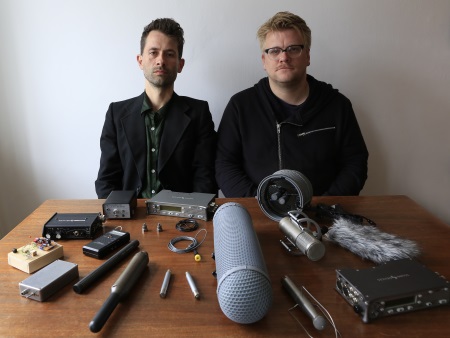
Jacob Kirkegaard (JK): I’m Jacob Kirkegaard and an artist with a primary focus on sound. I began playing music at 12 but have recorded sounds with reel to reel tape recorders recorder since I was 6. For over 20 years now I’ve created sound works based on recordings from my immediate environment to far distant corners of the world. I have a passion listening behind the immediate sounds of things: the vibrations underneath the earth’s surface, the popping of melting ice, or the ambient sound of an abandoned room in Chernobyl or Fukushima.
My works have been shown at galleries and museums around the world such as MoMA in New York, Mori Art Museum in Tokyo and at Louisiana – Museum of Modern Art in Denmark. And my sound works are released by record labels such as Touch, mAtter, Posh Isolation and Important Records.
How did you end up working together? And what were your initial thoughts about collaborating?
PA: I’ve been a fan of Jacob’s work for many years. I think the first time I heard of him was just after I graduated from film school 15 years ago. At that point I also wrote about music and actually interviewed Jacob for a music magazine. Since then we were talking on and off and each time Jacob put out a new album or did an exhibition I was mesmerized by his extraordinary sounds and advanced recording techniques. Then in 2007 I was asked to do the sound design for the Danish teen horror, Kollegiet, with the US title Room 205.
I still remember hearing the first batch of sounds Jacob recorded and they were mind-blowing
It was a ghost story and the ghost was a girl who got electrocuted, and I instantly knew I was going to need a massive amount of electrical sounds. Back then, all of today’s many indie sound libraries didn’t exist, and already during the movie’s preproduction I asked Jacob if he would collect a lot of electrical sounds for me. I was very happy when he said yes, as I think it was his first collaboration like this. I didn’t know Jacob that well at that point and I was a little nervous about the whole thing but I still remember hearing the first batch of sounds Jacob recorded and they were mind-blowing.
JK: Peter and I kind of grew up together but without knowing each other. I became aware of him when he first wrote about one of my releases but not because of the great review he wrote but because I immediately sensed that he knew what he was talking about and that he had sense for sound. So I was excited when he asked me for sound of electricity for a horror film. I knew that my friend Lary 7 in New York had been experimenting with electricity so I met up with him and made some fun short circuit experiments. I also visited a high voltage power station where they allowed me to record.
When I heard how Peter had mixed my sound I was completely thrilled and taken away
When I heard how Peter had mixed my sound I was completely thrilled and taken away. If I weren’t scared off by the horror film itself I was certainly shocked and rocked by its sounds.
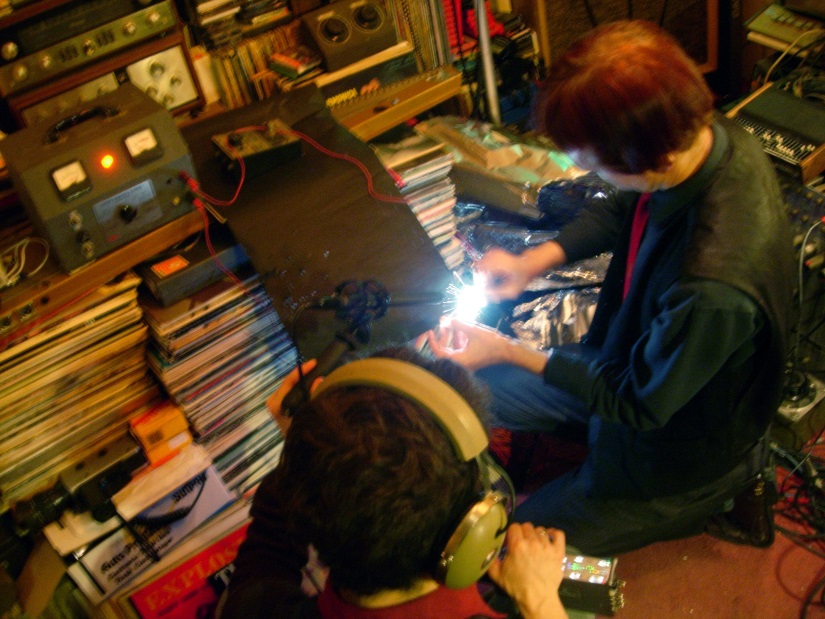
Sometimes you need that extra spark (photo by JG Thirlwell)
Overall, you’re both telling stories with sound, but in somewhat different formats. What are some of the key similarities and differences between your approaches?
PA: I think we’re both really into the sensuous and textural aspects of sound but we do it in very different ways. Actually, I’m a bit envious of Jacob because when he does his sound art pieces he has people’s full attention and he doesn’t have to be weighed down by all the unwritten rules of film sound – in a movie there is a lot of focus on the dialogue and on the music and sometimes the abstract, emotional potential of sound is left somewhat unexplored. At the same time, though, I love to create sounds for picture and the amount of cheating and manipulation that’s possible with film sound amazes me on each and every movie.
JK: I think what we have in common is that we both like when sound speaks without words and when sound can take us somewhere new. Whereas I also regard the power of emotion which can be channeled though sound, I do seek to avoid adding deliberate emotional undertones. The sounds I find and record around me usually don’t have any specific emotion embedded in them, they are kind of neutral. It is us human beings who add emotion and meaning to things. Like a piano with its many keys I believe that we contain the whole spectrum of potential emotions right there under our surfaces. In many films the soundtrack aims to play on that piano of emotion. And we can easily be moved. I’ve found that sounds work stronger if they remain more open to interpretation and not too demanding. And Peter is a master in treating my sounds with this sensibility.
https://vimeo.com/174821517
The trailer for ‘Mountain’, Peter and Jacob’s latest sonic collaboration
Jacob, what does sound art bring to the realm of film and documentary sound?
JK: In my opinion, sound art can bridge the gap between the musical soundtrack and the pure sound effects. The sounds I recorded for Camilla Magid’s film White Black Boy worked like the metaphor for the underlying darker ambience of the film: Albino killings in Tanzania. Whereas Johann Johansson’s soundtrack offered a rather light feeling to the portrayed every day life of the young albino children, my sounds would focus on the lower, the subtle or the more inaudible vibrations of the place.
I recorded their footsteps but with sensors placed underneath the earth’s surface, and the heartbeat of a small bird that the children had caught one day
At night I recorded the vibrations of the shanty roof where and while the albino children were asleep. I recorded their footsteps but with sensors placed underneath the earth’s surface, and the heartbeat of a small bird that the children had caught one day. Peter would include these sounds very discretely underneath the foley, sound effects and soundtrack. In this way my contribution became a kind of metaphor for the underlying theme of the film. The uncanny and frightening reality that isn’t directly mentioned in the film.
As an independent sound artist, I imagine there are few creative constraints – whereas with film and doc sound, you essentially have to make your work gel with someone else’s creative vision. Has that been a challenge?
JK: Just as one can feel challenged and constrained by working all alone with all that immediate freedom that can offers, I love the unexpected exchange of ideas and inspiration that can grow in a collaboration. I think that trust is essential for things to grow and I trust Peter very much. Not only because I’ve heard how he treats my sound and take them to another level but because I trust my intuition as well. The challenge in collaborations is of course always to be flexible and to give away control but again, if you trust and admire your colleagues, and if your ego allows to share the limelight with your great colleagues then you can really grow together.
 Tesla Model X 2015 electric full size crossover SUV sport utility vehicleKrampfstadt Studio65,00 $32,00 $51% OFF


What’s so unique about sound as a storytelling tool?
PA: Sound is so emotional. So extremely emotional. It’s connected to our subconscious in extraordinary ways. And because of that, sound can affect people in really powerful ways. Stories are often told with words but it’s actually often the spaces between the words which are more powerful and here sound can really shine. Storytelling is not just about understanding something logically, it’s just as important – I’ll actually say more important – to feel something, to be touched emotionally. That’s when stories turn into something really worth remembering, something extraordinary, something magical.
JK: I often find soundtracks for films way too emotional and demanding. And the moment I sense that the soundtrack wants to push me in a certain emotional direction the most natural thing for me is to resist.
If we feel we’ve figured it all out, the emotions won’t be free or have the right effect
I think we all prefer our emotions to grow from within ourselves rather than having them created for us. If we feel we’ve figured it all out, the emotions won’t be free or have the right effect. In order for emotion to grow freely from that unknown mysterious place deep within ourselves the sound must refrain from too much deliberate emotion and be devoid too many known references. What makes sound unique as a storytelling tool is that it can speak to us on a subconscious level, and thereby create magic.
In practical terms, can you outline how you typically collaborate on a film? What are your roles, and how do you divide the work between you?
PA: It’s been very different for each of the four movies we’ve done together – and the four movies have been very different. Kollegiet/Room 205 was a teen horror film, White Black Boy was a documentary about an albino boy in Tanzania, Idealisten/The Idealist is a cold war thriller, Mountain is a quiet, subtle Israeli drama. On Kollegiet/Room 205 Jacob was a kind of sound effects recordist providing me with amazing electrical sounds.
On the documentary White Black Boy, Jacob took part in the shoot in Tanzania and recorded a lot of normal ambiences from down there but also made several recordings with his so-called accelerometer which is almost like an advanced contact mic. These amazing recordings turned into the main sound design element of the film and Jacob was part of the process so early that his sounds really helped shaped the picture editing.
These amazing recordings turned into the main sound design element of the film
For The Idealist, I needed some special Greenland sounds as the film revolves about a US war plane crashing at the Thule base in 1968 and its subsequent Danish and international cover-up during the 1980’s and 1990’s. I didn’t just want normal, traditional Greenland sounds as they had to be very evocative and extraordinary, almost like they were filtered through the subconscious of time. Jacob gave me some stuff that he had recorded on a trip up there and I selected some distinct poetic sounds which were used almost as thematic sounds during the movie’s flashbacks to Greenland.
And then for Mountain I asked Jacob to go to the special location of the film, a vast cemetery on Jerusalem’s Mount of Olives. Long before the shooting of the film Jacob was in Palestine for another project and agreed to go to Jerusalem to collect the sounds for me. Jacob also used the accelerometer for this and those special sounds we’ve used almost as musical pieces in the movie which is actually almost devoid of music. And once again, because these sounds were recorded very early in the process, they were already integrated into the movie during the picture editing.

Recording with an accelerometer in Jerusalem (photo by Jacob Kirkegaard)
If there are creative differences between you on how to approach the sound for a project, how do you resolve them?
PA: We haven’t had any big creative differences and I think that’s because we respect each other’s work so much. I really don’t want to interfere with Jacob’s creative process and he gives me total liberty to play around with the sounds he provides. I really enjoy our different approach to sound and that’s very inspiring to me. There was one movie where I had Jacob attached at an early state to create a kind of sound score for the film, but it turned out we needed a more traditional score and there were no hard feelings about that.
Our next project together will be much more of a integrated, close collaboration all the way as we’re doing a sound art piece together which we’ll mix in Dolby Atmos. It’ll be a sound portrait of Copenhagen in several dimensions and it’ll premiere at the documentary film festival CPH:DOX next year.
Sometimes you forget to listen to the city you live in
We’ll record sounds from below water and underneath the ground and then also go to the highest points in the city and even record sounds from the sky. We’ll also work with old archive recordings and travel through time with sound. We both live in Copenhagen and it’s fascinating to try to document the city we know so well in new, creative ways – sometimes you forget to listen to the city you live in. It’ll be really interesting to really create a sound piece together and right now we have a lot of ideas that we’re going to try out. We’ve already started recording and we’re having a lot of fun.
JK: Our first recording session has been very inspiring. We went to water areas around Islands Brygge and Fisketorvet in Copenhagen. I had brought my hydrophone which allowed us to listen and to record the sounds from the bottom of the waters. And we were both amazed and surprised to find something that sounded between a thousand burping fish and deep subterranean fog horns.
What decides what projects you work on together? And Peter, how does a project sound different when Jacob’s been involved?
PA: Jacob is a poet with sound. He really has a special ear and sensitivity about sound. For all the movies I do, I work with the wonderful sound effects recordist Mikkel Nielsen and we always record tons of fresh sounds for each film. What makes it special to work with Jacob is that he doesn’t just record what you expect but takes the sounds into a new dimension, often recording sounds in unusual ways and creating abstract sonic environments which are totally unpredictable and has its own sonic poetry. Jacob is truly a sound artist and his different mindset is very, very inspiring. The projects that we collaborated on are projects where this kind of approach really enhances the movie – and then, of course, there’s also the schedule aspect: Jacob is a very busy man and is not able to do sounds for each and every project I do.
JK: Throughout the years it has been Peter who invited me to record sound for the films. But the more films we did, the more grew the desire to create our own project from scratch. And then this idea arose to create a project where we really explore field recording and sound mix. We decided to share each other’s fields and domains: we go out recording together and we sit and mix them together. In this way we hope not only to learn from each other but also to find the unexpected.
When you look back at your collaboration over the past 10 years, what’s the most important thing that’s come out of this fusion of sonic genres?
PA: For me, every project that we’ve done together has inspired me to think about sound in new ways and that’s very much because of Jacob’s sounds and also the talks we’ve had. Put Jacob and me in the same room and a lot of nerdy ideas, philosophical statements and bad jokes will inevitably fly through the air very quickly.
I think I’ve become better at listening by collaborating with Jacob and I hope that also shows in the work we’ve done
It’s very inspiring to discuss sound and listen to things together and exchange ideas. I think I’ve become better at listening by collaborating with Jacob and I hope that also shows in the work we’ve done.
Any advice for others who are interested in setting up unusual collaborations?
PA: It can be difficult to collaborate when you come from two different backgrounds even though you both work with sound. I guess all film sound people have tried problematic collaborations with composers, for example. For Jacob and me, it’s been a gradual process of getting to know each other both personally and creatively and having time for that is important. Be honest, discuss everything and remember that there are no stupid questions.
Please share this:
- Tesla Model X 2015 electric full size crossover SUV sport utility vehicleKrampfstadt Studio65,00 $32,00 $51% OFF