



Hello, Ana! I’m so happy to speak with you again. I heard you are working on an exciting new project called The Stanford Virtual Heart. Could you tell us a little about it?
Ana Monte (AM): Hi Adriane, thanks for reaching out again!
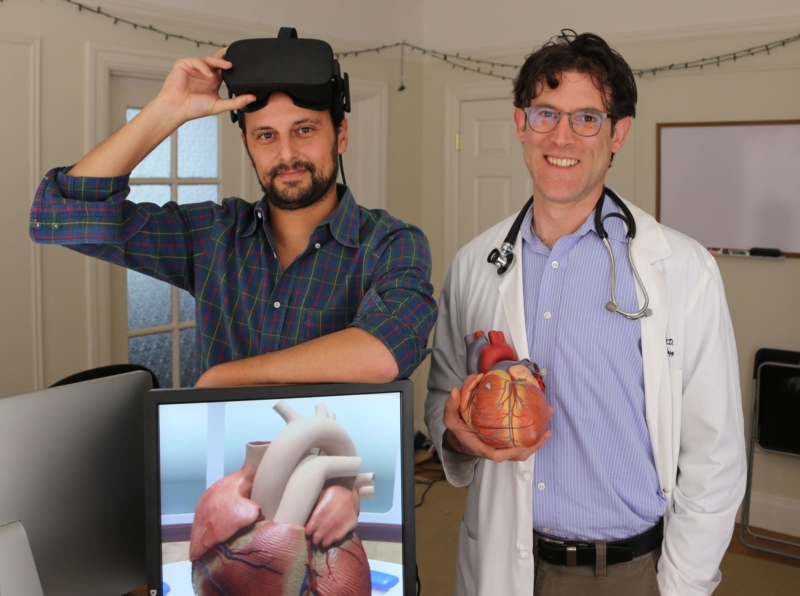
The Stanford Virtual Heart, an initiative at Lucile Packard Children’s Hospital Stanford, is an exciting VR experience breaking new ground in medical education. In this experience the virtual heart beats, pumps blood, and allows medical trainees to perform surgical repairs to correct congenital defects. The experience is far more immersive and engaging than textbook images or cadavers, and allows medical trainees to explore and interact with a living, virtual body.
The experience was developed with support from Oculus VR and The Betty Irene Moore Children’s Heart Center at Stanford.
The team plans to develop a full atlas of about 25 congenital heart defects that can be used in the Stanford Medical School’s residency training and advanced fellowship training programs.
Sources: Lighthaus and Stanford Daily
I have to say this type of project isn’t one that comes up every day. How did you first get involved with this momentous project?
AM: We are extremely fortunate and honored to have joined this exciting project. I guess we were just at the right place at the right time. Our journey started back in 2017 when my business partner, Daniel, and I were attending a big tech trade fair in Germany called CeBIT. The fair had a VR hall and Dan and I were curious to see which new VR experiences were being presented. We had already been in touch with Lighthaus, the production company and creators of “The Stanford Virtual Heart” and set up a meeting. We put on the HMD (head-mounted display, aka Oculus Rift) and were blown away. The experience was quite impressive and let’s be honest, only VR can transport you to the inside of a heart!
Little did we know, sound is an extremely important tool for diagnosing congenital heart defects
However, we noticed a big detail missing in the experience: there was no sound! This is when Dan and I offered our sound expertise to the project. Not having the medical background, we mostly had UI sounds in mind and maybe a basic heartbeat sound… Little did we know, sound is an extremely important tool for diagnosing congenital heart defects and a crucial part of a medical student’s training!
Since this tool will be used to train medical students on how to use their ears to recognize heart defects, how were the sounds of the anomalies recorded and designed to ensure the highest accuracy?
AM: Have you ever wondered what doctors listen to when using a stethoscope? They are looking for abnormal sounds coming from your body, mostly from your lungs and heart. In the case of the heart, there are two main components that doctors call lub and dub. Those sounds are caused by the heart valves closing (lub: mitral/tricuspid; dub: aortic/pulmonary) and make up the heart sound that we all know. However, depending on the congenital heart defect, the rhythm of the heart changes and some elements are added or removed.
Fun fact: doctors actually don’t know 100% if the heart sounds are caused by the valves closing. This is a speculation.
Initially, Lighthaus provided us with a database of sound recordings from each heart defect to optimize and potentially use in the experience. Unfortunately, simply “cleaning” these sound recordings was not an option since they all came from different sources and would not allow for a consistent sound quality. Also, some defects are so rare that there are only a handful of sound recordings. These recordings became, however, an excellent reference for our sound concept.
Later, our idea was to record authentic heart sounds using a DIY stethoscope mic or digital stethoscope. This way there would be a consistency in the recording quality. However, how do you find your sound source? These defects are rare and you can’t just go to a hospital and record sick children. Moreover, we knew the experience would have an “inside the heart” part, meaning separate heart components would have to be placed in a virtual space. We needed more than just one mono heartbeat sound. We also needed separate heart components to be triggered at different times in the game engine. For example, if I approach the tricuspid valve, I might want it to sound louder and maybe barely hear the mitral valve. Off to Plan C.
With the help of iZotope RX, we analyzed each heart defect frequency spectrum and decided to combine the “lub dub” sound from a real heart recording with some filtered pink noise for the “murmur” (more about the murmur later).
Kudos to doctors for having a better ear than sound engineers when it comes to hearing these differences!
For each heart defect, we received parameters from Dr. Axelrod. These parameters described one heart cycle and which events were happening within the cycle such as duration of murmur, amplitude, frequency range and occurrence of murmur in milliseconds. This gave us a visual representation of what was happening with the sound and was quite helpful, especially because if you are dealing with things in milliseconds, it’s quite difficult to hear a difference in heart components. The aortic and pulmonary valves close only within milliseconds between them. Kudos to doctors for having a better ear than sound engineers when it comes to hearing these differences!


How did the sounds of the heart defects differ from one another?
AM: Let’s look at the VSD (Ventricular Septal Defect) for example – the most common heart defect. In this case, the heart has a hole between the left and right ventricle. The blood travelling through this hole causes a sound called a “murmur”, resulting in a quite unique heart sound, almost like a steam engine or garden hose. In this case, we had to design the “lub”, “dub” and “murmur” separately to be able to position them spatially inside the heart.
VSD SOUND:
The HLHS (Hypoplastic Left Heart Syndrome), on the other hand, is missing a component: the mitral valve. This heart has an underdeveloped left side of the heart. In this case, the heart has a different rhythm, which was reconstructed using the data provided to us.
HLHS SOUND:
Since students can explore how each component of the heart works and even go inside the heart to see the effects of an anomaly, how did you approach designing the external and internal soundscapes?
AM: The VR experience is divided into two parts. Part one is the outside of the heart; here you can see a “library” of congenital heart defects and can pick up a heart with your controller. This external POV has a more realistic approach to it, using medically accurate heart sounds to facilitate the learning process. For this part of the experience, the user hears a single mono sound that was recreated to simulate what they would hear coming from a stethoscope. Some specific heart defects sound different depending on the stethoscope position and students must know where exactly to position it (on the front, on the back, on the rib cage, etc.).
The sounds of the heart’s components are spatially placed in their appropriate location and an “inside the body“ atmosphere is used to “glue” the sound field together
The second part of the experience, which is the internal POV, uses a more “cinematic” and “larger than life” approach to the heart sound. The sounds of the heart’s components are spatially placed in their appropriate location and an “inside the body“ atmosphere is used to “glue” the sound field together, creating an immersive sound experience. With the help of spatial audio, when the user is standing in the right ventricle, she can hear the “lub” coming from the tricuspid valve and the “dub” coming from the pulmonary valve.
What 3D audio tools did you use in Unity to implement and spatialize the audio?
Initially, we had a hard time locating the murmur, as it was blending too much with the “body atmosphere”, so we added some high-frequency information to facilitate localization.
AM: In Unity, Daniel used the Google VR SDK, but most importantly, we kept in mind the rules of HRTF and psychoacoustics. It’s dangerous to only rely on your SDK or plugin to do the 3D trick, so we made sure there was a slight frequency variation on the “lub” and “dub” and there was enough high-frequency information on the “murmur” to facility the HRTF effect. Initially, we had a hard time locating the murmur, as it was blending too much with the “body atmosphere”, so we added some high-frequency information to facilitate localization.
What was your biggest challenge working on this project?
AM: The hardest part was initially learning about all the heart defects. I didn’t want to just design something as I go and “hope it works”, I wanted to truly understand each defect and what is happening on the physiological level. I spent a lot of time researching the problems, analysing the sounds, their frequency spectrum and their rhythm. Dr. Axelrod was amazing at providing us the source material we needed to understand things better. We Skyped a lot throughout the process and every meeting brought us closer to understanding each defect.
As a sound designer, it was also difficult to step out of that “this needs to sound like Hollywood”.
As a sound designer, it was also difficult to step out of that “this needs to sound like Hollywood”. This is an educational app, so medical accuracy was extremely important. And if you listen to a thousand stethoscope recordings like I did, they are not pretty. These are flat sounding sounds. But that’s ok. That’s how they sound and that’s how the reproduced version had to sound like.
Last but not least, we had to keep in mind how spatial audio works and how our ear localizes sounds. We initially created the murmur to have the same frequency range as an original murmur, but that was causing problems once we went inside the heart. Having a mid-range frequency range made it hard to localize and was conflicting with the frequencies of the “inside the body” atmosphere, so we cheated a bit with psychoacoustics and made the murmur sound a little more high pitched and with more high-end information.
Do you have any advice for other sound designers who are looking to work on serious games and academic apps?
AM: I would tell people to “just do it” :D Dan and I won an award for startups in Germany and their motto is “mach einfach” which translated means “just do it”. We wouldn’t have gotten the Stanford project if we didn’t just go up to the guys and ask if they needed sound for their app.
Thanks for sharing such an interesting project and your experiences with us! Where can people learn more about The Stanford Virtual Heart and DELTA Soundworks and follow you on social media?
Here’s the DELTA Soundworks website + our accounts on Twitter, Instagram and Facebook
Here’s the Lighthaus website + their accounts on Twitter and Facebook
A big thanks to Ana Monte for giving us a look at the sound of The Stanford Virtual Heart – and to Adriane Kuzminski for the interview!