


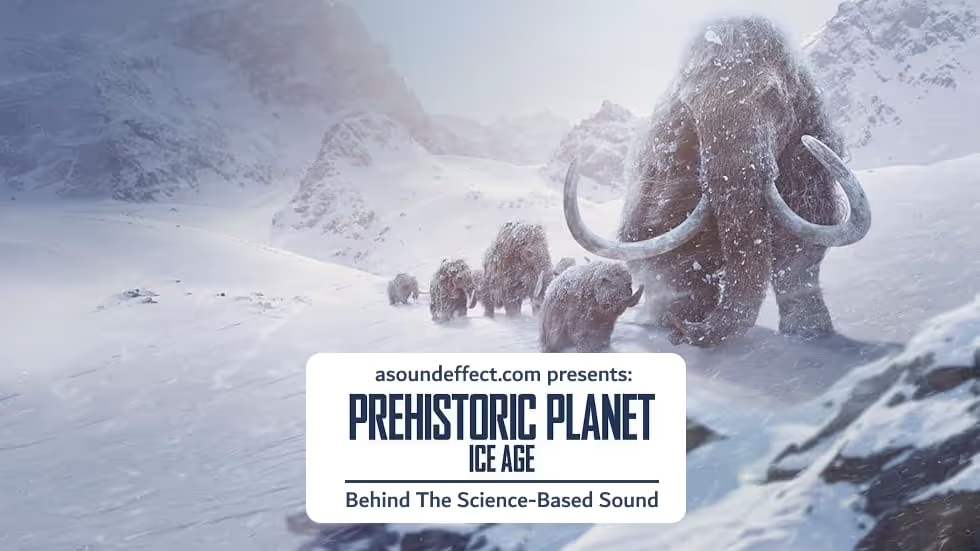
It’s always tricky to design sound for documentaries, balancing the need to create a realistic portrayal of reality while also creating an engaging sonic experience. Now throw in the fact that the documentary is set millions of years ago. And, it’s animated, so there’s no sync track. That’s the framework for Apple TV+’s nature documentary series Prehistoric Planet.
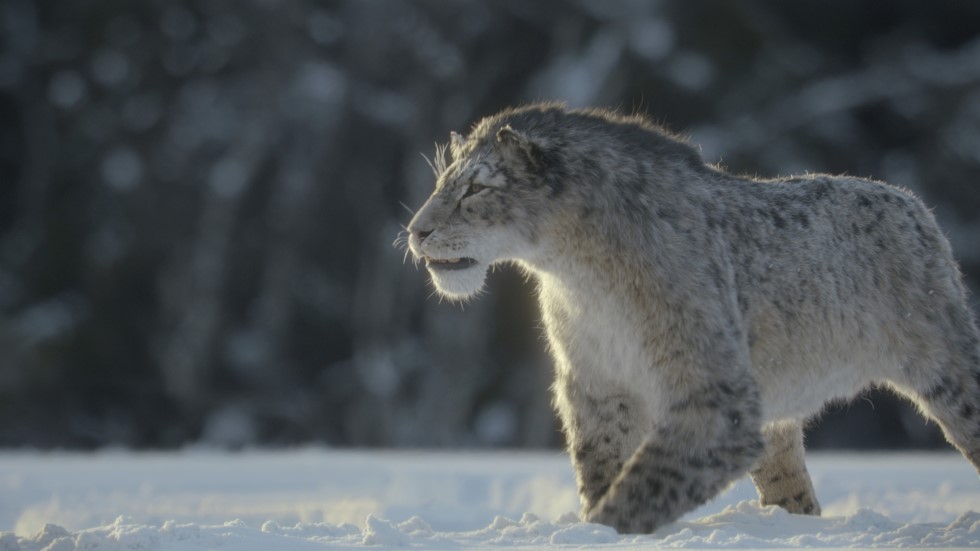
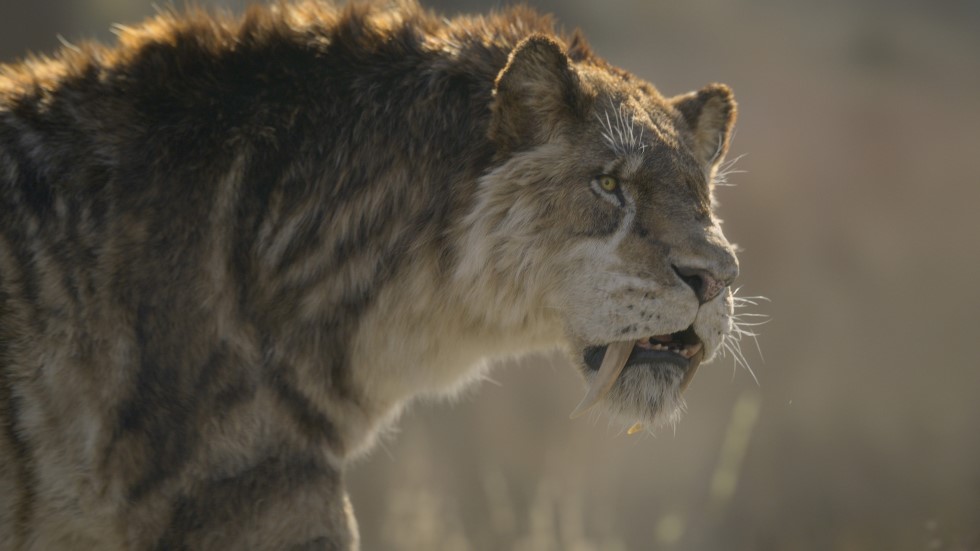
The sounds of the show’s prehistoric fauna are science-based, guided by a paleontological consultant who provides an exacting list of ancestrally related species, along with descriptions of how their earlier relatives may have sounded. Senior sound designer/supervising sound editor Jonny Crew, at Wounded Buffalo Sound Studios in Bristol, UK, has worked on all three seasons of Prehistoric Planet. So he’s comfortable working within these restrictive parameters, even when designing sounds for challenging species, like the big cats showcased in Prehistoric Planet: Ice Age. Not only did the Homotherium (a scimitar-toothed cat) have to sound different than the Smilodon (a saber-toothed cat), but there were two different species of Smilodon that needed to be distinct from each other. And, Crew noted, he couldn’t use any present-day lion or tiger sounds!
Here, Crew discusses his approach to designing animal vocalizations for Ice Age and how he handcrafted backgrounds with layers of individual sounds to convey depth and detail to bring the environments to life.
Find out who ‘Evil Bluebell’ is and what animal barks she contributed to, what cuddly creature contributed to the sounds of a prehistoric predatory possum, how sound props like tubes and bellows helped the animated prehistoric animals feel more alive, and so much more!
Prehistoric Planet: Ice Age — Season 3 Official Trailer | Apple TV
As the name suggests, the documentary television series Prehistoric Planet: Ice Age is set during the Ice Age, around 2.6 million to 11,700 years ago. Overall, what’s your approach to designing sound for documentaries (as opposed to designing for fiction shows)?
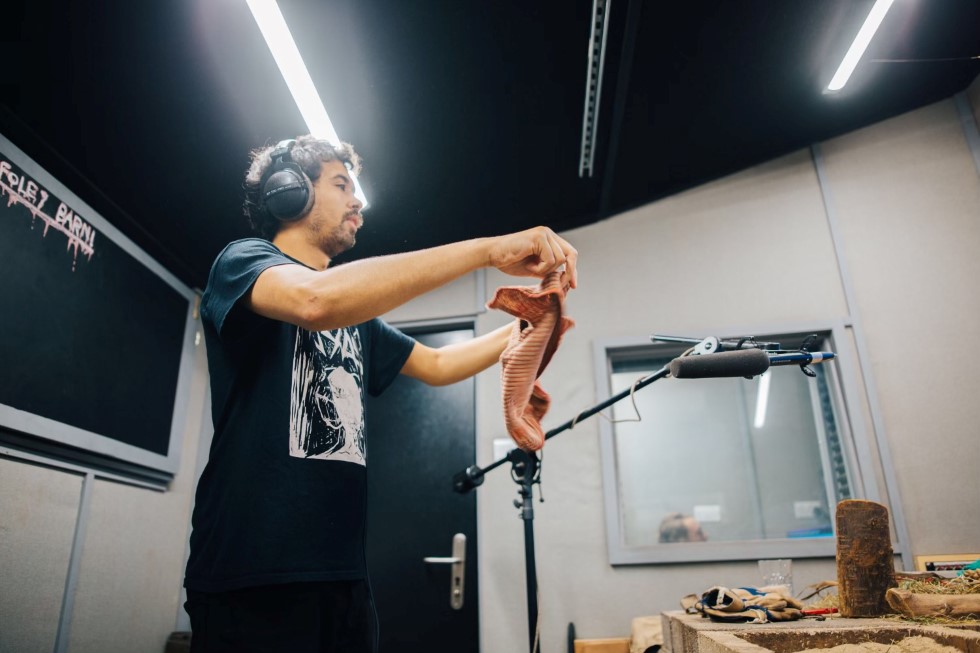
Jonny Crew (JC): We’ve worked with Mike Gunton (Exec. Producer) often over the years on many series of this type (e.g., Life, Africa, and Planet Earth). Prehistoric Planet: Ice Age is wildlife/Natural History documentary filmmaking, and the aim visually was to make it feel like the audience is watching something filmed that way. Obviously, animated pictures arrive with no sync sound, but we’re used to that because that’s the usual way in wildlife filmmaking. That is, we have to collect and organise species-correct calls, appropriate atmospheres (backgrounds), and record specialist foley to capture the movement. Natural history foley is an art form in itself; performing quadruped footsteps takes a lot of practice!
When did you get started on Ice Age? Were you working to storyboards/previz, or did you have fully formed visuals?
JC: I got started early on. During the storyboard stage, I had a discussion about sound with the VFX head and Matthew Thompson (Series Producer). I supplied them with placeholder sounds that could be used to help with the edit while I was also developing specific creature sounds for the sequences as they took shape. Having a long lead-in time, working with those sequences as they developed through the animation stages and the edit, allowed for a lot of experimentation over the course of a few months. So when the final pictures and edit were ready, all the creature sounds were signed off.
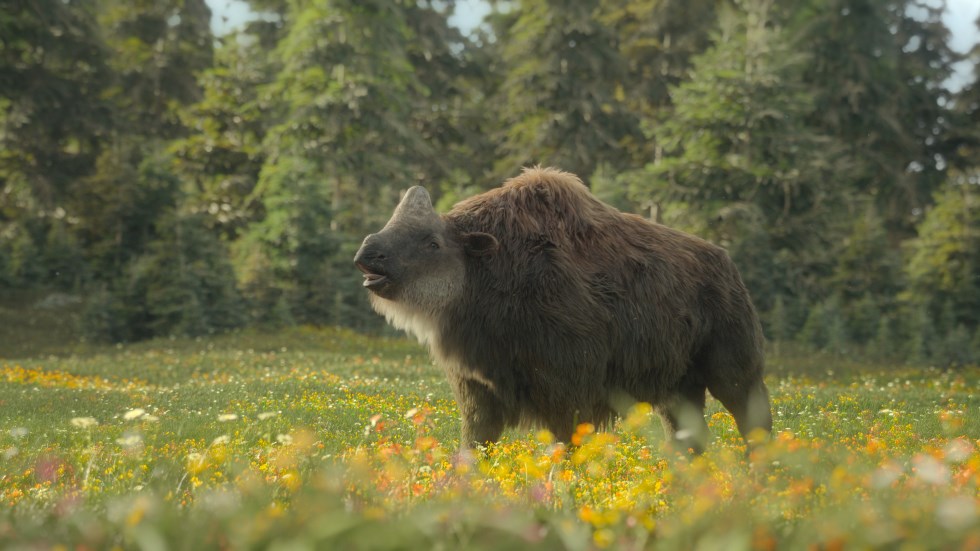
Considering this one is set so long ago, there’s a bit of room for creative interpretation since there are definitely no recordings from back then! How did you bring together factual and imaginative concepts into your sound work?
JC: As with other Prehistoric Planet series, Dr. Darren Naish was our paleontological consultant. His input and knowledge are so vast. He’s got a great ear, too, so he was able to offer advice and feedback throughout the process. Once we’d started getting previz sequences, I was able to send him playouts with just creature vocals for approval, and he’d have notes. We’d keep going until we had something that we were happy with. Something that’s been really gratifying across all three seasons has been the positive reactions from the paleontological community to the vocalisations.
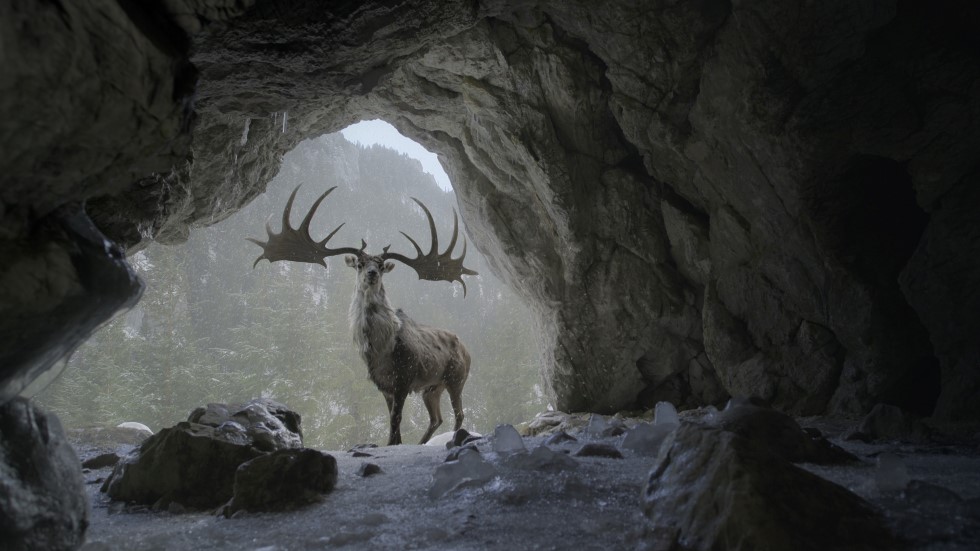
The ambiences/BGs are fantastic! They make this series feel like it’s live-action, as if it were a documentary shot on location. The environments in Ice Age range from caves to jungles to arid scrubland, and even underwater! What were some main elements in your environmental sounds/BGs? Did you get to do any field recording for the show?
JC: We’re always doing this! But to be honest, most of the time we use our library because we’re based in Bristol, UK, and these more extreme environments aren’t in our neighbourhood. What was useful about the Pleistocene is that most (if not all) wildlife that we experience in our aeon had evolved, so birdlife, insects, etc., were available for us to use.
I tend to start building up backgrounds from neutral air and wind, then stacking in more middle-ground detail, such as trees or water, and finally punctuating with ambient wildlife interjections off-screen, like alarm calls, etc. We don’t layer in loads of tracks, but try to make each element have its place in the spectrum and cut the more foreground elements for perspectives. Most of our tracks are still mono and stereo, which then get spread out into the Dolby Atmos environment in the mix.

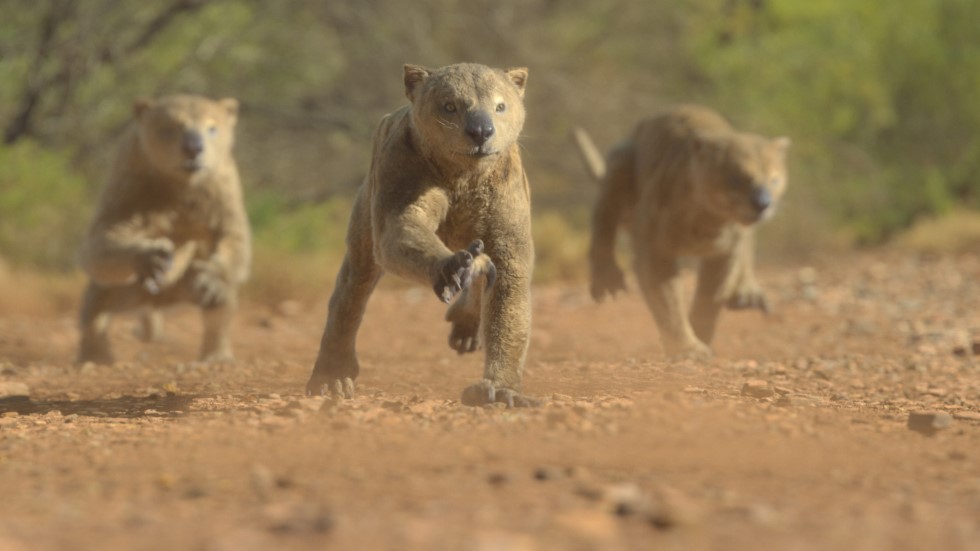
Each episode showcases interesting prehistoric animals, from mammoths to big cats to birds and squirrels, and everything in between. Can you talk about your sound design for the prehistoric animals and working closely with Dr. Darren, who advised on realism?
JC: Dr. Darren provided me with a sound list of suggestions before we started, and having worked with him on previous seasons, we had a good relationship established. That list of suggestions was really exacting. And whilst it could be felt as restrictive, it was actually really inspiring. Each animal would have a contemporary descendant that could serve as a jumping-off point for modification. The most common direction was, “It sounds like this, but it’s bigger.”
The most common direction was, ‘It sounds like this, but it’s bigger.’
Then I have to go on a trawl for species in our library and further afield, including searching A Sound Effect! There’s a wildlife sound recordist named Marc Anderson (owner of Wild Ambience) who has a great collection you can browse, and he’s really helpful. There was a koala library I bought that really helped with the Thylacoleo (the predatory possum!) design, but koalas are relatively small. The standard technique is to slow things down, but then you start to lose clarity and punch. So playing around with pitch and exciters can often help with that, plus layering in more detail like exhalation, mouth moves, etc. Avid’s Pro Subharmonic is really good for adding extra low end, which I keep as a separate element. Convolution reverb can help, too, by adding body resonance to animal calls. But, a lot of experimentation is required!
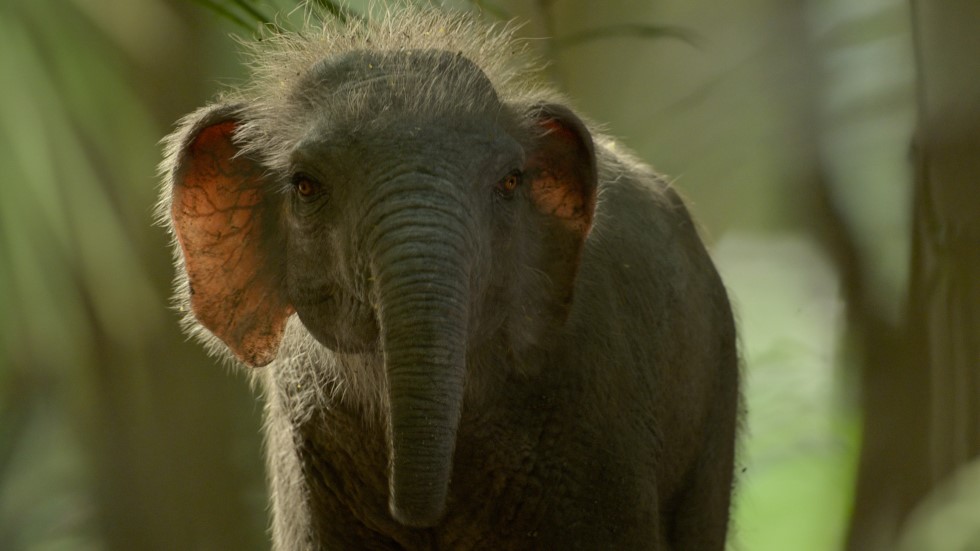
Can you share some specific examples of prehistoric animals that are most unlike what we’d see in nature today? What existing animal sounds were helpful in their designs? In addition to layering natural sounds, did you use any processing to help achieve the sound you wanted?
JC: One of the stranger ones was the Dwarf Stegodon, which looks like an elephant, but isn’t strictly one. And it’s tiny. Forest elephants were the closest initial source, which then underwent some further manipulation. Sound Editor Tom Mercer did a great job on that, along with the Psilopterus (Terror Bird), which were based on Seriemas but then scaled up.
Something that really helps bring these characters to life is all the incidental sounds like huffs, snorts, and breaths
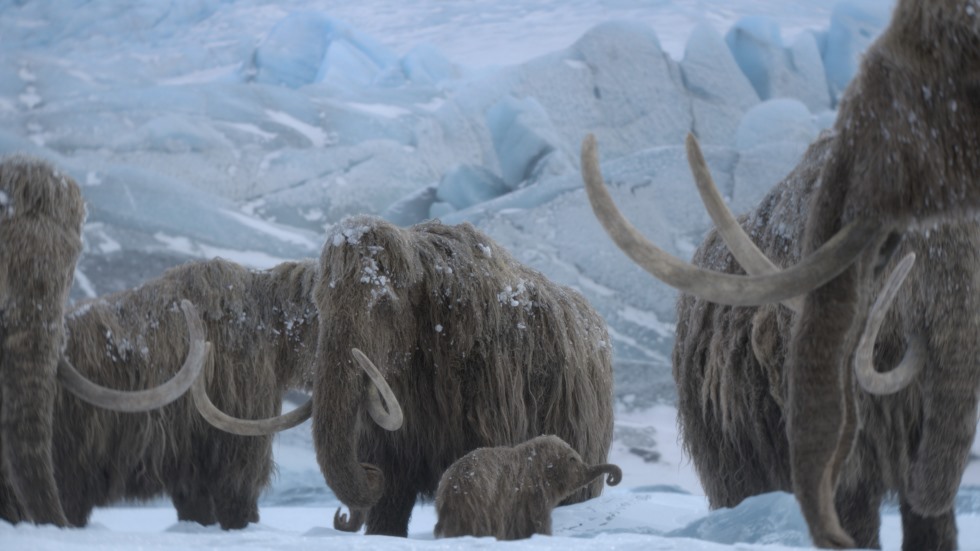
Something that really helps bring these characters to life is all the incidental sounds like huffs, snorts, and breaths, which also go through processing to make them sound suitable to the size of the animal. You can have more latitude with those sorts of sounds as a source — meaning that we could get creative with sound props like tubes, bellows, and such — than with the calls. For this series, it was important to get the calls right. We were using very specific species as the inspiration, but not anything closer. For instance, for mammoths, we needed to use Indian rather than African elephants, and then process those sounds to depict the scale of these Ice Age megafauna. With any processing, it’s really crucial that the sounds stay natural, believable, and without any artifacts, which is difficult to achieve!
What were some of your favorite animal sounds you designed for the show? What went into them?
JC: The Macaurachenia, whilst being an incidental character, was fun. It’s described as “horse-like with an inflatable nose.” So, obviously, horse snorts and such were useful, but for the inflatable sac on its nose, I made it from a Saiga with added slime-bubble squeaks and inflation sounds.
For the inflatable sac on its nose, I made it from a Saiga with added slime-bubble squeaks and inflation sounds
The cave sequence in Ep. 1: “The Big Freeze” was really enjoyable, with hyenas, lions, and bears stalking each other and ending in a massive fight. The fights were really fun as they were animated so well! Similarly, the face-off between the Enhydriodon (lion-sized otters)and Homotherium (a scimitar-toothed cat, not a saber-toothed cat, so it had to be different!) was great fun to cut together.
Glyptotherium (North American giant armadillo) stretched Tom’s creativity, but I think he came up with something really characterful and fun for that guy.
What animal sounds took the most time to design? Why was it challenging?
JC: The Smilodons (sabre tooth tigers) were challenging as there were two different species that needed to be quite distinct from each other, and we couldn’t use any big cat sounds (e.g., lions, tigers, etc.)
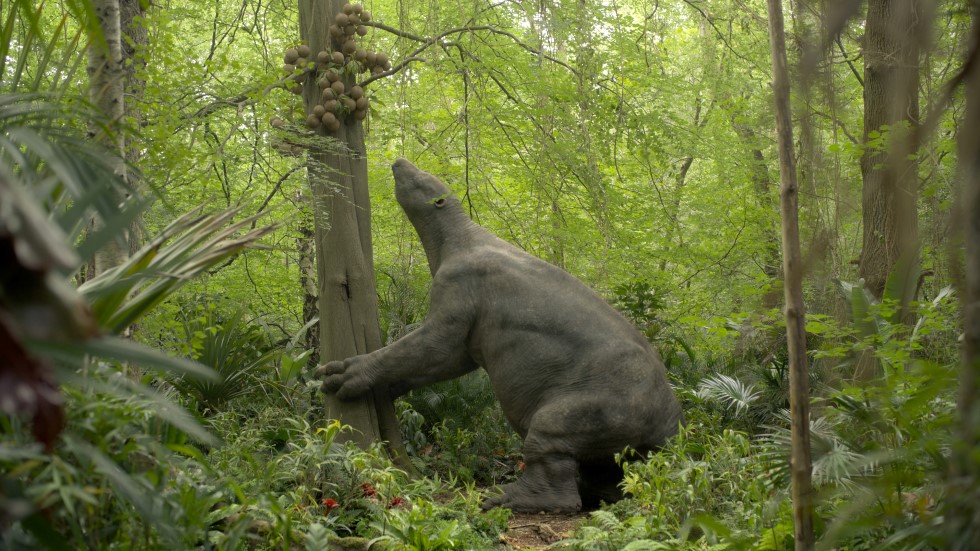
Gigantopithecus (Giant ape in Grasslands) was really tricky to get right because he was quite quiet and “thoughtful,” which was difficult to convey! We went through a few iterations of his call, and if I remember rightly, the animation mouth shape was adjusted to help us get there in the end.
Any recordings of ‘family pets’ that made it into the designs?
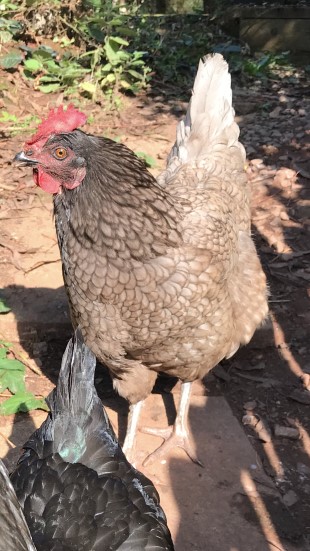
JC: Ha! Not on this series, but in Season 1 and 2, there’s a component of a Pterosaur ‘bark’ that’s one of our chickens called ‘Evil Bluebell.’ She’s no longer with us but lives on in the Cretaceous…
The music in the show (composed by Hans Zimmer, Anže Rozman, and Kara Talve of Bleeding Fingers Music) is amazing! How did the music influence your approach to the sound design?
JC: Something we always do is make our tracks flexible around the music. We hear work-in-progress music during the edit and can tailor to suit it, but it’s only really in the final mix that decisions get made about what gets featured.
The Bleeding Fingers team is great at doing the same, presenting everything as stems so music cues can be customised in the mix. We’ve worked with them a lot in recent years on other natural history projects, and they are so responsive and easy to work with!
What have you learned while working on the sound of Prehistoric Planet: Ice Age? What has this experience taught you? What will you carry with you from this experience?
JC: For me, it’s been a perfect opportunity to combine Natural History and animation sound approaches. Having creative license while also being grounded in science takes the work down many new and unexpected paths. Something I always enjoy about working on, say, Planet Earth, is that you learn so much about animal behaviour, different environments, etc., so that carries forward into the next projects. In experimentation (which I love), there are always little techniques and ideas you develop that you keep in your toolbox for next time, too.
A big thanks to Jonny Crew for giving us a behind-the-scenes look at the sound of Prehistoric Planet: Ice Age and to Jennifer Walden for the interview!