



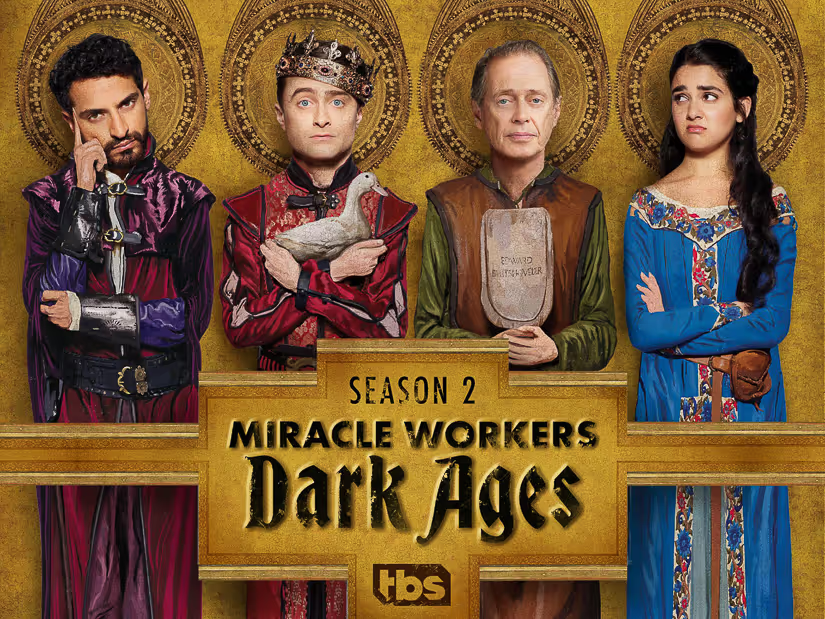
Miracle Workers: Dark Ages | Watch Daniel Radcliffe and Steve Buscemi in this exclusive sneak peek
Steve Buscemi. Daniel Radcliffe. Ducks. Beheadings. And a cart full of dookie, replenished daily. That’s just a fraction of what’s served up on Season 2 of TBS’s Miracle Workers: Dark Ages. The comedy series — created by humorist/novelist/screenwriter Simon Rich who’s written for SNL and The Simpsons and contributed to animated films like Inside Out and The Secret Life of Pets — follows the lives of solid-waste removal expert Eddie Shitshoveler (Buscemi) and his children Alexandra (Geraldine Viswanathan) and Mikey (Jon Bass) as they make the best of their urban-peasant lives.
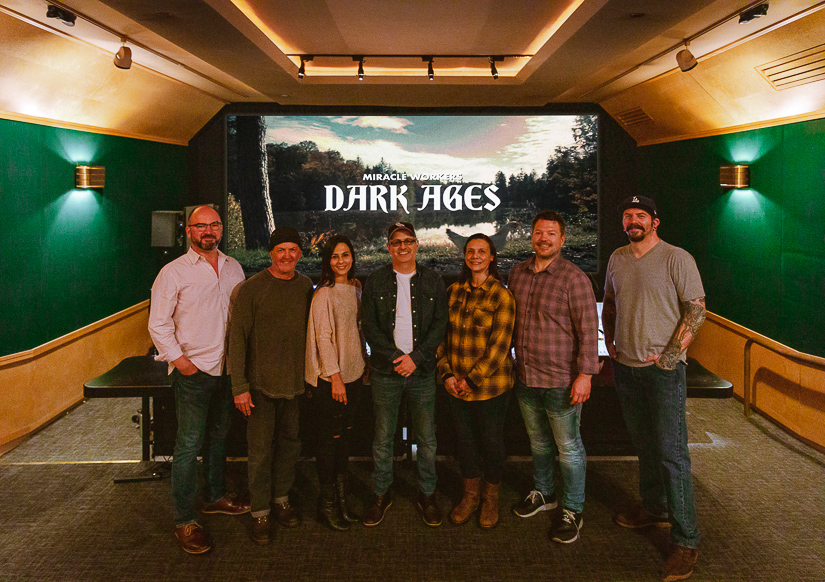
Sanaa Kelly Foley artist, John Chamberlin Re-Recording Mixer, Josephine Nericcio sound editorial, Michael Jesmer Dialogue Editor, Clayton Weber Foley editor, (Not Pictured)
Mark Messick effects editor and Nate Hill Music Editor
Miracle Workers: Dark Ages isn’t your typical comedy series where the jokes play in a mostly quiet world. Instead, there’s a wealth of off-screen sound bringing the medieval set pieces to life — from loop group for villagers and soldiers to background effects with chickens clucking or fires crackling in hearths to multi-layered Foley of wooden carts and people passing through the unpaved streets. Even the reverbs are used creatively to define the spacious castle interiors or play-up perspective on outdoor scenes. For instance, there’s a scene in Episode 3 “Road Trip” in which Alexandra dumps a bucket of snakes over a bridge and they land on Prince Chauncley (Radcliffe) who is hiding below. His screams ring out with a hollow, stony reverb that sells his location under the bridge. It’s a small detail that makes the viewer believe in this world and buy into what’s happening off-screen.
Warner Bros. Sound re-recording mixer John Chamberlin has worked on both seasons of Miracle Workers. He says, “What I wanted to do this season (and one thing I’ve really been doing lately) is to bring up my world in the surrounds. I was always a proponent of leaving the sound up front and panning only when things were getting too busy. But I wanted to enhance the world this season, to make Simon’s creation — this story that he has written — sound the way he imagined. I wanted him to sit in this room and be blown away by the sound of his show. I’m going for it in a more theatrical way than I ever have before.”
‘I’m going for it in a more theatrical way than I ever have before.’
Chamberlin, who mixed Miracle Workers: Dark Ages on WB Sound’s Dub Stage D in Burbank, is a master of mixing comedy. He’s mixed Portlandia, Orange is the New Black, Documentary, Now!, Corporate, Brockmire, Atlanta, Baskets, and the list goes on. Comedy is all about timing and delivery, and the final mix is critical because that’s the last chance to put a razor sharp edge on it. Is the joke funnier if a certain sound is nudged a few frames? What happens if additional sounds are added? Or if a reverb tail is extended? What happens in the world around the dialogue can impact the laugh factor.
In Miracle Workers: Dark Ages, the off-screen sounds add to the ridiculousness of the comedy so well, like Prince Chauncley training a squad of ducks in Episode 1 “Graduation” to put on a show for his domineering father King Cragnoor (Peter Serafinowicz). Off-screen duck quacks poke through the dialogue in a comically disruptive way. Their sound is part of the joke. It’s not just sound for sound’s sake. “Somewhat tongue-in-cheek is the Hippocratic oath of sound people to do no harm. We ask, ‘What can we add? What can we put in?’ But so often that can muddle the intent of the scene,” explains supervising sound editor Lou Thomas.
‘Somewhat tongue-in-cheek is the Hippocratic oath of sound people to do no harm.’
The trick is to fill in around the story without suffocating it. For instance, in “Road Trip,” Prince Chauncley and Lord Vexler (Karan Soni) pay a diplomatic visit to The Valdrogians in order to bring peace to the kingdom. When the prince’s carriage pulls up to the Valdrogian village, it’s a busy atmosphere, with villagers bustling about on muddy ground, hammers ringing on anvils, axes being sharpened, wood fires cracking, and a pulsing drum track. But when Prince Chauncley meets up with the Valdrogian leader, the background becomes a simple, eerie wind with a distant bird cry reminiscent of a human scream. There’s a tense feeling that’s created by juxtaposing a busy atmosphere with a quiet one. But this is a comedy and so tension isn’t the ultimate goal — laughter is. “The wind drone stops and the tone of the scene changes instantly,” says Thomas. “It helps to play up the difference between the tension and the break when the Valdrogian leader recognizes Prince Chauncley and they get into this buddy-buddy conversation.”
In the scenes that follow, the off-screen sound of Valdrogian’s partying gives the illusion of a much larger crowd than what’s presented on-screen. That holds true for the big battle in Episode 10 “Moving Out Part 2” as well. The showrunners wanted the sense of the Valdrogian army getting closer and the invasion becoming more intense all without showing a huge battle. “Most of it is implied. We only see the Valdrogian army later on when they’re approaching the castle, but we don’t see them fighting,” says Thomas.
Villagers flee as arrows rain down on their town of Lower Murkford. Off-screen screams and cannonball impacts create this feeling of destruction and chaos. Then Eddie (Buscemi) comes along, pulling his cart and whistling — just going through town as if nothing is happening. “For the close-up on him, we pull out a majority of the battle sounds and just hit the arrow impacts we see. The tough part was being able to come in and out of those realities — the reality of the battle and the surreality of Eddie’s world where everything is kind of okay. To play that difference but not to the point where it feels like something wrong happened was a challenge,” says Thomas.
Miracle Workers: Dark Ages | Siege of the Century | TBS
This approach of using off-screen sound as a way to transition between reality and personal perspective happens again later in this episode, as Eddie and his kids seek shelter in their emergency cellar. The storm of arrows and screaming subsides as they go underground, giving the illusion of safety. The sound of cannons firing feels far away and non-threatening, until a cannon ball falls through the roof. But even that on-screen event doesn’t break the illusion of their isolation from the battle.
‘For this show — and this is true for comedy as a whole — if it doesn’t play tight then it fails miserably.’
It’s actually the off-screen sound of the town-crier’s bell coming through the window that brings them back to reality. Eddie looks outside and sees arrows falling and people running. Off-screen, we hear debris crumble down from the ceiling; there’s a sword shing and someone screaming. Eddie looks out the window and once again the invasion sounds full-on. “That scene was fun because it brought together a lot of sound elements — loop group and specific effects — that hit the action so well. One guy gets hit by a flaming arrow so he’s screaming and on fire. We hear him get hit by a cannon ball off-screen and then there’s total silence from him,” says Thomas. “You can’t paint with a broad brush for scenes like that because then it just becomes a mess. You have to be very specific and that’s the kind of work that I like. I don’t really care for pastiche work; I’m much more of a detail person. For this show — and this is true for comedy as a whole — if it doesn’t play tight then it fails miserably.”


On-screen, the sonic details from the Foley team — Foley artists Sanaa Kelley and Matt Salib, Foley mixer Jordan McClain, and Foley cuer/editor Clay Webber — help to sell the medieval vibe.
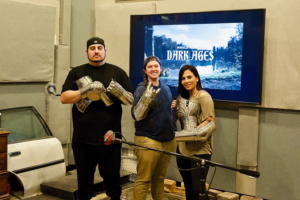
And their multi-layered approach to each Foley cue adds a feeling of depth and richness to the world. Even something as simple as setting down a cup has multiple layers of Foley; it’s often a mix of different ceramic bowls and different metals. “The props are unique and period-specific. For example, we have actual metal armor for the soldiers that we layer with leather creaks. And we add cape rustles and flutters when we see those,” says Kelley. “When we see Eddie’s wooden cart rolling along, we layer the sound of the wooden wheels rolling on the dirt with additional wood creaks on a different track. Then we add layers for the stuff in the cart moving around to give it different textures and make it full-bodied.”
Kelley’s favorite cues are the footsteps. And despite her small stature, she’s very adept at walking imposing male characters, like King Cragnoor. “The funny thing is that I do the king’s footsteps and my Foley partner Matt, who is a big guy, does the girls’ footsteps!” she says.
“I feel that footsteps are basically acting with your feet. When you’re walking, and you’re happy, it’s a bit springier. It kind of scrapes up a little bit. When you’re sad, it’s going to be sliding more. So you have these different emotions that we get to act out in the feet, and it’s great because they have so many personalities on this show. They are great actors and it’s always really nice to do Foley for great actors,” Kelley adds.
‘I feel that footsteps are basically acting with your feet.’
But it’s not just how the character walks; it’s also about what the character is walking on and how to differentiate between two or more characters walking together. “We have a lot of different dirt textures so when there are two characters walking together, Matt will do one character in a softer dirt and I’ll do my character on the harder packed dirt with more pea gravel. This gives you different tones and textures to help your ear differentiate between the two people, not only in terms of the weight of their footsteps but also in terms of the texture of the footsteps,” says Kelley.
“We have different grass textures as well. We’ll buy actual grass and bring that in. We’ll use ¼-inch magnetic tape. We use Easter basket grass. In one show, we’ll use all different grass textures so from one scene to another you can hear the difference,” she adds.
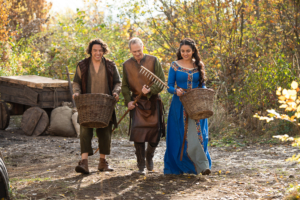
Miracle Workers presented some opportunities for creative Foley, like King Cragnoor’s bag of skulls that Kelley and Salib made from a mix of empty coconuts, large oyster shells, and smaller seashells. They also performed Foley for a goat chewing. “We wanted the sound to have texture so we were eating peanuts with the shells still on. That was absolutely disgusting, by the way. Not only did we chew these peanut shells but we were chewing them in time with the picture. Anytime the goat closes its mouth, we had to do the exact same timing. We are used to doing humans chewing, not animals. It’s different because it’s this chew and grind movement,” notes Kelley.
They also created Foley for production effects that lived in the track. “When they have the sound off-screen in the production effects, we try to match that and enhance it. If it makes sense to continue a sound then we do. It gives the track something a bit extra,” says Kelley.
[tweet_box]Behind the Sound of Miracle Workers: Dark Ages[/tweet_box]
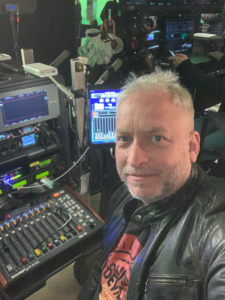
It’s not always easy to capture production effects when your main focus is, of course, to capture the cleanest dialogue possible. The show was mostly filmed in Prague on Barrandov Film Studios’ backlot where they built a medieval set, and at Pruhonice Chateau and park. “It is a bit tricky to record dialogue for a 15th century-based scenario in the middle of 21st century city life,” says production sound mixer Petr Forejt, CAS, who was also dealing with wardrobe challenges like plate armor, and multi-camera setups that made boom miking impossible at times.
“One of the most challenging and difficult scenes to record was in Episode 1, when Prince Chauncley is traveling to the battle on a wooden cart, flanked by two knights, all of them wearing armor. It’s a typical multi-camera scene, with one wide lens and two cameras on close-ups. The cameras were covering the set from edge to edge, seeing mostly everything. In such a situation, I was glad to have Audio Ltd. A10 radio mics and their internal recorder capabilities, which can offer master-quality, timecoded audio back up in case of signal loss or drop outs,” says Forejt.
“Having an experienced wardrobe department is always a big help and makes your job easier and faster, especially for scenes where the characters are wearing armor. That’s a great example of wardrobe and sound crew cooperation to make the metal parts ‘quiet.’ And it gave us the chance to run the wire and get great sounding dialogue,” he adds.
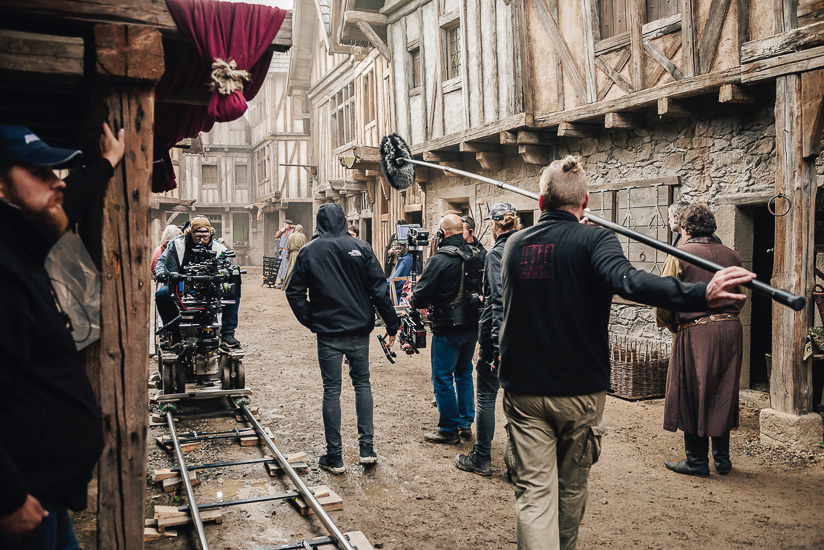
Forejt relied on his sound crew of boom operator Tomas Cervenka, Jr. and 2nd boom/radio mic operator Ondrej Jirsa. He also found on-set help and support from first assistant director Jesse Nye. Forejt says, “Beside the stressful situations, there were some funny moments, of course. Imagine nice sunny days in the park by the pond, with a mad sound recordist and half of the crew chasing the wild ducks!”
Forejt’s efforts on-set paved the path for a great sounding show. “The dialogue was so well recorded that only a few times did the natural ambience come through. I ended up using a combination of the boom and lav mics. Michael Jesmer, who cut the dialogue on the show, used Auto-Align Post (by Sound Radix) to line up the two production tracks,” notes Chamberlin.
‘The dialogue was so well recorded that only a few times did the natural ambience come through.’
“Then in post, we worked so hard to create these environments and direct the loop group so well, and to perform Foley art like they’ve never done for a half-hour comedy. Everyone was doing things out-of-the-box, yet they were perfectly appropriate and very well executed. The sound work — including the music editing by Nate Hill and Lance Povlock — isn’t far off from the departments that created the look, feel, scripting, and lighting. Everything about this show blows me away. I’m glad the sound team was able to put our best foot forward,” concludes Chamberlin.
A big thanks to John Chamberlin, Sanaa Kelley, Lou Thomas, and Petr Forejt for giving us a behind-the-scenes look at the sound of Miracle Workers: Dark Ages and to Jennifer Walden for the interview!