


Interview by Anne-Sophie Mongeau
This library is meant for sound designers, can you explain what that means and why you took that initiative?
Nick Dixon: The library has been designed to be versatile enough so sound designers can get quick results in terms of a finished sound effect, whilst allowing enough creative control to be able to place that weapon in any environment they want, maybe add sweetening layers or further processing.
The first requirement we had for the project was that every sound absolutely must meet expectations when it comes to achieving a big cinematic gun sound
In addition to offering this flexibility for sound designers, we hope the library also gives smaller game developers the opportunity to use this content to create advanced playback systems for their games which would usually require a much larger investment in sound recording, sound design and mixing.
The first requirement we had for the project was that every sound absolutely must meet expectations when it comes to achieving a big cinematic gun sound. Whilst we wanted each effect to be comparable to that kind of quality and presence, Watson also didn’t want to compromise on an organic sound that shared character with the original firearm and felt natural. We both work with the sound of firearms a lot so we are all too familiar with the problems that arise when mixing heavily processed gunfire with impulse responses, often the results can sound un-natural or be challenging to control the frequency spread in a busy mix. The challenge is even greater in a video game where these events are created in real time, often across a range of distances whilst players dynamically change environmental reverb settings.
The library also includes all the relevant Foley and casing sounds for each weapon. In other words, artists and content creators can purchase the content knowing they will have the majority of sounds they needs to recreate any of the weapons in this library.
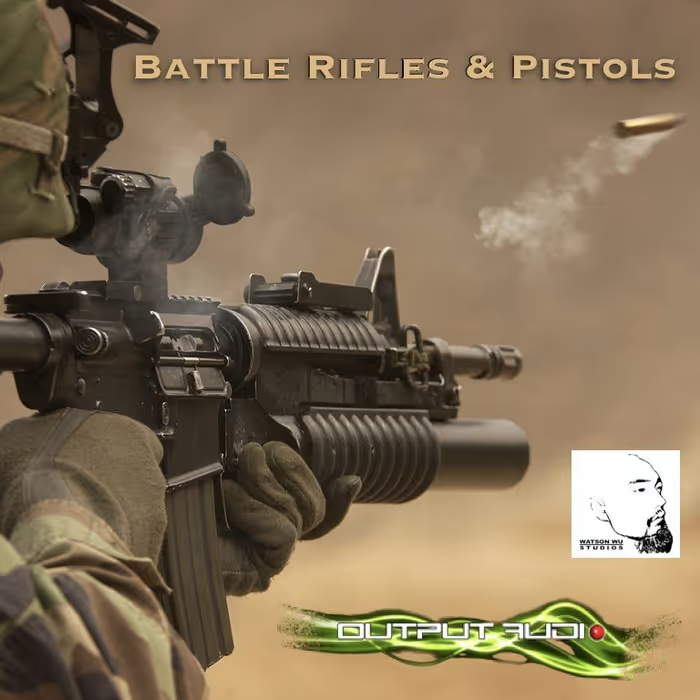
Hear what the Battle Rifles and Pistols library sounds like
What recording techniques and equipment did you use and how did you mix down the recordings from 10, 12 and 16 channels to stereo or mono? Did you use the same strategy for all recorded weapons or did you adapt for each?
To capture overall sounds of weapons, mics were spread out and placed at close, medium, and far perspectives
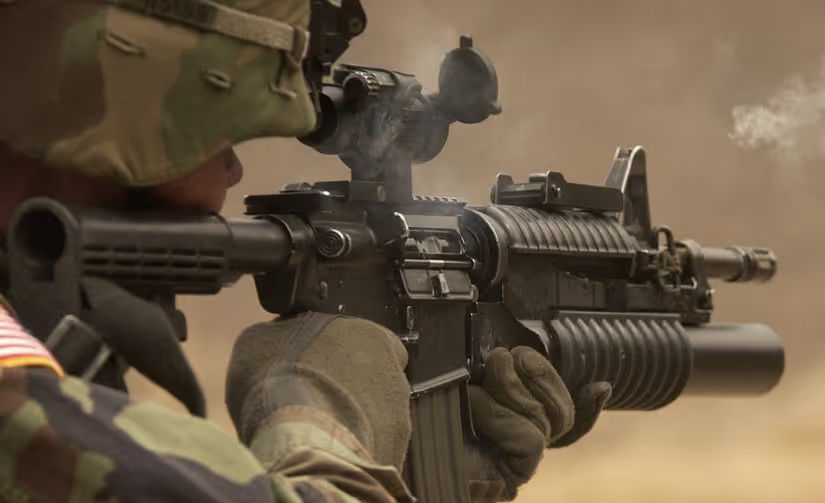
Watson Wu: We use Sound Devices mixers and recorders for all weapon sessions. It’s much easier to manage tons of files when I use the 788T-SSD 8 track vs a bunch of smaller stereo or 4 track recorders. The most often used mics are brands like Sennheiser, Rode, Neumann, DPA, Shure, etc. There are too many to name. To capture overall sounds of weapons, mics were spread out and placed at close, medium, and far perspectives. Once I hit record, all of the perspectives are captured into poly-wave files. That way, the same take contains distant gunshots from actual distant shots, close shots from actual close shots, etc. There are other ways of recording but I prefer the speed and consistency of this method of the shooter staying in the same position.
After copying files to my NAS, I export them into single mono wave files using Sound Device’ Wave Agent. I use Reaper DAW to edit, layer, and design natural beefed up sounds, then pass them onto Nick.
ND: The mix was done using Pro Tools. I did have a designed plugin chain for some of the bus processing that is common to most weapons. The editing approach had to consider how each sound might need to be broken up in terms of mixing and rearranging those sounds to picture or in a game setting that could have its own dynamic acoustics. The final files all represent this structure in its individual elements, ready to be recompiled or used straight away with or without additional processing.
• AK47
• FN SCAR
• SKS
• XM8
• Micro Uzi
• MP7A1
• 44 Magnum
• Baretta M9
• Desert Eagle
• Glock 18
• TT-33
• Benelli Supernova
• 9mm
• 45 ACP
• 50 BMG
• 223
• 303
Impulse Responses Included:
• 5 Floor Apartment Stairwell
• Underground Car Park
How different was your setup when recording outdoors VS indoors?
WW: Every location is different so I sometimes have to improvise to capture all of the needed perspectives. For example, one of my favorite ranges here in Florida doesn’t have a really far distant area for me to place mics. To capture distant shots I placed an independent 2 track recorder with 2 mono shotgun mics across the street. Next to the mics was my walkie talkie radio. I would say into my radio what was being fired as well as take numbers for notes.
In this library, weapons recordings are provided with ‘No Tail’, with ‘Tail Extra’ and simply ‘With Tail’. Can you tell us what was your approach for this – why you chose to provide those three different versions and how to make the most of them?
WW: We know that many games contain multi-levels with different types of locations. So the thought was to produce a library that’s not limited to one particular kind of sound. I have recorded gunshots in various types of environment such as grassland, desert, over a lake, forest, indoors, and urban areas. Here in grassland Florida is where you get incredible close and medium perspectives for very focused tight sounds. In the Nevada desert is where I go to capture long lasting crazy tails. Some shots last up to 13 seconds long!
Check out this Essential Weapon SFX recording guide by Watson Wu.
ND: This nomenclature is the structure I referenced in the second question. Each sound has an original version that is a mixed exterior recording. Sound designers can use this for quick results in exterior settings. This is the base sound of that weapon and represents all its layers combined to produce a final sound effect. We call this ‘With Tail’ as it contains the tail end of the gunshot sound recorded outdoors. This characteristic is fundamental to the weapons sound in a large open space, typically exterior settings.
Next is the ‘No Tail’ option. This is a heavily controlled version of the original mix that has the tail element extracted. I’ll do this by removing certain takes from the mix that contain more distant recordings. The absence of any substantial tail end of a gunshot sound is typical to indoor environments. Users might use this version for interior settings and apply their own reverb, slap delay or whatever acoustic processing they need in order to anchor that sound in a virtual space or to picture.
Artists can remix the overall balance of the tail and shot elements whilst having enough scope to add further compression and processing
The ‘Tail Extra’ version offers complete flexibility when combined with the ‘No Tail’ mix. Artists can remix the overall balance of the tail and shot elements whilst having enough scope to add further compression and processing. Most designers instinctively pitch gunshots down and add more low frequencies, the sounds all have the scope to do that whilst delivering on loudness and weight straight away. Using the combined approach for video games offers a lot of exciting potential. The different versions can be controlled in real time to reproduce an infinite number of environmental effects just by adding or removing the tail element and using acoustic processing to suit that space. This design approach is becoming more common now players have higher expectations in terms of game audio design and more specifically firearm sounds in video games.
[tweet_box]Behind the making of the new Battle Rifles and Pistols Sound Library[/tweet_box]
What was your strategy when recording ‘With Tail’ and ‘Tail Extra’? Are they boosted artificially or natural? Does the result come from different mic placement or editing?
WW: We did a mix of both. I find certain shotgun and large diaphragm mics when placed on top of a hill or mountain can capture extremely long lasting gun tail sounds. I like to use 2 to 4 mics per perspective. This way we can capture both Long Tails as well as Longer Tails from the same weapon.
• BR AK47 Auto With Tail
• BR AK47 Auto No Tail
• BR AK47 Auto Tail Extra
Using the above as an example – BR – refers to ‘Battle Rifle’. Other types of pre-fix include – PS/SMG/SG/IR – Pistol/Submachine Gun/Shot Gun/Impulse Response. The term ‘Auto With Tail’ refers to two important factors. The firing mode ‘Auto’ and the type of effect ‘With Tail’ meaning outdoors or exterior recordings. The term ‘No Tail’ indicates the tail has been removed from the effect. This may be desirable if you want to apply an IR and recreate an interior space. The term ‘Tail Extra’ indicates this effect is the remaining tail extracted from the ‘No Tail’ recording. The two files can be combined and mixed to reproduce the ‘With Tail’ effect. Using this approach will allow a user to combine these files at run-time in a video game, or remix the effect to their own personal preferences for film, TV or other.
Two short IR examples have been provided in the ‘Distant’ category. The IR files to recreate these effects can be found in the IR category. We encourage users to source their own IR samples and further extend the potential of this library.
How many different types of weapons have you recorded for this library and why did you chose to record the ones you did?
WW: I recorded over 20 weapons for this library. Sometimes we mixed and matched certain layers for the right sounds. Recording different calibers was the key. An M16 rifle in .223 caliber basically sounds the same as an M4 rifle that also shoots the same .223 caliber cartridge. This finding is based on experience as well as from armorers who have good ears.



Can you tell us about the impulse response included in the library and how you recorded them? If users wish to process your sounds with their own IR, do you have any recommendation on what would work best? Also can you tell us about your own personal preference regarding convolution reverb plugins to process sounds with IR?
ND: The impulse responses are provided with examples of processing as a guide to what is possible in terms of processing with convolution reverbs. The impulses themselves are simple clapper IR recordings, this is an approach I use a lot. I cover this subject in more detail in my blog.
Finding the right IR recording that has all the acoustic properties, sounds clear and has an extremely low signal to noise ratio will produce the most organic sounding firearms in enclosed spaces
There are a few convolution reverb units that I prefer, then one or two I use on a regular basis. Melda Productions offer a selection of IR compatible reverbs, I like the flexibility of the MMultiband Convolution Reverb, particularly when using the effect on transient sounds with a broad spread of frequencies like gunshots. The multiband control lets you focus processing on frequency bands of that sound which respond better to the reverb effect. This also preserves lower frequencies and can help eliminate unwanted high frequencies in the reverb mix. Any IR should give you results, but finding the right IR recording that has all the acoustic properties, sounds clear and has an extremely low signal to noise ratio will produce the most organic sounding firearms in enclosed spaces.
When putting together a library such as this one, what is your workflow regarding metadata – what tools do you use and what keywords do you find are the most relevant to include?
ND: I use Soundminer for metadata encoding, this is done as the final stage of compiling a library. We designed the naming structure to contain most primary keywords we wanted to include. I actually have a script that a friend wrote for me, this gathers file name, format, length and other information then creates a .csv file. This is used to make the final keyword strings, fill in any other metadata fields and then final that information to be rendered with the files using Soundminer.