



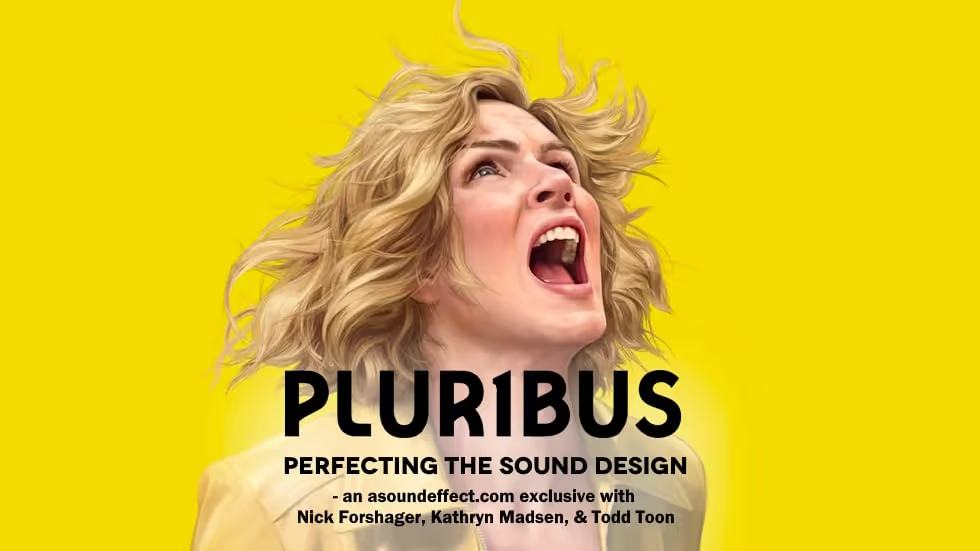
The enigmatic allure of post-apocalyptic science fiction series Pluribus — streaming on Apple TV+ — starts with the most unlikely advocate for saving humanity: Carol. She’s unsociable and somewhat pessimistic, but she also values the individuality that comes with being human. So when the world’s population is infected with a positive-leaning hive-mind alien virus, Carol gathers the other immune earthlings to discuss possible solutions for a cure.
Showrunner Vince Gilligan (known for Breaking Bad and Better Call Saul) embraces the quietness of the post-infection world, where people no longer need to communicate verbally thanks to their collective consciousness. Removing a significant portion of dialogue and all crowd walla exposed the backgrounds, effects, and foley. Those elements, now taking center stage, weren’t simply added to fill up the sonic space. Instead, they were highly orchestrated and curated to tell the story that’s unfolding. For instance, the opening 13 minutes of Ep. 2 are sound effects-only — no dialogue, no music. The characters move wordlessly from one task to the next; everyone understands their role and can effectively complete any task necessary, even flying a C-130!
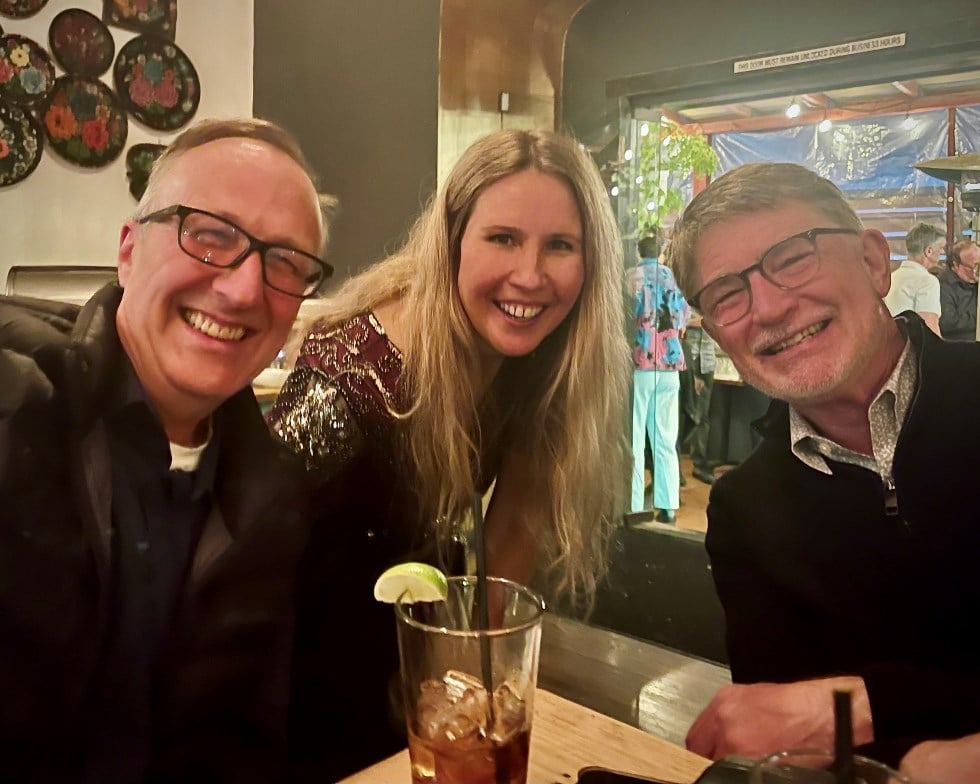
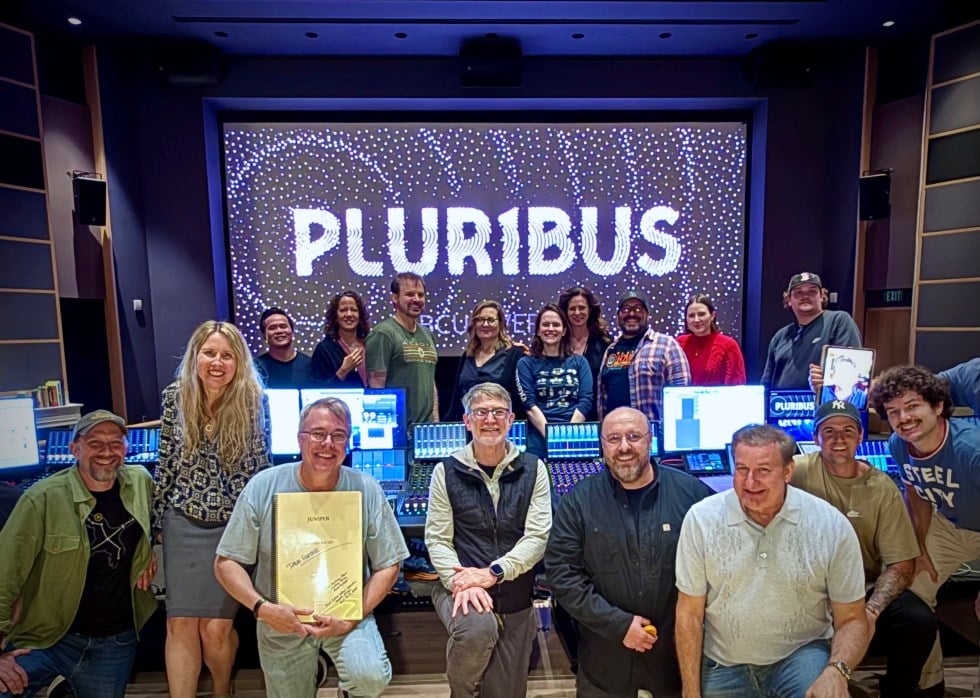
In this chat about Pluribus Ep. 1 – Ep. 3, find out how Supervising Sound Editors Nick Forshager and Kathryn Madsen and Sound Designer Todd Toon found the voice of the hive-mind-infected “others,” how they created a jaunty vibe for the virus replication sequence in the lab, what went into the authentic sound of the C-130 takeoff sequence, how long the reverb tail was on the IR recorded in the empty airport lobby, and more!
Pluribus — Official Trailer | Apple TV
When did you get started on the Pluribus?
Nick Forshager (NF): We’ve been with it for so long. We did a temp dub back in June last year.
We started editing at the beginning of January, started mixing in May, and then we worked through the whole summer. We would do three episodes, take a month off, then do two more episodes and take a month off. It was a long process for us.
So it was this long process. After a while, you lose focus. We attended the premiere and watched episodes one and two with an audience. That’s the first time I’d seen it in probably eight months. It was great to see it with an audience because you could really see that everything was working and everyone was getting it. It was really, really rewarding.
What were showrunner Vince Gilligan’s initial ideas for using sound to help tell this story? How did he want to use sound for the pre-infection versus post-infection world?
NF: Vince had a really pretty good idea of how he wanted things to evolve. For the pre-infection world, he wanted it to be as chaotic and busy as possible. He knew we were going into this post-infection world, where it’s much quieter and more individual. We really wanted to amp that up, going into that.
For the post-infection world, he had some really good ideas we wanted to explore. I think the original idea was to be very quiet, and then the natural world would come back, as if nature were reclaiming the world we had before. But as we got to the stage, we found that the isolation and the quietness with Carol seemed to work better. So he was willing to evolve with the sound as we were, exploring it on the stage.
Todd Toon (TT): I think Nick nailed it there with what Vince had in mind. There was a bit of curiosity among everyone as to how being quiet would play. It was a little unknown. That was a big mystery once we got into it, but it resolved pretty quickly. He just embraced it. That’s one of his favorite things about the track now, how quiet it gets. He was really surprised. And, it’s effective without a doubt.
Kathryn Madsen (KM): That was one thing that Vince wanted to have: a big contrast between episode one and pretty much the rest of the show, to have that definitive change between a lot of people talking and then no one talking at all. At our spotting sessions, Vince told us that they don’t have to talk to communicate.
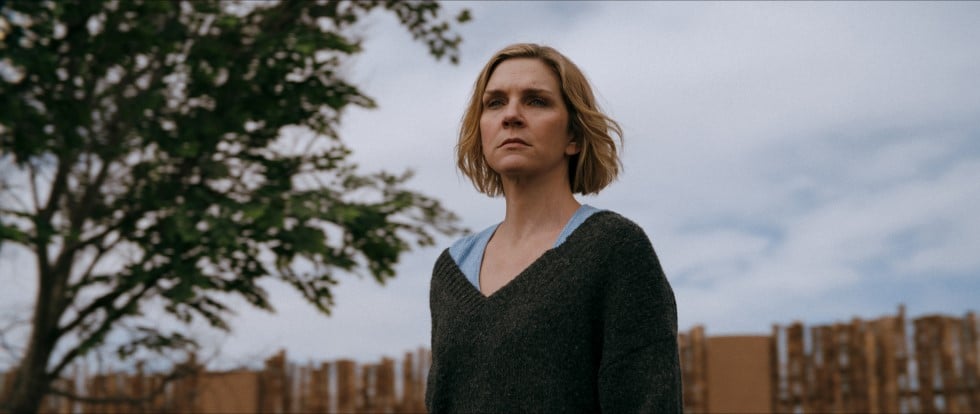
Yeah, Carol lives such a quiet existence, even when others are around, since they don’t need to talk. You hear so much of the sound effects and backgrounds – every detail. Can you talk about your overall approach?
TT: It was definitely intentional, everything we’ve done. And challenging because, as Kathryn said, people don’t talk anymore. So, obviously, for normal crowd scenes, you have to get away from using walla, and you forget how much you lean on that in those scenes. That kind of messes with your mind a little bit when you see a crowd, and you don’t hear them. It’s creepy. So, what’s left? There’s a lot of foley detail, obviously, in the crowds. But even something like traffic is different. The whole world has just completely changed. And so it does uncover a lot of the details, a lot of the sounds that are left behind. And as Nick said, nature is taking over at times. I think it is effective for Carol’s isolation.

NF: Without a doubt. We actually had more sounds in the early pre-dubs, and we found that as we began stripping them out, things became way more specific. And, Vince has always been a master of detail. Finding those moments has always been really important. We even took a whole other layer out of it to really find those moments when we did have a sound. It really had something to say to the scene or to where Carol was in her thought process. I think that’s what made it stand out and be more effective throughout.
The sound is more orchestrated, with each sound telling you something. It’s part of the story and not just filling the space where dialogue would be. That was a big concept, and that was a hard concept at times — not just for us but also for Vince to get his head around: are we too silent? But every time we put something in, it felt like, “Oh, we’re taking away from that.” So then stripping it out seemed to be the way to go. Then we embraced it, because we stayed with Carol much more that way, and that made a better experience when we were watching it.
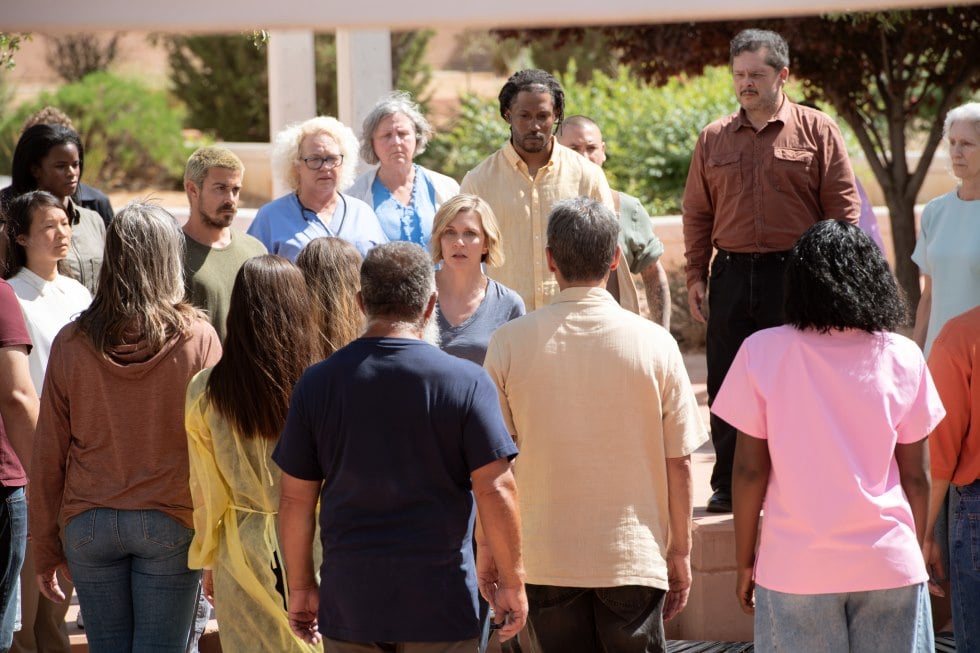
In terms of the hive-mind responses from the crowds on screen — were those from production (were all those people mic’d up?!) Or was that loop group? What were some challenges in syncing and layering the multiple voices in the hive-mind responses?
KM: Vince’s first idea, when we were spotting the episodes with “The Others,” was to hear what it would sound like if they were all completely in unison. That’s what we tried first. I had our group speak in unison as much as possible, and I would also record them individually so I could put them all in unison.
I had our group speak in unison as much as possible, and I would also record them individually so I could put them all in unison.
We tried the unison way of speaking on the mix stage, but it actually was better to have them not be completely robotic because they are still human. They share a consciousness, but they’re still human, so they don’t speak at exactly the same time.
NF: It made it feel a little more off-kilter when they weren’t exactly in unison. So even though they’re saying these pleasantries and are trying to help Carol, it made it feel a little more uneasy. It ended up making it even more effective and sometimes even funnier. So, that was one concept going in that ended up being a different concept on the stage, one that worked much better.
KM: In the hospital scene in Ep. 1, that’s the first time we hear the hive-mind response. They didn’t have the actors in the crowd individually mic’d up, but I think they had a boom mic going. I think the doctor might have been specifically mic’d up. So, some of that crowd is the practical recording on the day, but a lot of it is our loop group.
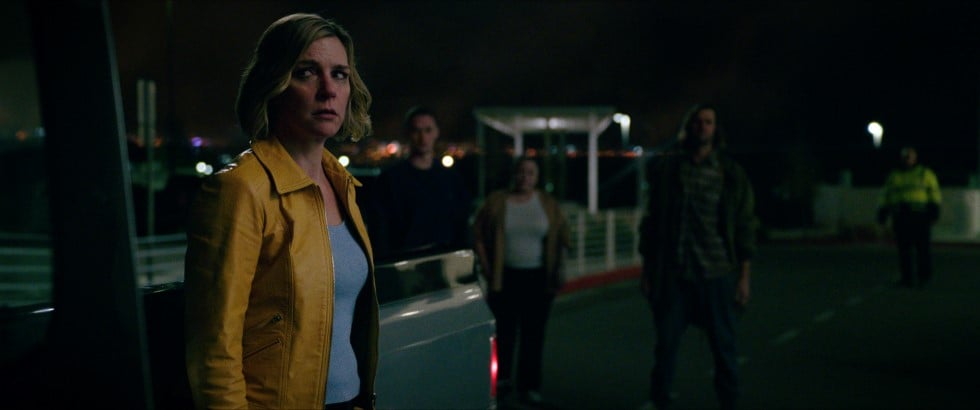
The loop groupers did a fantastic job of matching each other’s tone – this helpful but not overly enthusiastic tone of voice…
KM: They were fantastic! And that was one thing we had to work out: what should their tone of voice be? ”The Others” are all in this state of bliss, but it’s not overly crazy-happy. It’s more a state of contentment. We had to play with the levels of happiness there, and the one we landed on is really effective.
Working out the timing of the layering and getting the right tone for their responses were definitely our challenges with “The Others” responses. I think it turned out great.
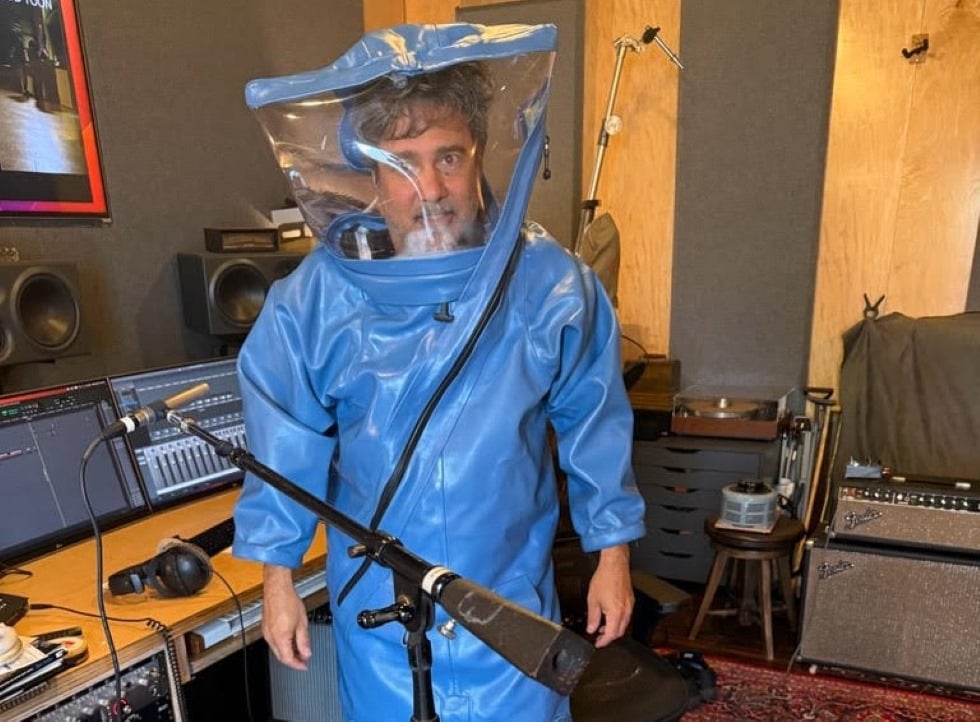
What went into the sound for the lab rat scene? And, can you talk about the in-suit vocal processing? Were the actors mic’d up in there?
KM: That’s actually how people talk to each other in those suits, through mics. We did have to do some ADR for that scene. We were able to get one of the original suits they used on set, but it’s very claustrophobic. Ultimately, we used only a portion of the helmet to achieve the same suit sound in ADR. Then our re-recording mixer, Larry Benjamin, took the vocals we recorded with the helmet and fine-tuned them to match the original suit’s sound.
we had a sound effects recordist, Charlie Campagna, do a foley-movement-type pass as well. He put the suit on, and he was dying
NF: On our original pass, we actually were able to get rid of most of the air circulation sound that’s on the in-suit dialogue. But then it felt too clean, so we had to reintroduce some of the noise because we got it to a point where it no longer sounded natural. A lot of that production sound of that air moving around the dialogue we ended up putting back in to create that in-suit effect. It was helpful to have that.
TT: Just before the suit went over to Kathryn’s ADR session, we had a sound effects recordist, Charlie Campagna, do a foley-movement-type pass as well. He put the suit on, and he was dying. But for all the attachments and stuff on the suit, we got a nice assortment of recordings. Then we created a lot of the air, too, using close-up microphones to capture breathing. We ran that through a little comb filter or something to add to that production feel.
I love the production-line-esque lab scenes – first creating strains to test, then mouth-swabbing to spread it across the Petri dishes — with the music and effects creating this rhythmic feel. Can you talk about your sound work for these scenes?
NF: That was built by picture editor Skip Macdonald and composer Dave Porter; they did a great job composing that. So the rhythm of that was built in the first cut.
Then, the foley team at JRS up in Toronto did the foley work on that. They did a great job ensuring all the details of those Petri dishes matched. They built it in layers, covering every single person in that scene. They built the rhythm to match our production, so it could emphasize it and bring it home. It was really a lot of detail work, and they did a great job putting that together.
Skip had created a great base to work with, and the foley just brought it over the top and finished it off for sure.
TT: It really is a combo platter of the work that Skip did in the Avid, as well as the foley and the production effects. There are sound effects, too. I was able to ingest all of it and then make sure it wasn’t too precise and robotic — just as Kathryn did with the loop group. You want a little bit of slop in it. So, there are elements from all those categories, and I thought it worked really well. Skip really should get the credit for that, as well as Dave. We’re just following a really good template.
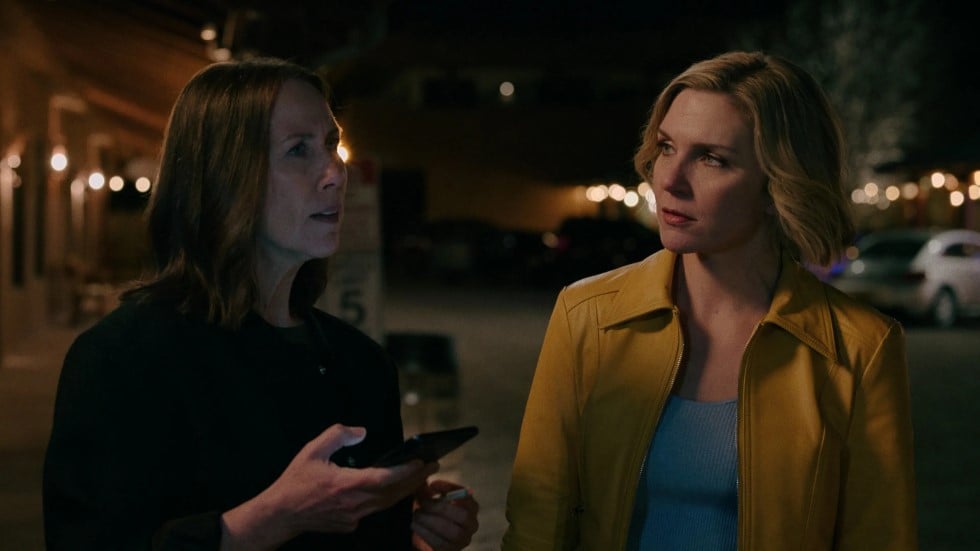
The infection hits everyone en masse, and it’s apocalyptic. Can you talk about creating the sound of Carol’s experience inside the bar when the virus first takes hold?
NF: That’s our last experience of “typical” sound for the real world pre-infection. And so it was really important to Vince that we really played it up, that everything in the bar had big activity because we knew coming out of that scene, we were going to a completely new world.
Yet, it couldn’t be so obvious either. It was a subtle transition from the car wreck to getting out of that world and into this new one. But it was really this big moment we built up to, so that when we went to that new world, it had a completely different feel.
It’s actually a precursor to what we’re going to. There are still these remnants of sounds from the others transforming into this state of being. And so a lot of the sounds in the bar, such as the band with the woman blowing into the microphone, we re-recorded so that we had the sense of something happening, but you don’t really know what it is.
And it really played great. It was a great combination of the loop group and Todd going out with Charlie to re-record instruments and vocals to match what we were seeing on screen. And then we were able to strip that back a layer to where we go back to this silent world.
A lot of it is worldized, even the recordings of the instruments […] Kathryn then recorded all of the woman’s vocals, and we re-recorded them through a PA system
TT: A lot of it is worldized, even the recordings of the instruments and whatnot. Kathryn then recorded all the woman’s vocals, and we re-recorded them through a PA system, so we had several options for how to layer it. You also have the original source for Larry to treat, so he had plenty to play with on the dub stage.
KM: This was one of those things that changed when we were on the mix stage. When we originally mixed that bar scene, we had a lot more efforts from all of the people seizing. I had recorded efforts for everyone in that bar so that we had a parade of seizing sounds as Carol is walking through all of the people. But we found it was more striking and eerie when we stripped back some of the efforts and kept only the specific sounds, like the woman who’s blowing into the mic repeatedly and the drummer who drops his sticks.
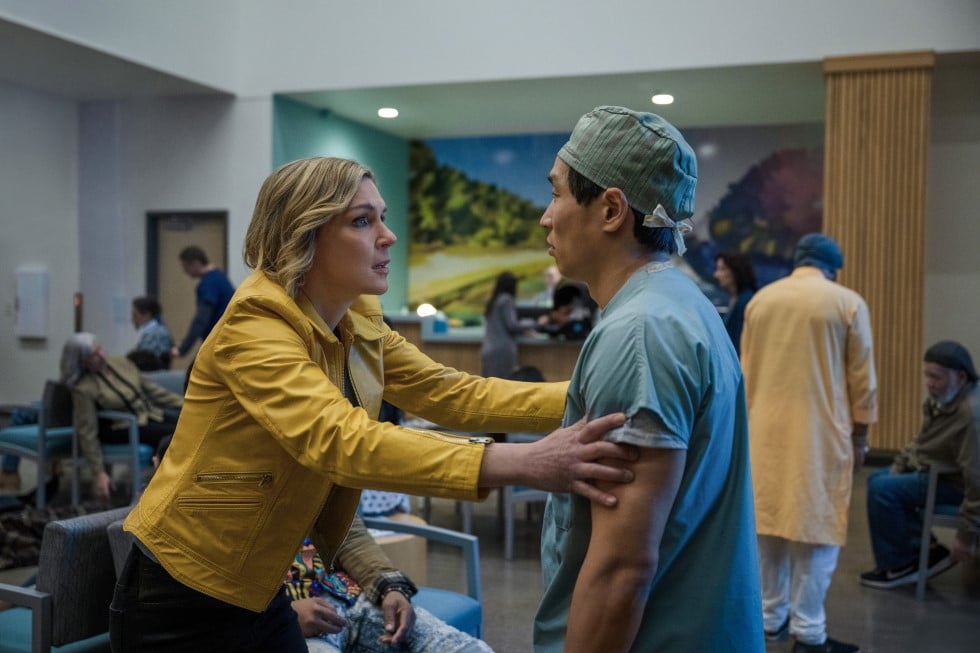
What went into the sound of Carol’s experience at the hospital? What were some opportunities for sound here? (I loved how you sold the idea of scary zombies until they interact with Carol, so cool!)
NF: It’s a really emotional scene, too, because it’s right when she’s lost Helen. We were trying to build from that — that Carol has lost the last part of her regular world — and transition into the new world she is left with, and now these people are coming back alive. Finding that transition from this sensitive moment into them coming back alive and them being around her was a bit of a challenge. There’s a lot of subtlety in there to bring that about.
The zombie thing was obviously something we were worried about because they’re not zombies. But we also wanted to make it weird and creepy. It was a tricky moment to navigate. It’s a hard left turn in the middle of that scene to make that happen.
I thought it played really well in the end and got us to that next phase of Carol’s journey in this.
TT: Part of that scene is that she’s still hopeful. She’s hoping that, even though this is happening in front of her, they can help bring Helen back. Then at a certain point, though, she’s just like, “Get outta my way.” She recognizes what’s going on, and that’s when she wants to get Helen out of there. She takes off with the truck, and you start wondering, “What are we in for from this point on?”

The first 13 minutes of Ep. 2 is all sound effects/design – no talking, no music… a sound designer’s dream! What were some challenges and opportunities for using sound as a storytelling tool, to not just carry the action but also convey emotion to the audience?
NF: It’s funny because I found out about that scene early on, before we had even seen it, because they spotted music way ahead of us. I was working with Jason Newman on another project at the time, and we just spotted Ep. 2. He said, “You guys have got your hands full with this one.” We got this long scene that I didn’t know anything about, and he’s like, ‘It’s all you. Vince doesn’t want to do any music; it’s super busy.” We couldn’t wait to see it! We were thrilled to have the opportunity to jump at it and do it.
There’s a lot of production in there, but it’s mainly built from foley and effects — every little movement is there. And it’s such a big scene in the story where we get to see what the world is like from the others’ side, from their side.
There’s a lot of production in there, but it’s mainly built from foley and effects — every little movement is there.
We had this opportunity to have the sound tell what they were doing and how they would do things and how they move around in this world, and how meticulous they are. Like when she’s in the plane, it was so important to make sure that we got all of that working really, really well.
KM: And there’s no talking. No talking at all.
NF: Just the idea that this person who’s doing one thing is now going to go into this plane and fly this plane, we’re telling part of this very important section of the story. Being able to sell that and sell it just with the sounds and their movement and the actions that they’re doing on the screen was really, really important.
And it was super fun to do. Todd, the foley team, and everybody did a great job on that.
TT: When I watched it the first time, I honestly thought that there was still some Dave Porter-esque mock score that they hadn’t cut in yet. But when I asked Nick about it, he said, “No, that’s all us.”
A lot of it was just exposing what we normally do when there is dialogue and music. We always go 100% for all the detail, all fully filled and everything. But in this case, you really did have to be very specific about what’s happening on screen; you are telling the story.
NF: It was very, very specific.
Vince, being a helicopter pilot, was very meticulous about that section. He’s been on a lot of runways, and so we had to get that sequence right.
TT: Especially with the C-130 takeoff sequence. We weren’t there when they shot it, but she’s actually in the cockpit, and it looks amazing. It’s just this huge machine trying to get off the ground. Vince, being a helicopter pilot, was very meticulous about that section. He’s been on a lot of runways, and so we had to get that sequence right. Anything to do with aviation is a challenge, so we have to go in fully prepared to change it up as needed. But in this case, we had covered it pretty well, and it was a matter of just finding the right elements to dig out for each specific spot. When we played the teaser for Vince, we got a “F**k yeah” in response. He was happy, and that was a huge relief.
KM: They taught actress Karolina Wydra (who plays Zosia) the whole takeoff sequence, so she knew exactly which buttons to push and everything.
TT: The sounds for the buttons and toggles came from recordings aboard a real C-130. We tried to be as authentic as possible. Then foley came up with some nice sweeteners. There are some sweeteners throughout to give that sense of motion. There are production effects, too. It was whatever worked together in combination to sell the moment, but by and large, it’s the real deal.
for each one of those four engines that click on, there’s this solenoid clicking sound […] that’s something that somebody who is familiar with it is going to pick up on
NF: We didn’t cut any corners on that. I think that was part of showing how mechanical this world is and how mechanical the “others” are, where it’s normal for this woman to just get in a plane, go through the sequence, and take off. We were really meticulous about making sure that you go through the sequence and see how methodical they are. We had every single engine start sound; we had every single button click. It truly was the sequence you would do to start a C-130. And you just don’t do that in shows. So being able to really capture that and make it part of the storytelling process was really amazing.
TT: One thing that did come up, and I’ll credit Vince for it because it didn’t come up during spotting, was that for each one of those four engines that click on, there’s this solenoid clicking sound that he remembered hearing. I dug through a bunch of recordings, and we added that as a sweetener on fix day. I thought that was a really nice catch because that’s one of those little details that, when you’re listening to these recordings, you might not hear. You just hear the engines. But when you’re listening for it, you do hear it; you can identify it. And so we sweetened those, since that’s something that somebody who is familiar with it is going to pick up on.
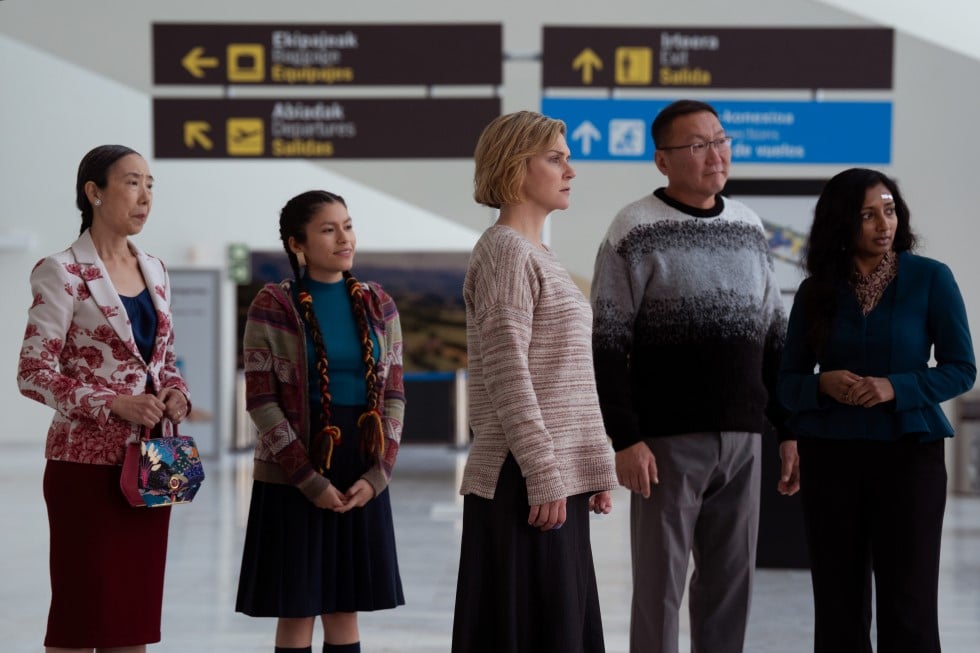
Carol meets with four other infection-resistant people. They’re in a nearly empty airport lobby — a huge, reverberant space. What were some challenges for dialogue here?
KM: Yeah, there was a lot of reverb in that building, but one of the great things about Vince is that he loves the sound of verb in a big space like that.
Originally, we listened to what it would sound like if we took out the verb, but then we found that we missed it. I think most of that is the original verb, and our production sound mixer Phillip W. Palmer is one of the best in the business. He knows where to put the mics so that you get a good recording.
We did have some ADR in that scene as well, so Larry had to match that natural verb. But yeah, that is the natural verb of that huge space.
NF: Philip actually had sent us a recording of that space. He was really concerned about it because in his mix track of all the dialogue lines, those long reverb tails were causing overlaps. They were stepping on each other because of the overlap of the reverb on each other’s lines. So, he sent us an IR recording of that lobby. And the reverb had a ten-second tail. We’re like, “Oh my gosh, this is going to be really bad.” But when we got to the individual mics, and we built the scene, we saw that the reverb wasn’t quite as long on the smaller mics.
And so there wasn’t as much reverb over each other as we had thought when we got to the stage. Originally, Larry had gotten rid of a lot of it so that we could hear it more specifically, but then it lost its edge. It didn’t feel like they were quite in that space anymore. And so we ended up dialing a lot of the natural reverb back into it because we could. It was definitely one of those unique locations that we don’t see every day, and there’s nothing else there. It is just the five or six people in there talking.
TT: And we couldn’t help out with sound effects there. The dialogue was out there all on its own.
NF: And Vince wasn’t going to loop it either. We really had to make sure that it could work.
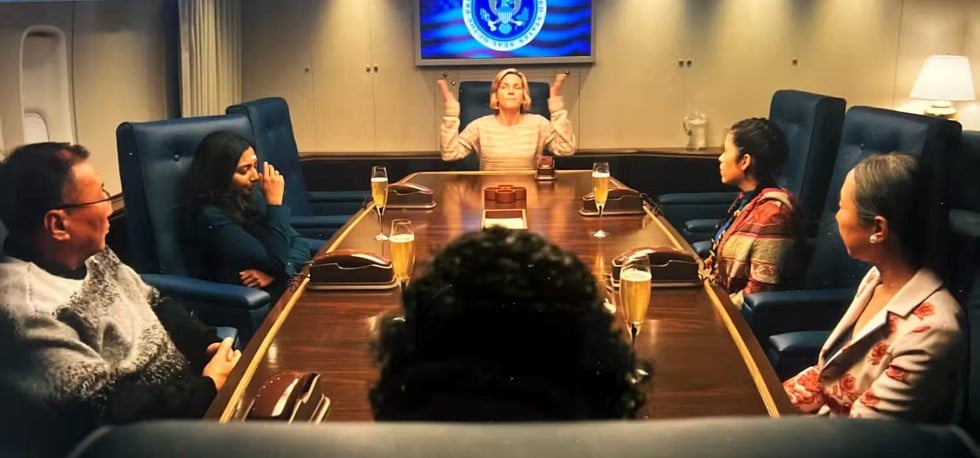
Air Force One pulls up on the tarmac; it’s loud and slow. Koumba yells from the plane over the engine noise, and you have to hear him yet that engine has to sound LOUD. Can you talk about your sound work here?
TT: That was tough because it was 100% VFX, and we didn’t know what it was going to look like at first. So, we had to guess using just the animatics.
But also, with the different jets arriving, you can only make them sound so different, and they’re all pulling up one at a time, so they blend into each other.
Air Force One was layered with multiple jets and a lot of low-end to give that sense of size and power. The actors do a good job of selling it as well. Just before they board the plane, they cover their ears, which helps a lot. It encouraged us to push it further.
It’s moving slowly, and you can often sell that movement with the sound of tires on pavement, but if you can hear that sound, it means the engines aren’t loud enough to drown it out. So, playing that detail works against you. It makes it seem not as loud.
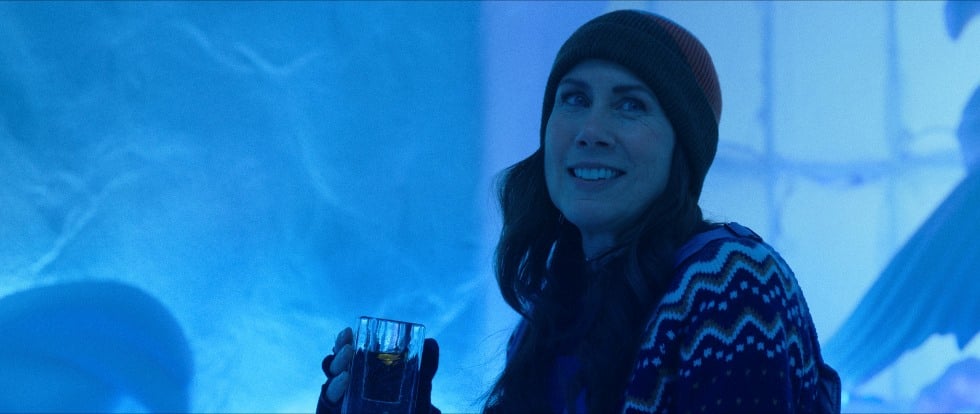
I love the ice hotel in Ep. 3! Great crunchy footsteps in the snow. Can you tell me more about your foley team for the show?
NF: On every episode, they’re great. It’s JRS Productions up in Toronto. I’ve been working with them for years, and they’re magnificent at getting the details just right.
That scene in particular was shot on a stage. So, it didn’t sound right at all. The sled didn’t sound right; the snow didn’t sound right. That was a big concern for Vince and Gordon Smith, who directed that episode. It needed to feel correct. And so the foley team did a great job recording that and getting us just enough of a crunch to make sure that we were selling what we were seeing all the way through that.
Todd did a great job finding sounds that made the rooms feel cold. Because, as I said, it was a set and it needed to feel more natural. Todd found great elements to help sell that whole location for sure.
I am especially grateful for all of the foley and the atmosphere sounds in there because there is a bunch of ADR
TT: It’s inspired by interior wind, but I think Vince and Gordon wanted to create an atmosphere that was a bit unsettling, which is what I think we accomplished. Even though they’re on this amazing vacation, it should be a little bit not just cold, but a little bit uneasy.
KM: I am especially grateful for all of the foley and the atmosphere sounds in there because there is a bunch of ADR for the Norwegian guide in that scene; his name is Thor Knai — how Nordic! He had to do a lot of ADR for that, so I really appreciate it when they’ve got a lot of good foley and atmosphere so that it doesn’t sound like ADR. Then, of course, Larry’s a fantastic mixer as well.
When Thor came in, he told me the actors were just walking around in circles during that first scene. It was a small space. So it’s great what Todd and Nick and the foley guys did to make it sound like they’re going through this whole, long route to get to the hotel room. The sound is so great in that scene. I love it so much.
TT: Vince is always interested in exploring the use of Atmos, and the camera does a 360-degree pan, so Thor ends up on one side, crossing back, and he’s talking. So we tried to be as literal as possible with what we were seeing, and then it just felt a little disembodied. So we had to pull it back. But Vince has always encouraged us to do those kinds of things.
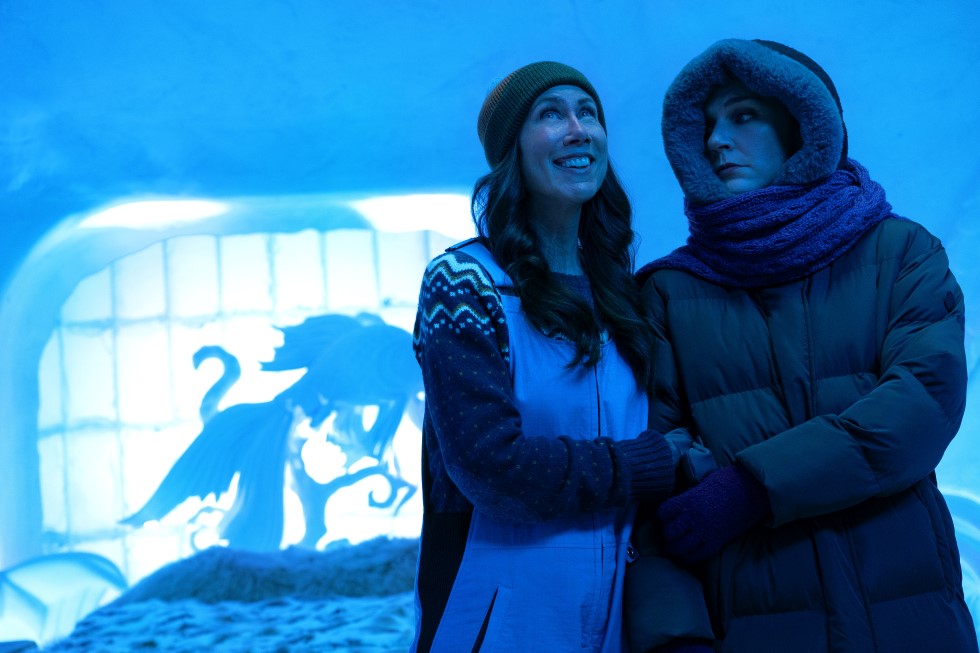
And what about the room tone after Helen opens the window shade? There’s this high-pitched, glassy sparkle to the aurora borealis they’re looking at…
TT: It’s a bit magical. It’s a sparkly, shimmer sound with some lower-registered tones. That came up during spotting with Gordon, who was very specific about the idea that even though you wouldn’t hear the aurora borealis — that’s pretty far-fetched that you’d hear anything — it should feel magical. This place is magical. And even with the visuals and hearing this magical tone, it makes Carol more isolated in a way. She still feels anxious and uneasy, and she’s not enjoying herself in the moment.
NF: We did talk about that in spotting, and it was one of those ideas that got thrown out there to try. I kept thinking this was going to go away; it seemed silly. But between Todd finding the right elements and Tim Hoogenakker (our effects re-recording mixer) finding the right balance, it stayed all the way to the end. It just worked. It made the scene feel connected.
KM: And it’s just barely there in the mix.
TT: You feel it more than hear it.
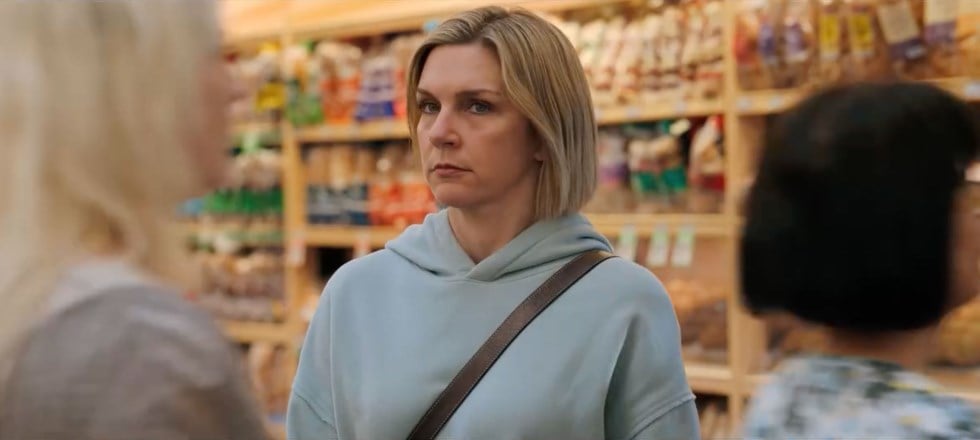
Carol has everything returned to her local Sprout grocery store. This was another fun music-and-sound-effects scene! Can you talk about your sound work here?
NF: This one wasn’t Skip. This was editor Chris McCaleb and director Gordon Smith. They spent a lot of time choreographing it and getting the rhythm visually. Similar to Ep.1 with the Petri dishes, our job was to fill it in and bring that emphasis home of what’s happening on-screen. Again, foley spent a lot of time getting all those footsteps and not making it feel like marching, but that there was this rhythm to it.
And then Todd did a great job getting all the hand trucks, doors, and everything to match what we were seeing and feel like it was part of the same space. It took a lot of work. There’s this coordination that had to happen. And it’s the same thing with the trucks coming in. If you played it for what you saw, it would just sound like noise. So, trying to find that specific sound of which truck was coming in and when is the second truck coming in and getting that movement to sell this kind of choreographed dance was something we spent a lot of time exploring and getting to feel right.
The actors tried to do it on set, but they couldn’t quite get it to a single, smooth sentence […] So I had to go in there and make very microscopic edits to get that to sound smooth
KM: I have a moment of pride at the end of that scene. Three different people say one sentence as they’re walking out: “You’re all set, Carol. Let us know if there’s anything you need.” The actors tried to do it on set, but they couldn’t quite get it to a single, smooth sentence said by all three. So I had to go in there and make very microscopic edits to get that to sound smooth. I’m very proud of that.
NF: That’s one of those things that, when you see it, it doesn’t seem like that big of a deal, but it really was difficult to make that seamless. During production, they couldn’t quite get the timing, the way Vince and Gordon wanted it. So to go in and try to make that smooth, it is one of those editorial challenges that people just don’t understand what we do — how difficult it is to make that seamless.
KM: Yeah, it required lots of micro-edits. But that’s the magic, to make it feel like it happened naturally on the day.
The end of that episode always makes me laugh because of the muzak. Vince has a thing with muzak in this show. You hear it in the supermarket and in other locations throughout the series.
TT: The muzak choices were perfect, and then you add on the futz. It’s always the perfect muzak song for the moment.
What has stood out to you so far in terms of your sound work on the show? What’s been your favorite part of this experience?
NF: For me, just being able to explore sound in this neutral space where there’s not a lot happening and trying to find those bits and pieces of sound to really fill in those gaps. It’s definitely been a challenge, but I think that, when we do nail it, everybody on the stage knows it’s right.
And there are many places throughout where we’ve had to do that. We obviously have some really big scenes, but it’s those smaller scenes that are really the challenge for us. Being able to keep it alive and keep us focused on the storytelling, yet still feeling like there’s a world happening around us, was the big challenge, at least for me as a supervisor. I’m sure Todd and Kathryn have different ideas, but those were the big things I found for us.
TT: I agree with that 100%.
I also credit the people involved, including Nick and Kathryn. It’s a great experience just working on the show, and I’m happy to hear that your ears are picking up on some of this stuff that we tend to think will go right by most people. But we’ve been getting a lot of good feedback about the sound, which is really rewarding. We all put a lot of time and effort into our projects, and it’s nice to get good feedback.
KM: It’s a different kind of show from the norm, and figuring out how we could make this new world sound, including the way that “The Others” speak, has been neat. There’s a big set piece at the end of Ep. 4 where “The Others” try to stop Carol from getting some information from Zosia, and I got to work with our fantastic composer, Dave Porter, on that scene. Dave had written a piece that amps up the tension with a crescendoing choral musical phrase and sent it to me before my group session. I recorded and edited the practical voices of the people you see in the scene to build in the same way Dave’s music did. When you’re spotting an episode and you’re talking about these big ideas, you think, “Oh, this is going to be awesome!” But then you have to figure out how to actually do it! You hope that it will be effective, and when it is, it’s the most gratifying feeling.
I recorded and edited the practical voices of the people you see in the scene to build in the same way Dave’s music did.
I also have to give a shout-out to the cast of this show. They have been amazing with all of their ADR. Karolina Wydra had to do all these different languages. And then Carlos-Manuel Vesga (who plays Manousos) had to do a ton of ADR in Ep. 7 because of all the different locations. And, of course, Rhea Seehorn is just fantastic. Also, as Todd was saying, Vince, Gordon, Skip, and Chris are passionate about sound and keen to ensure that we have what we need. Diane, our post producer, would say to us, “What do you guys need? Let me know, and I’ll see if I can make it happen.” It’s a wonderful thing working with people who really care about sound.
NF: It’s a real group effort for sure. It’s highly collaborative.
TT: It’s always great to have that support. And without Rhea’s performance, we’d have nothing to talk about. It was really amazing.
NF: It was a really unique experience — unlike anything I’ve ever worked on before. This was definitely a challenge. Each episode had its own challenges, and I’m glad it’s getting the attention that it is getting because everybody put so much time and effort into it. It’s really special.
A big thanks to Nick Forshager, Kathryn Madsen, and Todd Toon for giving us a behind-the-scenes look at the sound of Pluribus and to Jennifer Walden for the interview!