




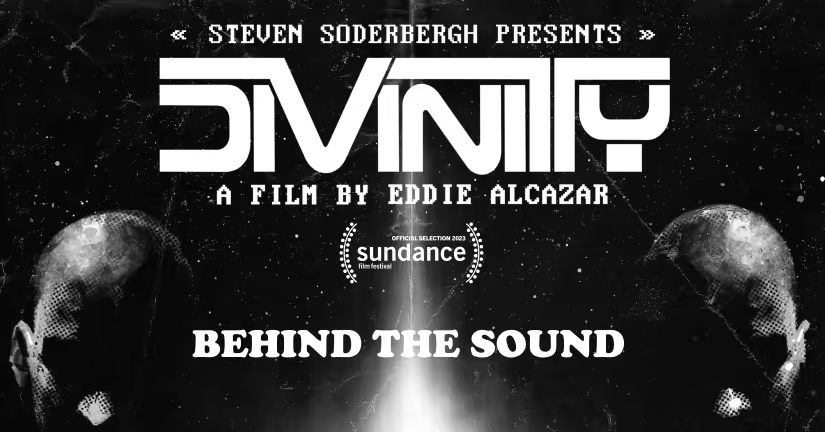
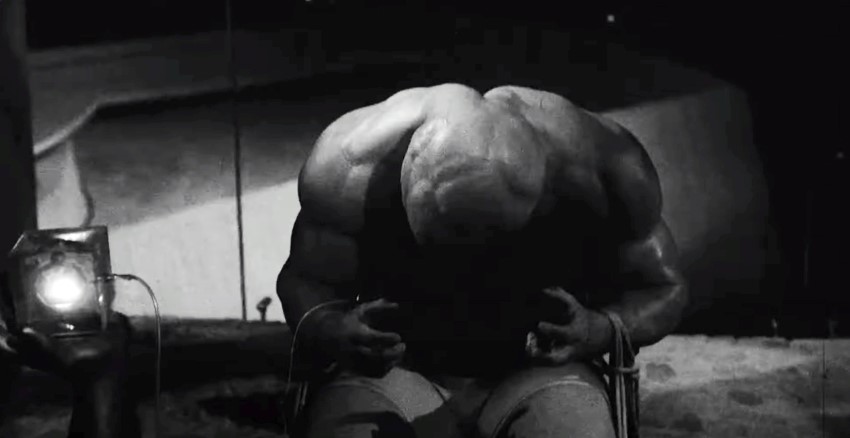
Director Eddie Alcazar’s black-and-white film Divinity – part of Sundance 2023’s NEXT category – is a sci-fi journey to an otherworldly planet where an immortality drug called ‘Divinity’ is causing disturbing shifts in society. Two alien brothers arrive on the planet and attempt to intervene by taking the drugmaker – a scientist named Jaxxon (played by Stephen Dorff) hostage and injecting him with a high dose of Divinity, causing the scientist to transform into a muscle-bound creature.
2x-Oscar-winning sound designer Mark Mangini at Formosa Group teamed up with award-winning sound designer Jacob ‘Young Thor’ Flack at Unbridled Sound to create a sci-fi sound that is firmly grounded in reality – an approach that Mangini prizes for sci-fi films. Here, they talk about recording magnets as the source sound for the alien brothers’ telepathy, using distant whale groans to create a mysterious atmosphere for the alien planet, working with actor Stephen Dorff to get a performance-based creature sound, creating an alien transmission stream from manipulated recordings of foreign languages, and so much more!
DIVINITY – (Trailer) Steven Soderbergh Presents A Film by Eddie Alcazar Sundance 2023
What were director Eddie Alcazar’s goals for sound on Divinity? And what were your creative ideas on how sound could help to tell or support this story?
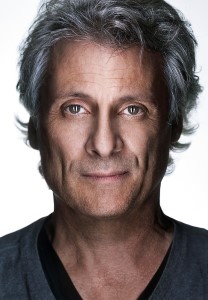
Mark Mangini (MM): I give Eddie a great deal of credit. I think what he wanted most for this film was to exceed the expectations of what a traditional ultra-low-budget film should sound like. That was part of the allure for me. I saw a gifted filmmaker who created an interesting movie that begged for narrative sound. Traditionally, with such a limited budget, I wouldn’t be able to participate, but I felt that one of the contributions I want to make to filmmaking is helping support filmmakers like Eddie by elevating their game and participating when normally I couldn’t. I love movies and I love smart filmmakers. I want to align myself with people like Eddie who see and recognize the power of sound to further their story. I want these filmmakers to flourish.
This film is a big challenge sonically. Part of the allure was Eddie was open to using sound as a narrative storytelling tool. Often, especially at this budget, sound works perfunctorily – filling in the missing sounds and working diegetically. Eddie wanted to do something different. He had lofty goals without specific ideas of what things should sound like, and that felt attractive.
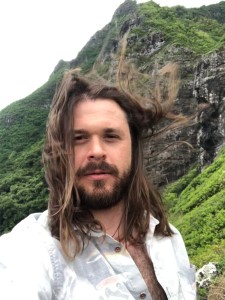
Jacob Flack (JF): Divinity is a sci-fi film and it takes place in another world, so everything needs to have a sound, even as simple as the backgrounds and the ambience of the world. Eddie really wanted to establish that; he wanted to keep it dark, scary, and mysterious.
The film is full of motifs and abstract ideas. One was for the Divinity cube. (Divinity is a serum for immortality). He wanted a sound for this cube but he didn’t know what sound. Eddie leaves it up to us. He trusts his team to come up with these things. The Divinity cube looks cool, but there’s not much in the way of visual effects for it, so we really had to establish its sound. Mark and I came up with the idea of having a pulsing heartbeat for it. You feel and hear it as though it’s almost alive, and breathing.
Another sound motif was for the communication between these brothers who are aliens. Sound was really important because there weren’t a lot of visual effects to show these telepathic communications. We don’t really visually see it, so we needed to establish that with sound. And it was going to be used throughout the film to represent how they could speak to each other. It’s how they gain information and that was an important aspect, but there was just not a visual cue for it, so that was really leaning on sound.
There needed to be an evolution to the sound as he’s evolving from one stage to the next and he’s becoming more creature-esque.
We also had to create a transformation sound for when Stephen Dorff’s character Jaxxon gets injected with the drug and transforms into a creature. There needed to be an evolution to the sound as he’s evolving from one stage to the next and he’s becoming more creature-esque. We decided to have Stephen Dorff make that part of his ADR performance. We were very experimental and he took it as far as he could for the creature sounds. This way, later in the process, there wouldn’t be so much processing. Stephen gave us a great performance; he really killed it on that.
If you had to pick one scene that best represents your sound work on this film, what would that be? Can you describe the scene (in general terms) and what went into your sound work on it?
JF: Even before the edit, and after our brief spotting session with Eddie on his goals, Mark spent a few weeks creating new sounds and hand-picking sounds from his own personal library that would best fit Eddie’s vision and ideas for the film. This immersive, eclectic, rich, and multi-channel library then became the backbone of the entire film. These sounds inspired many (if not all) of the difficult motifs that needed to be created and became the foundation of the film.
A great scene that really exemplifies these sounds of the film would be the opening of the movie. All these establishing sounds that you’re hearing throughout the film needed to be established within these first 10 minutes.
This was then underscored by a very eerie siren-like female voice that is reminiscent of angels.
Starting with the opening shot, this crazy birthing scene where we’re in the womb with these two alien brothers, you have these amniotic fluid sounds and heart pulse. One of the big things that Eddie wanted was to have an electricity field for the brothers, so the heartbeat has an electrical pulsing to it. This was then underscored by a very eerie siren-like female voice that is reminiscent of angels. This is an important theme later when we see the brothers ascend to the sky as angels at the end of the movie.
Eddie also had this idea of hearing transmissions and frequencies, as though the alien brothers were scanning through the universe for waves of information, looking for this single transmission of their dad talking about the drug Divinity. Their sole purpose is to find that transmission and go to this world and save it. Since it all takes place in a different world, the transmissions have unfamiliar voices and chatter and foreign languages. It’s very alien in a way. That was really tough because, again, there’s no visual for it. Eddie really wanted sound to sell this idea of searching this universe for this specific transmission of the dad talking about this immortality drug. That was all sound-driven.
In the mix, these sounds are panning around you as though it’s passing by you.
To make the transmissions, we used foreign languages that were sometimes pitched up and reversed. Even if you did know the foreign language, it comes and goes very quickly so you can’t understand what’s being said. We also have bleeps and blurps. In the mix, these sounds are panning around you as though it’s passing by you. You might hear a fragment of a jingle or something almost familiar like you’re scanning through the radio, but there are definitely some very unfamiliar, alien sounds in there. Right off the bat, you know you’re not on this earth.
…we didn’t want it to be just winds, so we created these different weird insectoid clatters and chitters.
Then we go into the dad’s point of view in the lab, so we’re establishing the lab and the Divinity cube for the first time. You hear the cube pulsing and when he touches it, you feel how powerful it is. There’s no visual for that power either; he just touches it. So we express that power through a big powerful sound.
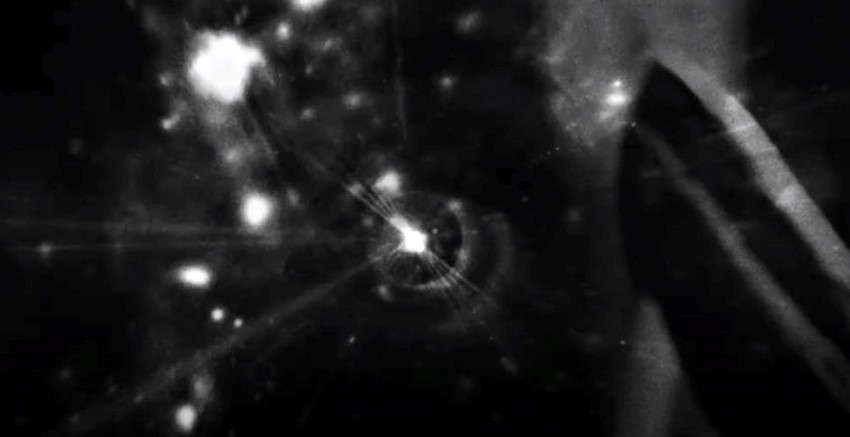
The shot zooms out of that into hyperspace, as if we’re shooting through the stars and traveling through time and space on this transmission from the past that reaches the brothers in the present.
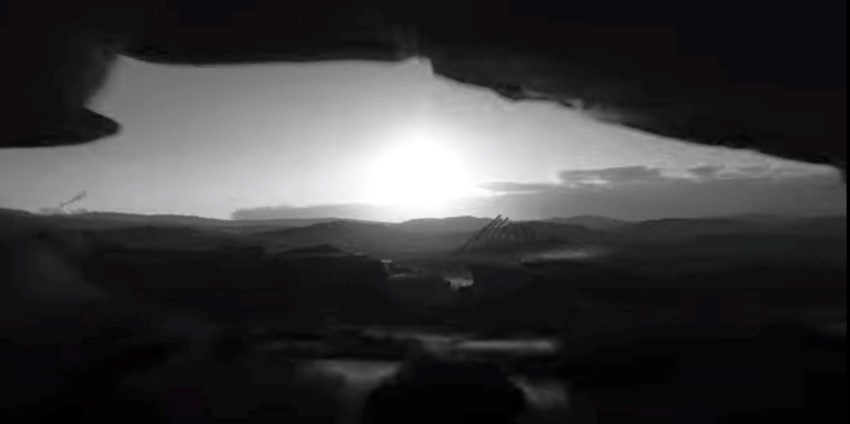
We’re introduced to their present world, which looks like a desert but it’s very alien. There are weird fossil bones in the background, but this is the first time we actually hear the world that they’re in. The world is very desolate; there are neither animals nor birds – nothing like that. We didn’t want to have that familiarity. Yet, we didn’t want it to be just winds, so we created these different weird insectoid clatters and chitters. In the distance, we had these big, crazy whale groans. It’s indistinct; you don’t know where it’s coming from, just that there’s some sort of weird life in this world. It’s very alien.
The brothers shoot down from the sky and onto the surface of this world, and they land with an impact that makes a crazy explosion sound.
This all happens within the first 10 minutes of the movie.
MM: While I did design about two hundred bespoke sounds for the film, I think my biggest contributions were in shaping the soundtrack through conversations with Jake [Flack] and Eddie, which often revolved around science fiction and its sonic tropes; I was offering guidance on maybe what we shouldn’t do, rather than what we should do.
…I was offering guidance on maybe what we shouldn’t do, rather than what we should do.
Jake did the heavy lifting, though. He did all the sound editing and a great deal of sound design as well. I didn’t do any of the editing, but I feel as though it was through my guidance that we grounded the film in organic sound as much as possible and that is a mantra of mine, to use real sounds as the foundation for the design.
Science fiction presents one with ideas and imagery that are new and perhaps never seen before, and that arguably asks for sounds never heard before. That leads one down a path of synthesizers and synthetic sound. That makes science fiction less interesting because it’s less grounded in a reality we recognize.
…everything had to have a very rich, organic sound, a more believable sound.
So part of my pitch was, ‘let’s create as much sound as we can from organic sources versus synthetic ones so that it can still be sound that we’ve never heard before, but we feel like we’ve heard before.’
JF: Mark felt that everything should have a very organic sound; he really doesn’t like the sound tropes of sci-fi with these little synthetic/synthesizer sounds. So everything had to have a very rich, organic sound, a more believable sound.


What was the most challenging (or second-most challenging, if the above scene was the most challenging) scene for sound? What went into it?
JF: Another big challenge was creating this evolution of the creature. Eddie really wanted to signify each different stage of this evolution from normal into a full-blown creature. And that got really tricky in the later stages. There’s a scene where he’s almost at his final transformation and Eddie really wanted this creature to sound out of this world, crazy-unique. He didn’t really know how that should sound, so it was up to us to figure out how we were going to do that.
We had to develop an arc for the transformation, for the change in our protagonist’s voice, from a scientist into a creature.
MM: We had to develop an arc for the transformation, for the change in our protagonist’s voice, from a scientist into a creature. By the last scene of the film, the scientist is full-creature and his voice is vestigially related to how it sounded before the transformation. So the challenge was to create an organic-sounding, non-science-fiction, non-growly, monster-sounding creature voice for Jaxxon (Stephen Dorff). The fun was focusing on an organic approach that relied on working with Dorff and helping him find his inner beast.
JF: We needed Stephen Dorff to ADR his lines because the creature was played by a body double. So when Stephen was in the ADR booth, he did experiments with crazy things like holding water in his mouth, squeezing his neck, and pinching his nose. The idea is that, during this transformation, his body organs are being crushed and constricted and his vocal cords are being constricted because eventually, he turns into a giant muscleman who has no face. So we needed to express this transformation happening inside his body as if his organs are getting squished.
…Stephen’s character was saying lines so it couldn’t be full-creature because we needed to know what he was saying.
This was challenging because Stephen’s character was saying lines so it couldn’t be full-creature because we needed to know what he was saying. So he’d say his lines with water in his mouth, or while choking his neck in crazy ways.
We recorded his lines using a Sanken CO-100K really close up at 192 kHz. This provided a good proximity effect with pronounced low end. And later, when we pitch the recordings in different ways, we didn’t have any artifacting.
We also recorded a wild take of Stephen performing weird efforts and grunts while doing those same techniques. We wove this wild take in between the spoken words and pitched it down a bit just to make it a little more creature-esque.
…there were layers of creature sounds supporting Stephen’s creature-esque performance.
Mark also created some really cool creature vocalizations that we bookend in between Stephen’s lines, so there might be a grunt or a growl, and then his line, and then it ends with a growl. He also had these really cool coughing-grunts that I was basically cutting underneath the dialogue, underneath the syllables of his speech. So there were layers of creature sounds supporting Stephen’s creature-esque performance.
MM: I didn’t want to take the traditional creature voice approach, that of taking lion or bear or whale sounds and designing them, torturing them and turning them into a creature we’ve never heard before. I wanted it to be grounded in Dorff, his character. I wanted there to be just this teeny piece of his humanity still in the voice, and that meant using Dorff’s voice as an audio source to help build those sounds.
We did two grueling sessions with Dorff where I sat with him and coached him through ways of summoning his inner creature.
We did two grueling sessions with Dorff where I sat with him and coached him through ways of summoning his inner creature. (Not that he didn’t know how to do that.) He’s an extraordinary actor and we have a video of the torture we put him through, voicing this incredible creature.
Because I’ve done so much of this for previous films – using my own voice for vocalizations – I have practical knowledge of how to get there. I got to coach him through this, and offer advice on what to do with his voice, what to do with his hands, and what to do with his lips, how to start here with his vocal cords and go to there.
What we ended up with was this extraordinary palette of weird creature vocalizations to which we could add a bit of light processing and turn into what is a very believable creature yet the audience still feels resembles the person it once was.
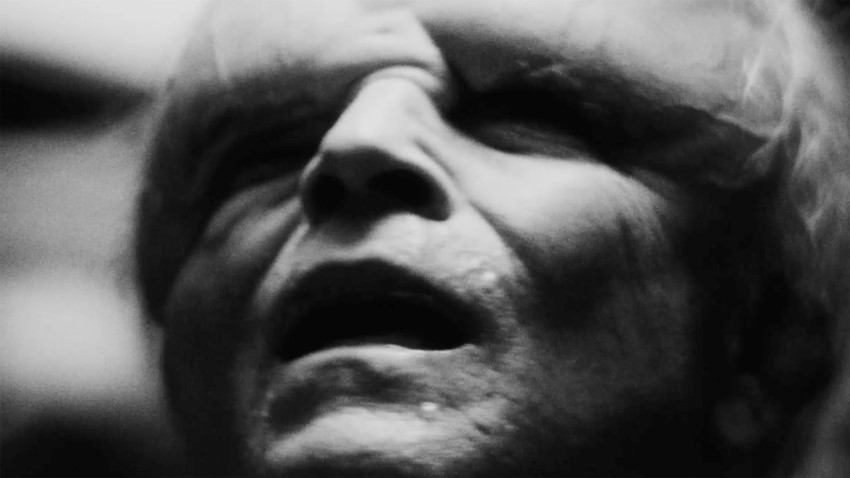
JF: It was really tough to figure that all out. It was a process of showing Eddie our ideas and working on them more. We did have some nice visuals in that scene, close-up shots of the veins and his arm with IV fluids going in. At that point, we could really show the transformation.
For the fluid shooting through a tube, I recorded an old Halloween mask that pumps blood through the mask. That actually makes a really good pumping sound. It has this cool, crazy sound of fluid squirting through the tube. We added crazy, gory, bone-stretching, and crunching sounds. Those shots happened really quickly and then it would jump back to him talking.
The visuals of the transformation were mostly hard cuts that showed his arm, and with sound, we really made it feel like something is happening inside of him. You don’t necessarily see his body bulging or anything like that. But with the hard cuts and with that sound, you feel it. You feel that he’s growing.
[tweet_box]SUNDANCE 2023: Behind Divinity’s Organic-Based Sci-Fi Sound – with Mark Mangini and Jacob Flack[/tweet_box]
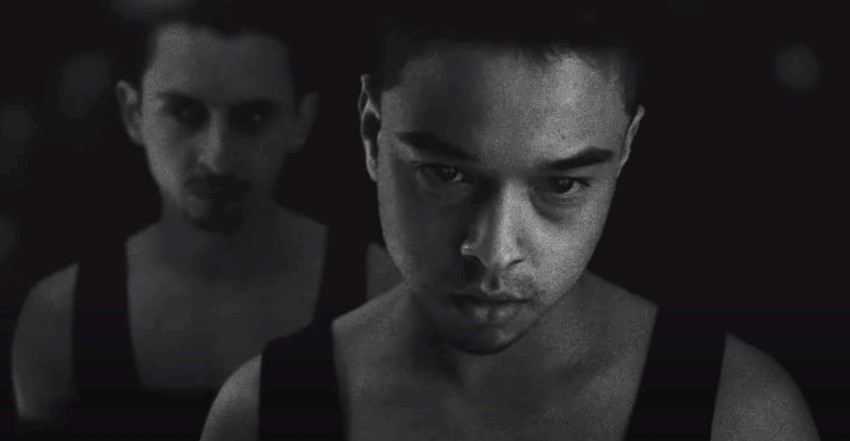
The NEXT category at Sundance is all about showcasing “innovative films that are able to transcend the confines of an independent budget.” How were you able to use sound to help the filmmakers achieve that on this film?
JF: A lot of these things weren’t represented visually, which would probably take a lot of time and certainly cost more, especially for the transformation. I imagine that would be very tough to do, so we had to sell these ideas with sound. For instance, going back to the brothers’ telepathy, we created this static-ey, clicky sound. I did record this little static lighter/little taser thing, which was one layer of it. Ultimately though, the main element was the sound of these magnets, that when slowed down and pitched down, made a very cool, organic clicky sound, a purry chitter-chatter sound.
the main element was the sound of these magnets, that…made a very cool, organic…purry chitter-chatter sound.
MM: They were Hematite magnets. That’s a perfect example of using a real sound for a sci-fi element. Those magnets were recorded with a regular microphone in a regular acoustic space. Having a little bit of the acoustic space embedded in the recordings tells the brain to interpret it as real. It feels real because you’re hearing the acoustic clues that are a function of an actual acoustic recording. But electronic sounds, whether it’s produced by a synthesizer or a tone generator, have none of those tells, and the brain has to do some extra work to accept it as reality. So these acoustic recordings are a shorthand for the brain to accept these new sounds you’ve never heard before as real and that allows you to focus on the narrative without having to think about it too much.
Having a little bit of the acoustic space embedded in the recordings tells the brain to interpret it as real.
All films have a mountain to climb, which is the suspension of disbelief. We inherently know going into a movie theater that movies are artifice. The more we can do to present something that gets us over the artifice, that overcomes the disbelief so that we believe what we’re hearing, the easier it is for the filmmaker to move forward with the narrative and tell their story.
JF: You can provide so much information with sound, without having to show everything visually. And we were working closely with Eddie, which a lot of times as a sound editor, you don’t get to do. But there’s so much in this film that needed to be confirmed and approved, so we were sharing sounds with Eddie before we got to the mix. That really helped the budget as well, because we weren’t dumping a bunch of new material on him during the mix (material that he hasn’t heard yet), which would have taken up mixing days. That’s where a lot of your budget for sound gets eaten away.
You can provide so much information with sound, without having to show everything visually.
MM: I’ve always felt a kinship with young filmmakers who have something to say. One of the first films I did – Sex, Lies, and Videotape – was for Sundance. Steven Soderbergh was an early friend of mine, and I just wanted to help Eddie bring a film to Sundance that sounds better than they normally do. And I had a unique ability to do that, not only through my willingness to find budget solutions but because I wanted to be a part of this project.
I think that’s part of my responsibility as a filmmaker, to help people out and get them off the ground. Sometimes if we (the sound team, or cinematographer, or costume designer) all make a big contribution that lifts the boat; the boat rises with the height of the water. And that gives a good filmmaker like Eddie an opportunity to go further on the next film. So it’s a responsibility. People still care. We’re not all cynical although it’s easy to be that way.
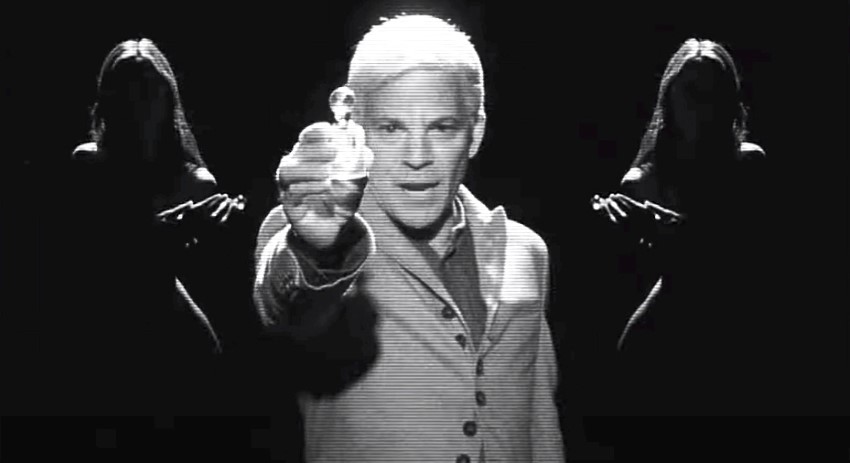
What have you learned while working on this film that has helped you to grow your craft – as a sound artist and sonic storyteller?
JF: Getting the chance to collaborate with Mark and hearing his insights into storytelling was just immeasurable and a dream come true! What I really learned from him was to be very purposeful with your sounds. It’s not always about ‘let’s make this badass and cool,’ but rather, ‘why make it this sound? What is this sound trying to tell you? Can this sound evolve over time?’
…it’s about being very selective about the sounds and understanding why it’s in there.
For instance, for the creature, we can start with a normal voice and then slowly introduce a few creature sounds and then evolve that to arc with the story of the film. That helped me to really get into storytelling more. Mark has a very keen sense of storytelling. I would do an edit and show Mark, and he would have all these different notes and ideas, like, ‘what if we play this sound or this motif and then that could give this feeling?’ It was using sound in a way that’s purposeful, and simpler too. It’s not necessarily all about loading it up; it’s about being very selective about the sounds and understanding why it’s in there.
Another thing I really learned was to make choices as the sound editor in the edit. Sound editors will give several options to the mixer, who then figures it out during the mix. But on a tight budget like this film, as the editor, you need to make good choices, so you’re not overloading the mixer with all these options. Decisions are made during the editorial process so when it gets to the mix stage, everything goes much smoother.
So, I learned to be very purposeful, to pick good, tasteful sounds, and to take a less complex approach. Making those choices during the edit makes it a smoother process on the mix stage.
…the more I challenge filmmakers to use sound as a storytelling tool, the more they respond to that.
MM: I’ve learned that as my success has grown I’ve become more comfortable with pushing the boundaries of sound. I loved that Eddie wanted sound to be as important as the look and the feel of his movie, and I’m discovering that the more I challenge filmmakers to use sound as a storytelling tool, the more they respond to that. I’m being encouraged more and more lately to explore that.
Sometimes sound can be an effective and efficient storytelling tool that liberates a movie from the ways we filmmakers conventionally make films. And the more I spread that gospel, the braver I get and the more I get positive responses. There’s a sort of reinforcement loop going on that I feel really good about.
A big thanks to Mark Mangini and Jacob Flack for giving us a behind-the-scenes look at the sound of Divinity and to Jennifer Walden for the interview!