




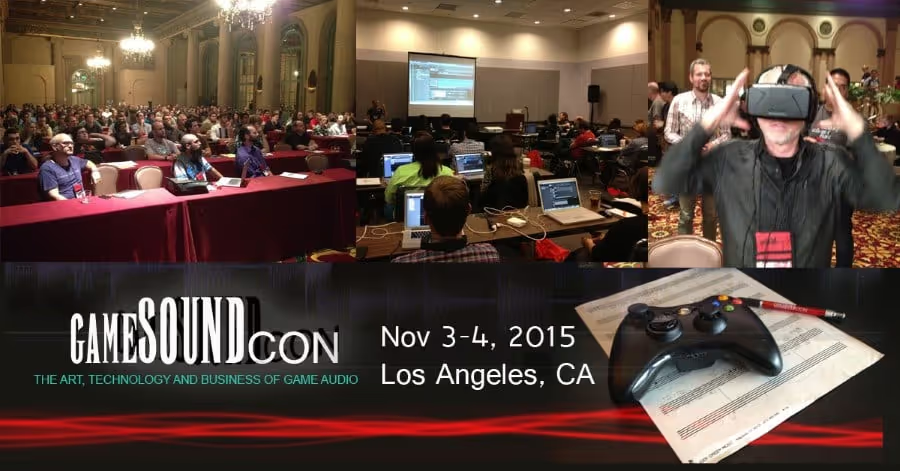
Hi Brian, please introduce yourself and GameSoundCon:
Thank you for the opportunity to talk with you! I’m Brian Schmidt, founder and Executive Director of GameSoundCon. I started in game audio in 1987, and have alternately been a freelancer and full employee working the whole time in game music and sound design. I’m just now finishing up the score for “Game of Thrones” pinball (the actual, physical pinball, not a simulator! :).
GameSoundCon is a conference dedicated to sharing knowledge about composing music for games and video game sound design. We have a combination of masterclasses, panel sessions as well as some hands-on training in game audio development tools and sessions for everyone from the rank rookie to the seasoned veteran.
Who is GameSoundCon aimed at?
GameSoundCon is for composers, sound designers and other audio professionals who work on games or would like to.
We have three main groups who come to GameSoundCon. The first is composers, sound designers, recording engineers, etc who mostly work in other media—most typically Film, TV, etc.—but haven’t had much or any experience in games and would like to know the lay of the land.
The second group is the seasoned game audio professionals. They know the business, having worked on anything from casual, mobile games to AAA blockbusters and want to keep their finger on the pulse of the industry.
We have a separate ‘session track’ for each: In Game Audio Essentials, we cover the nuts and bolts of game audio, from technical to creative to business. Think of it as a Game Audio 101 Cram Course in two days. The second track is Game Audio Pro. That’s where we have sessions about more advanced topics in game audio. Physical modelling, advanced interactive compositional techniques, the state of audio for Virtual Reality and so on
The final group attends our hands-on training sessions in FMOD or Wwise. This group generally is pretty well versed in game audio, but want to go through the sessions (presented by the people who create the tools) to quickly get up to speed on the latest in game audio design tools.
I’ve had some multi-decade veterans attend some of the “Essentials” sessions and say “wow, I didn’t know that”
People are free to go between all the different tracks, and I’ve had some multi-decade veterans attend some of the “Essentials” sessions and say “wow, I didn’t know that” or go to one or two specific hands-on sessions.
What’s the most fun is seeing all the groups get together and feed off each other. We host a big mixer/networking event after the first day, and the conversations during that are amazing.
How did GameSoundCon get started in the first place, and what have been some of the major milestones for the conference since then?
I started GameSoundCon in 2009, back when it was only the “Essentials” track; sort of a “Game Audio 101” masterclass. I started it because during my 10 years at Microsoft, I saw a lot of game titles being developed, and I also saw a lot of composers and sound designers coming from more traditional media doing their first games. And I started to see a pattern. While all extremely talented, they were all stumbling over the same issues; issues that have no counterpart in Film, TV or commercial music. Things like composing for interactivity, dealing with technical issues like streaming, memory limitations, compression, or not understanding how very fundamentally different games are from traditional media.
While all extremely talented, they were all stumbling over the same issues; issues that have no counterpart in Film, TV or commercial music
That’s what made me think a conference, where we teach everyone those very unique technical, creative and even business challenges of composing music for video games or doing video game sound design would be beneficial. So when someone new to the industry did their first game, they wouldn’t be blindsided by terms like “Ogg vorbis,” “perforce” or “vertical vs horizontal” interactive music.
A big milestone for us was 2013, where we expanded the format to include the “Game Audio Pro” track and adding the hands-on training. That meant more than quadrupling the space (the original GameSoundCon was a single room; this year we have 7 reserved at the venue) and reaching out to people experienced in games.
What sort of planning and preparation goes into organizing the conference? It must take a lot of effort to get all the panels, sessions and masterclasses in place?
It’s a lot of work, but it’s also a lot of fun. When I was program manager for audio at Xbox, I gave a LOT of talks and presentations (I think I counted around 150 or so), so I had a really good idea on how I wanted to organize the content in the early days. This year I had a record number of talk submissions, and it was really hard to choose. I try to round it out among specific topics I know I want to cover (business, technical, creative essentials), but then see where the submissions take me. I do try to balance the sessions out, so that we cover some production issues, some sound design issues, some music issues, a bit of VO, etc. Game Audio is very broad and even with 2 main tracks; it’s hard to cover everything.
For the hands-on FMOD and Wwise sessions, I generally let the people at FMOD and WWise figure out what they want to present; they are top notch and they pretty much take care of everything.
Aside from the sessions, what else does GameSoundCon have?
As mentioned, one of the highlights of GameSoundCon is our networking mixer. It’s a chance for attendees to unwind, talk and meet each other as well as our speakers and panelists. We also have a variety of companies demonstrating game audio technologies or other tools and products. The mixer immediately follows the keynote, so the room is fresh from being inspired. There’s something about bringing 250 composers and sound designers together in a room for two days and geeking out over game music and sound design.
Does this year’s conference have a specific theme?
Audio for VR’s going to be given some extra highlights. That is an area—like much in game audio—where the road ahead is largely unpaved. I also have a couple deliberate talks on making virtual orchestra sound real. Although a lot of game music is scored with live musicians, the bulk of game music is created by the composer alone with their DAW. Laura Karpman is giving a talk on how to best compose and sequence to make virtual instruments come to life, and the incredibly prolific film and game music mixer, John Rodd follows Laura’s talk with expert advice on mixing and mastering a virtual session.
And what are some of the highlights?
I’m thrilled to have Chance Thomas provide our keynote this year. Chance has been a leader in the game audio community for well over a decade—he was responsible for putting together a committee which successfully lobbied NARAS to make video game music eligible for a GRAMMY award. His work on games like Lord of the Rings and DOTA 2 are incredible, his passion for the industry shows in everything he does.
It always awe-inspiring to hear what literally a century’s (or more) worth of experience has on their collective minds
Chance is also the author of the forthcoming textbook, “Composing for Games” soon to be published by Focal Press.
I always love the roundtables. For the past several years, we have ended the conference bringing everyone together for the final 2 sessions: the Composer’s roundtable and the Audio Director’s roundtable. It always awe-inspiring to hear what literally a century’s (or more) worth of experience has on their collective minds..
When you look at the conference lineup this year – and game audio in general – what trends are you noticing?
As I mentioned, AR/VR will definitely be on peoples’ minds. Between simulated 3D sound, virtual music, there is such an open palette of possibilities. And frankly, that’s one of the best things about game audio. Although we are getting mature as an industry, there is so much yet out there that is uncharted.
It’s also clear that the casual/mobile industry isn’t going away anytime soon. According to a recent article in Gamasutra, last year the app store was seeing 500 new games per day. While that’s not the greatest news for developers trying to stand out, it’s actually pretty good news for composers, since a goodly portion of those games hires composers and sound designers.

What has been one of your proudest moments with GameSoundCon?
I’ve felt proudest by the incredible support I’ve had for GameSoundCon from my friends and colleagues in the game audio community: the speakers, panelists have all been incredibly supportive and giving. Almost without exception the people in the game audio community love to give back, love to share their knowledge, passion and expertise in game music and sound design. It’s a community that doesn’t quite exist in other areas of game development.
I also love it when I run into someone who attended a GameSoundCon some years before and discover that they’re working at EA, or Sledgehammer, or have written some incredible game score, or speaking at GameSoundCon! It’s a great feeling.
For people who will be attending the conference for the first time this year, how do you recommend they prepare, and what do you think will surprise them the most?
Just arrive with an open mind and be well rested! We dish out a lot of content in just 2 days, and it can be a bit overwhelming. You will want to look at the agenda ahead of time so you can map out which sessions you want most to attend.
For those new to the industry, people almost always say they are stunned at how much information the presenters share
If you are going to partake in “speed mentoring” (6 minutes with selected GameSoundCon speakers and game audio professionals) you might want to bring a demo of your best stuff for critique (but we do limit demos to 60 seconds, please).
For those new to the industry, people almost always say they are stunned at how much information the presenters share. That how, in such a competitive environment, they are willing to share what they know and talk about what it is they do and give details on how they do it. I like to joke that there are so few people who understand what it is that we do, that once we find people willing to listen, we can’t shut up about it!
You still have early-bird tickets available – where can people find these?
Earlybird tickets, as well as a listing of our speakers and sessions are online at www.GameSoundCon.com (Register by Oct 2 to get the earlybird discount!)
Last year, the conference completely sold out, so it was pretty exciting.