




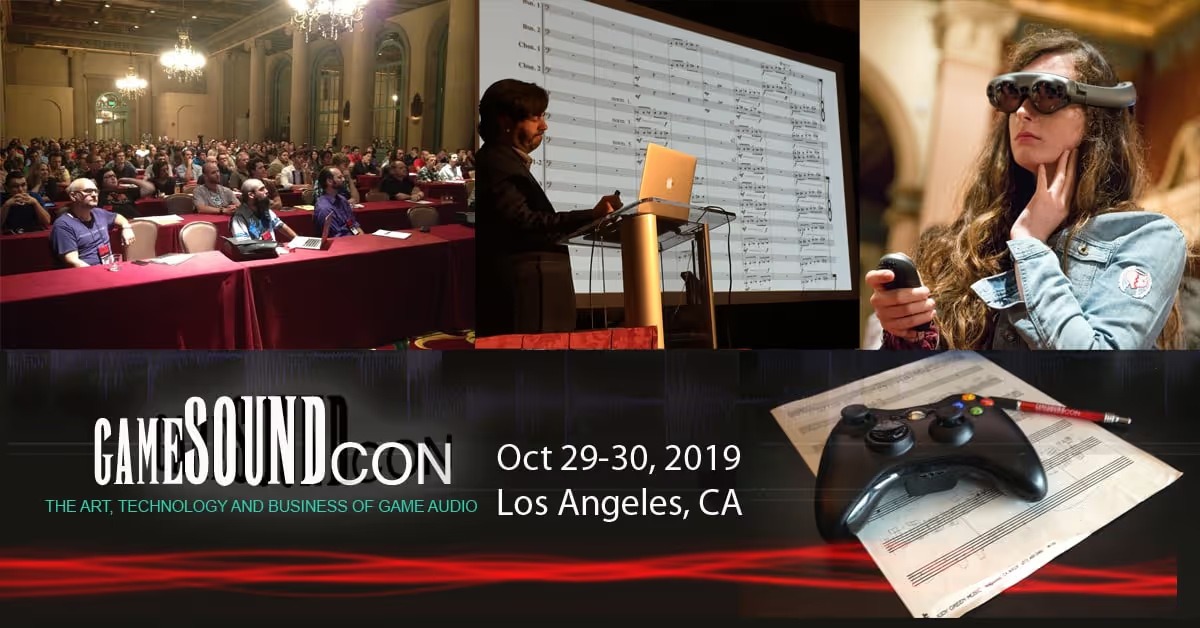
BONUS: Brian Schmidt is kindly offering one lucky A Sound Effect reader the chance to win a ticket for GameSoundCon (a $700+ value) - enter below for your chance to win!
Coming up soon is GameSoundCon in Los Angeles, CA, from October 29-30. This professional game audio conference welcomes both industry newcomers and established professionals. There are over 70 panels and sessions, covering everything from crash courses on game sound integration using Wwise, to academic discussions, like how sound can create an emotional connection between a player and a character in VR, to future-oriented talks on topics like the changes in game design and player interaction.
This is GameSoundCon’s 11th year, and the conference continues to steadily grow, drawing speakers and attendees alike. It’s not a trade show, but rather an educational and inspirational meeting of the minds. It’s an opportunity to explore the art and business of game audio, both from practical and academic perspectives.
Here, Brian Schmidt, founder and executive director of GameSoundCon, looks at how the conference has grown and the direction it’s headed in. He talks about the benefits of attending GameSoundCon and how to make the most of your time there, from effectively scheduling sessions to tips on networking.
How has this conference grown over the years? What do you hope this conference will offer the game sound community 10 years from now?
Brian Schmidt (BS): The first GameSoundCon was at the Century Hyatt in Los Angeles. There were 45 attendees and 14 speakers; we barely filled the small hotel conference room. I was looking back at last year and we had 399 attendees and 117 speakers, and have just about outgrown the Biltmore Hotel. So it’s been fun to see it grow. We started out with just one room, and GameSoundCon was just a Game Audio 101 crash course. Last year we had six rooms running in parallel pretty much the whole time.
One thing I’ve been trying to do with GameSoundCon is to bring disparate groups of people together. The focus is game sound, so if you’re a composer or sound designer you can come and share the things you’ve done. People in game sound love talking about what we do and sharing amongst each other and helping the next generation coming up. But there has been a little bit of a disconnect. There are other communities that are related to what we do, related to the people who actually do the games. There are academic or industry researchers, or programmers or DSP-wizard mathematicians working on how to generate sounds purely algorithmically or using machine learning techniques to improve interactivity in music or something like that. So I want to get the people who are doing those kinds of tech, who might be useful in games. Maybe their work isn’t ready for application in creating game sound now (maybe we need another order of magnitude processor or something like that) but I’d like to get them into the same room and talking with the people who write the music for games or create the sound for games.
I’d like GameSoundCon to be this mix of people who are studying technologies or doing research —taking an academic pursuit of game audio — and people who are making the game audio and making the products. It would be great to have these different groups geeking-out on game audio for a few days.
Similarly, there’s a very fascinating academic field which studies videogame music, called ‘ludomusicology.’ They do this formal, music theory-type approach to studying game music, almost like somebody would study Mozart’s scores. They apply these techniques to game music. It would be fun to get those people together with the people who are writing music for games.
10 years from now, I’d like GameSoundCon to be this mix of people who are studying technologies or doing research —taking an academic pursuit of game audio — and people who are making the game audio and making the products. It would be great to have these different groups geeking-out on game audio for a few days.
It’s not easy to get away from work and family to attend a conference. Why should people in the game sound industry make GameSoundCon a priority?
BS: I hold the conference on a Tuesday and Wednesday, so it’s a professional conference — a work conference. It’s a work event and not something that I hold over the weekend as a casual thing.
The game industry is very different from film. I’ve never worked in film; I’ve only done games. But one thing I hear from film people is that you should be networking with directors — that there isn’t a lot of value in getting to know other composers or hanging out with them because the directors are the ones who hire film composers.
In games, it’s different. A lot of the hiring — especially at the high-end on professionally produced games — is done by people who themselves are former or current composers. So it’s very important to network within the game industry. Get to know fellow composers and fellow sound designers because maybe the freelance composer that you’re chatting with today might become the Audio Director at Blizzard two years from now. Or maybe they’ve gone on to be the music supervisor at EA.
At GameSoundCon, you’re surrounded by composers and sound designers and technologists and dialogue specialists. And they remind you of why you love doing game sound.
I view GameSoundCon as an opportunity to not only learn and to keep your thumb on the pulse of the industry (which is always changing very, very fast and you want to know what is going on) but to network and to be part of the broader community. Maybe two years from now the person that you were talking to at GameSoundCon will be an Audio Director at Ubisoft or Microsoft. So, you already have a connection and they are familiar with your work and know who you are. So as a professional networking event, I feel it is very important.
It’s also an excellent opportunity to keep up on what’s happening in this rapidly changing industry. What are other people doing out there? This conference can be a source of inspiration. It can inspire you to do better or try something new. Those of us who work in games can get ground-down. There are deadlines and bug fixes and standup meetings. Those can grind you down a little bit. At GameSoundCon, you’re surrounded by composers and sound designers and technologists and dialogue specialists. And they remind you of why you love doing game sound. It certainly re-energizes me and I’ve heard people who have said the same.
You talked about networking, which is important. A Sound Effect is currently running a series on ‘How to Survive a Layoff in the Game Audio Industry’ and networking has been a consistent recommendation. For people who attend GameSoundCon, how can they use their time there to build their network? Do you have any tips for approaching peers about work, or approaching potential employers? What should they say? What should they probably NOT say??
BS: One thing I’ve seen and that people have said to me is that it can be challenging to approach people. It’s strange, as game composers and sound designers, we have this dual thing going on. In one sense, composing and creating is this solitary endeavor; you’re there with your keyboard and DAW. A lot of us tend to be shy and a bit awkward in social situations. Ironically, at the same time, a lot of us grow up performing on stage in rock bands or orchestral ensembles or barbershop quartets or something. So we feel more comfortable presenting formally in public (I think that’s why the game audio industry has people who are very good public speakers). But how do you walk up to someone and start a conversation? How do you not be a wallflower? It’s tough.
My advice is to approach networking as a long-play game… The best encounters for your career are conversations where you connect with the other person.
My advice is to approach networking as a long-play game. The idea is to get to know people in the industry. Don’t be a wallflower. Don’t be afraid to enter conversations respectfully. Of course, no one wants someone to just butt in. But keep in mind that networking is a long-play game. It’s much better to leave an event like GameSoundCon or Game Developers Conference with a small handful of really good conversations than to have just passed out 60 business cards. It’s less productive to have those speed-dating types of conversations. The best encounters for your career are conversations where you connect with the other person. Maybe you end up talking about flyfishing because you both love flyfishing. That’s good. You want to establish a meaningful connection with people. Ask people about themselves! Don’t say, “Hey, I’m a great composer. Why don’t you hire me?” You want to find out about them as people.
I think there’s the misconception that networking is about getting your name in front of as many people as possible as quickly as possible. From my experience and from the networking tips you see from people who do that for a living, most of them will say the same thing — the speed dating approach doesn’t work. You’re most forgettable if you do that.
I remember a conversation at GameSoundCon a few years ago between two people who had never met and they had a discussion about how difficult the piano part was for the Hindemith Tuba Sonata. They both shared war stories. This was someone who was brand-new into the industry speaking with someone who had composed one of the most instantly recognizable game scores in the last 20 years. So it’s that kind of thing that can really be interesting.
And we’re all music, sound, and tech nerds. So there are some interesting shared topics to talk about. There’s some common ground.
It’s not uncommon for me to get a call from somebody or get a referral from somebody who I’ve worked with 20 years ago. There’s trust. You have to establish trust with people. A couple years ago, I was so overbooked and there was no way that I could take a new job. So I referred another composer and it occurred to me that I only knew this person through events like GDC and GameSoundCon. I had never actually literally worked on a project with him. But, if you are referring someone else to a client then you want to make sure that you are super confident that they would do a great job because if they don’t then it reflects badly on you. Over the course of years, I had gotten to know this person well enough that I trusted them professionally. There are so many people who are great content people but when you are hiring somebody or referring somebody you want to know that not only are they good at what they do but that they are professional and responsible. You have to trust that they will deliver what they said they will when they said they will. That’s a difficult kind of trust to gain with quick, fly-by networking. That kind of trust only comes from getting to know people, getting a feel for who they are as people — not, was their demo reel really good?


What about the ‘Speed Mentoring’ that is available to attendees of GameSoundCon? There’s this opportunity to sit down one-on-one with game sound professionals and present your demo reel. What should people expect? How can they prepare themselves/their demos to make the most of this?
BS: A great thing is to simply come prepared with questions. We found that the mentoring sessions at GameSoundCon have this cool, informal vibe to them. There is a 60-second limit on a demo reel and the reason we do that is practicality. We don’t have time to have people listen to 22-minute compositions or what not.
…you want to come armed with specific questions you might have about the industry.
It’s really fun seeing the sessions because they tend to evolve semi-organically. We have them at round tables and typically they’ll start as one-on-one but because so many people tend to have similar questions they evolve into facilitative group discussions but on a more intimate basis. So we try to maximize everybody’s time by having the mentor listen to the demo and make some positive critiques. But really, you want to come armed with specific questions you might have about the industry. What sorts of things you need to work on, or things that have mystified you, like should you work for free on an indie game? Or how long should a good demo reel be? Or what type of social media presence should I have? Those sorts of things.
• Just published: The 2019 edition of the Game Audio Industry Survey – tracking compensation, working conditions, contact terms and production information for the video game music and sound industry.
• How to prepare for – and power through – a layoff in the game audio industry
This conference offers many different sessions, and multiple different tracks that attendees can follow — from sound design to music to VR to tech research. There’s a lot being offered. For people who are planning out their conference schedule, what are some tips to help them make the most of their time there?
BS: We do try to schedule the conference so that if you are a composer you’re not having to pick between conflicting music related sessions. Or, if you are primarily a sound designer, you’re not missing out on a session because it conflicts with another happening at the same time.
You definitely want to plan out your schedule ahead of time. We have a new conference app this year that we are trying out for the first time. As the sessions are going up online, we’re trying to tag them with #sounddesign, #dialogue, #music, or #tech tags. So you want to work your way through them.
I am a big proponent of people stepping into fields or sessions that aren’t their main thing.
With that said, I am a big proponent of people stepping into fields or sessions that aren’t their main thing. If you’re a VR specialist, for instance, it might be good to look at some of the other talks that are there.
This year we are planning on video recording most of the sessions so if you don’t make something in person you can catch it online afterwards. With so many concurrent rooms, we don’t want to make people feel like they have to choose. These videos will be available to the attendees of the conference. We may make some of them publicly available but for the most part it’s for attendees, as a way to time-shift the conference for people who attend.
What are you really excited for at this year’s conference? Any particular speakers that you can’t wait to hear? Or any particular sessions that you find compelling?
BS: There are so many speakers I’m looking forward to this year. Composer Wilbert Roget is our keynote speaker this year and I am super looking forward to his speech. He’s just finished Mortal Kombat 11 which is a game that a really good friend of mine created 25 years ago. So, there’s the notion of how do you work on a property that has been around for a long time. And Will has had such an interesting career. So I’m definitely looking forward to that.
There are panel sessions on the use of songs in the industry. There are sessions on physical modeling from a sound design perspective. There are talks on the dialogue pipeline, which is something that is near and dear to me especially now because I’ve been working on some sports games. So there’s announcer dialogue and the challenge of managing tens of thousands of lines of dialogue. It’s tough to just pick a few sessions.
…we’re having a couple roundtable discussions on issues of harassment and diversity in gaming. We are really trying to focus on all of the things that are affecting our industry, not just how to approach sound design if you’re a composer and that sort of thing.
Any other thoughts you’d like to share on GameSoundCon?
BS: We worked very hard to keep GameSoundCon very professional. The vibe is informal and relaxed but at the same time it’s pretty intense. We cram a lot of sessions in.
Another thing we’re doing is having a couple roundtable discussions on issues of harassment and diversity in gaming. We are really trying to focus on all of the things that are affecting our industry, not just how to approach sound design if you’re a composer and that sort of thing.