


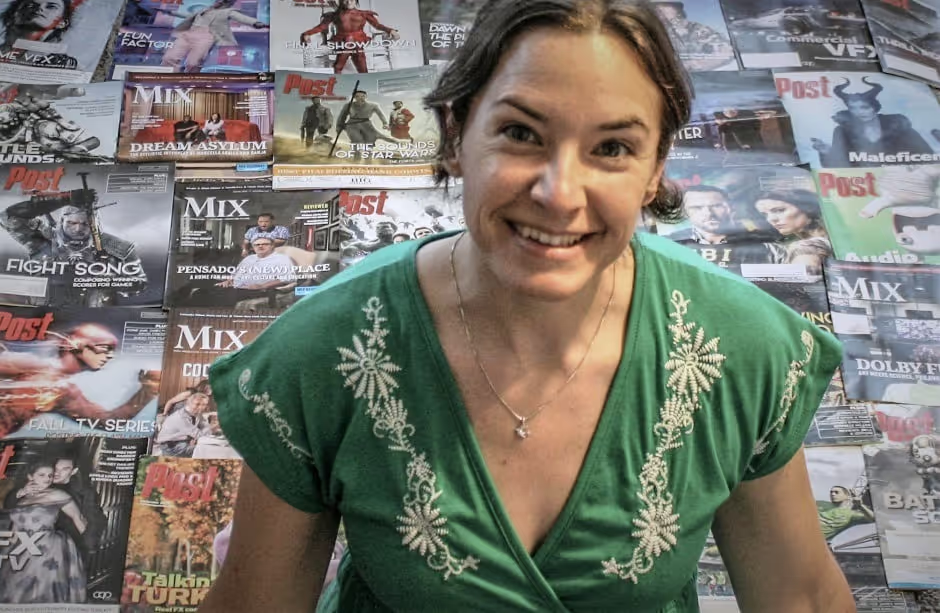
Hi Jennifer, how did you get started writing about sound – and who are you currently writing for?
I started writing product reviews for Post Magazine back when I was a sound designer/mixer at the now defunct Ultra-Sound, a boutique audio post house (formerly part of The Napoleon Group) in Manhattan. Ultra-Sound’s senior mixer Ron DiCesare, who was writing for the magazine at the time, offered me the opportunity to review Sound Ideas Ultimate SFX library. So I was introduced to Post Magazine’s editor-in-chief, who at that time was Randi Altman.
It was this perfect golden opportunity, a real stroke of luck.
I did a few reviews for her before I eventually left the studio to raise my daughter. Ron asked if I’d like to take over for him in writing the monthly audio features for Post. I jumped at the chance. I love writing and I love post sound and Randi is just awesome to work with. It was this perfect golden opportunity, a real stroke of luck.
After a couple years of writing for Randi at Post Magazine, she decided to start her own post production news/info site, postPerspective.com. I continued writing for Post Magazine, but I also started writing for her site too. Randi is an extremely talented writer and editor, and she’s passionate about the post industry. She participates in trade shows on a global level, consumes copious amounts of entertainment and industry related content, and she’s a mom, too! She’s amazing. My goal is to be involved with whatever she has going on, even if that meant writing on a volunteer basis.
Last year, I got involved with Sound & Picture. They’re interesting because they really like stories to focus on collaboration from a creative standpoint. The tools and tech are secondary in the story.
Another perfect golden opportunity came in March last year, in the form of an email from Thomas Kenny, the senior editor of MIX Magazine. I’ve always been an enormous fan of MIX Magazine, from way back in my student days. So when Tom offered the opportunity to cover a story on the SFX library industry, I grabbed it with both hands. I’ve been so fortunate to have done six stories for MIX now, and I hope to get the opportunity to do many more!
What’s a good sound story to you, and how do you decide what to write about?
The creative process is part inspiration, part experimentation, and part serendipity. When you’re creating sound design, or music, or crafting a detailed mix, or even when you’re out recording in the field, it’s never the same experience twice.
A good sound story comes from the willingness of the sound’s creator to share the nitty-gritty details of his/her experience
Every project is unique. Every project has its own challenges. A good sound story comes from the willingness of the sound’s creator to share the nitty-gritty details of his/her experience. Nothing springs from the mind fully formed. No one is Zeus. So let’s talk about the creative path you traveled to get to this amazing end point, wrong turns and all. That’s what makes a good story in my mind.
I’m lucky in that I get to choose, for the most part, what I cover. I’m always listening and reading. I’m curious by nature. Sometimes one project will lead to another, or one story will lead to another. Also, people bring ideas to me, which is great, because if someone is excited to talk about their work then I’m eager to listen. Enthusiasm is contagious. I love movies, especially animated films or sci-fi films, because the sound gets to play in a space of alternate reality. That’s so fun! Games have that freedom too, but I love games on another level. Game sound has this added element of problem-solving. Games are an interactive medium and so that interactivity will have an impact on the designer’s or composer’s approach to the sound. I’m always curious to find out how interactivity influenced the game’s sound.
What’s one of your favorite articles you’ve written – and what’s been one of the highlights writing about sound in general?
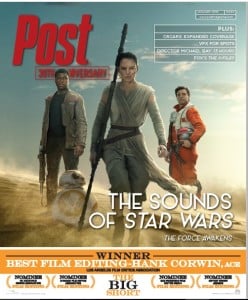 I have a framed copy of the January 2016 issue of Post Magazine over my desk. Star Wars VII: The Force Awakens! It was the cover story, and I had the most amazing interview with the uber talented Skywalker Sound team of Matt Wood, David Acord, and Chris Scarabosio. It was a total geek-out project for me.
One highlight of writing about sound it that, with sound, what you think you’re hearing isn’t necessarily what you are actually hearing. Like Kylo Ren’s force sound has cat purring in it! You’re not hearing a 300 lb. bear growling in The Revenant, you’re hearing Randy Thom!
Sound designers, Foley artists, and re-recording mixers are great illusionists. They make you believe that what’s on screen is actually making that sound.
Sound designers, Foley artists, and re-recording mixers are great illusionists. They make you believe that what’s on screen is actually making that sound. And it’s not! I love asking them, ‘what elements did you use to make this sound?’ The answers are always interesting.
How do you use your pro audio experience when writing sound articles?
It helps me write better questions I think, because I can imagine a project in the beginning stages with little or no sound. I can think about scenes or concepts that a producer or director might be focusing on from a sound standpoint. For instance, The Last Witch Hunter, the witch queen has this power of immortality, so how would you express that in sound? There is this dream world and the real world, do you treat them different sonically? I was able to pick supervising sound editor Peter Brown’s brain by putting myself in his shoes, in a sense. Of course, all of these amazing post sound people are doing projects on a much grander scale than I did at that little boutique post place, but I can still talk shop a bit and that helps the conversation flow.
How’s the media landscape changing when it comes to writing about sound? And do you see a way to get the sound stories out to more people / a broader audience?
That’s a great question. I’m on a computer all day and I get sick of it. So, I like physical magazines and books. Analog media I can get my hands on. BUT, with digital magazines and websites, you can reach more people faster and cheaper. I know Sound & Picture has gone to an all digital format and they’re very happy about it. Randi’s postPerspective.com, which is also strictly digital, reaches more readers than rival print magazines. From a writing standpoint, there are a lot of options, a lot more outlets to run a story. It’s not just a handful of print publications; you have blogs, and news sites, and online sound communities. You can pick the best outlet for the story instead of tailoring the story to the publication. That is, at least, if you can get the publication to run it.


On getting the sound story out to more people – Randi got me into Twitter about a year ago and that has been an amazing social outlet on which to share stories. Also, LinkedIn is nice because you can send specific stories to specific Groups, so a sound design story I wouldn’t post in a music-related group. For a game sound story I can post that in a game sound group and it fits better there than in a general post production group. It sounds simple but you should try to find the right audience. Facebook is also becoming more useful. There are supportive sound groups and communities. Sound designers are on there sharing sounds they recorded, or talking about project they’re working on. They’re friendly and helpful, and so I’ll share a story if I feel they might be interested. For example, there’s been a lot of talk about mics and field recorders and I’m writing a story for Post Magazine about field recording for sound design. Since the story fits with what they’re talking about, I would definitely post it to the group. Or if I feel the story would start a conversation, I’ll post it.
At the end of the day, it’s all about helping people get their stories out there to the sound community, because creativity is a feedback loop.
Those three social media sites are all different and you have to present the stories differently on each one: LinkedIn is more professional, Facebook is more laidback and casual, and Twitter is like poetry – the best words in the best order. You have to be concise, and always always always have a picture with your tweet! At the end of the day, it’s all about helping people get their stories out there to the sound community, because creativity is a feedback loop. We can all learn from, or be inspired by, someone else’s experience.
What trends are you noticing in the world of sound design and audio post – and what excites you the most right now?
With Dolby Atmos, and also with game sound, I’m hearing a lot of love for mono recordings because you have the ability to play, move, and layer sounds discretely. I never thought mono sounds would be so popular.
I’ve caught VR fever just like everyone else. I had the great opportunity to write a piece for MIX Magazine’s March 2016 issue about The Martian VR Experience. Sound designer/composer Dražen Bošnjak of Q Department/Mach 1 was an absolute wealthy of knowledge on VR sound. We must have talked for over 2 hours, and it could have gone longer. I had a ton of questions about everything and he had answers to all of them, plus more! I’m finding out about the VR sound process, and the more I learn the more questions I have. It’s exciting because the workflows are still developing and changing and so everyone has their own solution.