






There’s plenty of Oscar buzz for Scorsese’s The Irishman in categories across the board, including sound editing and mixing – and in its first week, it’s been streamed more than 26 million times on Netflix.
In this exclusive A Sound Effect interview, supervising sound editor/re-recording mixer Eugene Gearty talks about crafting its subtle, elegant and detail-oriented soundscape:
Originally, I watched The Irishman on my TV with 5.1 surround sound. But then I re-watched the film on my laptop with headphones. I’m so glad I re-watched it with headphones. The subtle sound details are incredible…
Eugene Gearty (EG): I’ve had that experience too. On airplane rides, I’ll listen to my colleagues’ work over headphones and it’s like, wow, there’s really good stuff in here that I never heard before. It’s a good way to listen sometimes.
This film had an interesting release tactic — running in theaters quickly and then streaming soon after. So much time is spent perfecting the Dolby Atmos mix and I think people at home can benefit from listening to this film on headphones, as taboo as that sounds!
EG: I agree. One of the biggest struggles I have at home (and I think most people without a center speaker on their setups experience this) is that it’s really hard to understand the dialogue. With headphones, that would be a lot easier.
You and Philip Stockton (co-supervising sound editor on The Irishman) have worked with director Scorsese on numerous projects now. I’ve lost count, but it’s roughly 16?! There’s the Oscar-winning Hugo and Emmy-winning Boardwalk Empire…
EG: Yeah, I don’t remember how many it’s been now but I certainly remember the very first project I worked on with him. He was part of a trilogy of New York directors working on New York Stories, which I believe was 1988. His section was called “Life Lessons.”
From there, I did some work on The Last Temptation of Christ (1988); Skip Lievsay was the supervisor. He and I used my Synclavier to develop some very cool backgrounds. But yeah, Phil and I have been a tag team with Marty for a long time. Our first one together was Bringing Out the Dead, I believe. I was a sound designer on the film (Phil was supervising sound editor).
When did you come on board The Irishman? What were some of your initial conversations in terms of sound on this film?
EG: I read the script and was confounded that the whole world didn’t know about the book it’s based on, I Heard You Paint Houses by Charles Brandt. I googled it and found the book and read that. In 2017 the Picture editor, Thelma Schoonmaker, (another long time collaborator with Marty) had sent over some of the scenes when I was working on Mary Poppins. She needed sound design for certain scenes of the movie. We recorded all of the cars in the film in 2018. Then I came on officially for the final mix in July 2019.
It’s typical that I work this way with Thelma and Marty because they very much want to develop the sound design while they’re editing. Their post edit schedule is pretty significant, usually 12 months of picture editing before the film is turned over to sound. So often times I come on very early, working a week here or a couple days there as they need sounds for their personal screenings. Marty really likes to hear and watch his movie as he is editing it. He screens it with a good temp mix and he wants certain elements very much in place to help the story.
The film is three-and-a-half hours long, and Phil (who budgets the time for our work) had to take into consideration the running length. It’s literally two movies. So if you need a six-week post production sound schedule for a regular film, well that’s 12 weeks for this one. A four-week final mix now needs to be an eight-week final mix.
You mentioned recording the film’s cars. What did you record?
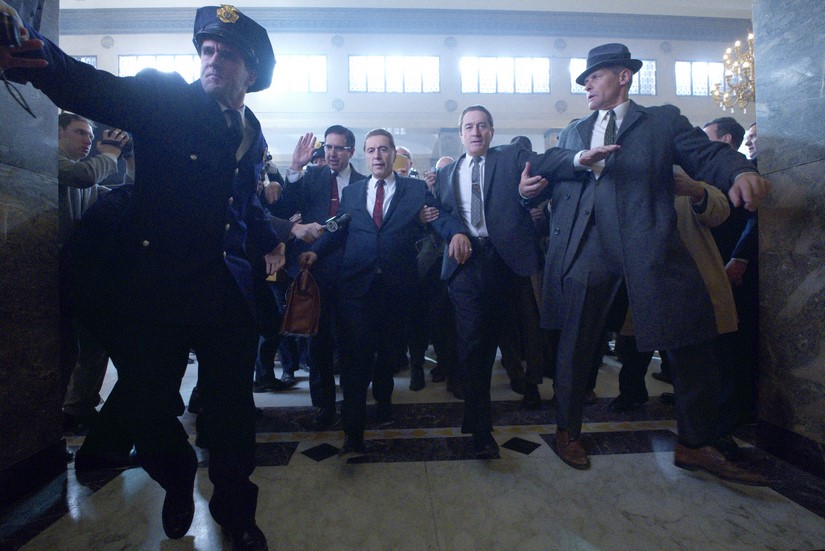
EG: Early on, I got the word that during the shoot Marty really loved the sound of the cars they were using. The film spans three decades, so we have late 40s Fords and then we’re into the 50s and 60s and 70s. The Marquis that Chuckie (Jesse Plemons) uses for the final scene, when they drive to the house where Frank (Robert De Niro) shoots Jimmy Hoffa (Al Pacino), is particularly important.
I was immediately given an incredible support team. While they were still shooting, Kelley Cribben (my post supervisor)arranged to have nine vehicles and a full crew. It was a location shoot without picture; everything was the same otherwise. There was an assistant director, craft services, medical staff, porta-potties, the whole bit. I had at my disposal a sound mixer, his boom operator, and my portable two-track digital recorder. I know what I need to get as a sound editor. While most production sound people are thinking more about getting good sound quality on tape, I’m thinking about recording sounds in a way that I can cut them together later, or getting a long take of the engine idle so I don’t have to loop it later. So, I carry my own rig.
We shot sound for 10 hours one day, back in February 2018 at Floyd Bennett Field in Brooklyn, which was extremely difficult. JFK airport is right there, so there were jets taking off. It wasn’t ideal but apparently they were lucky to get it because of permits and all that.
So we spent a full day on that shoot and those recordings were important in the movie, but not as important as it was originally thought. When Thelma and I sat down the first time we chatted about the movie, Marty had an idea that the film was going to be a road trip and so the sound of the cars was going to be really important to the story. But that never happened even though there was a lot of time spent in cars. It wasn’t what I thought we were really prepping for which was an elongated road trip where the sound of the cars was going to be supercritical. The cars sounds were important but the focus on them wasn’t what was initially talked about.
With that said, I can’t tell you how important a couple of the car engine sounds were for Marty in particular scenes. He was so intrigued and excited. For instance, the car that Frank drives up in to case the house in Detroit is a late 60s or early 70s Ford LTD. When he comes into the parking spot across the street, the LTD makes this really interesting downshift sound. The car was an automatic but when you slow down, it does this cool downshift and Marty thought it was so ghostly. It was fantastic. He was so excited about that sound. I asked him if I should try an alternative and he said, “No, no! It’s perfect. Don’t touch it!”
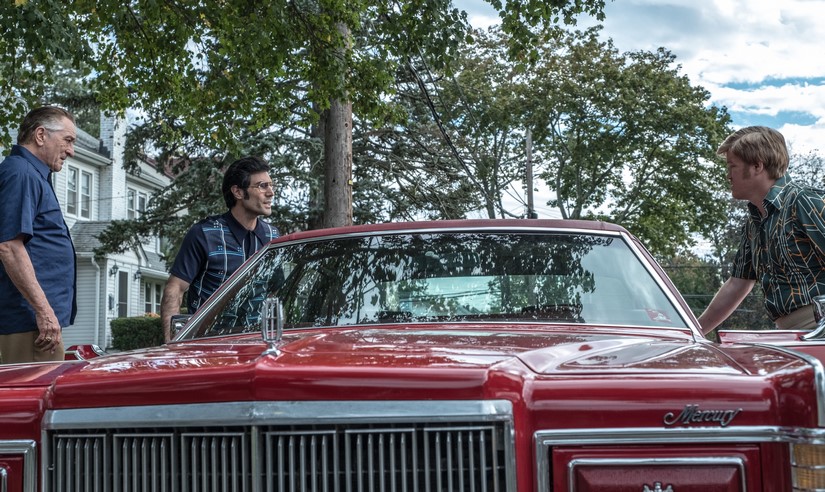
So in some very subtle ways — which you probably heard over headphones better than people watching the film on the big screen — the car sounds were very critical to the emotion of the scenes, especially the scenes where Hoffa is being driven in Chuckie’s Marquis. We were really conscious of the road bumps, the segment bumps. I worked really hard on getting all of that to be kind of ominous. Again, we are talking about subtle sounds relative to sounds in other scenes or in other movies. Upon multiple listenings, you might catch those details. But upfront, everything was subtle in this movie. It was about subtlety, ultimately.
This was new to me in a way. I’ve been doing this for a pretty long time, about 35 years. I am learning, really for the first time, how equally challenging being subtle is. When you have an obvious action or need a big sound, you can come up with that. It’s what do you do when you have absolutely nothing but have to hear something to still create some interest. You have to rely on very subtle timbres of sounds that go quite unnoticed (understandably) but at the same time have a very strong effect on the film… or not. Maybe you need a sound that doesn’t interfere with the film or doesn’t bring attention to itself and lets the emotion of the scene be that much more effective. It blew my mind to learn this at such a late stage, to see Marty and Thelma go about making their film. I was learning the whole time. It was a whole other world.
The subtle details at times are integral to the story. For example, prior to shooting Crazy Joe, Frank talks about picking the right gun for the situation. He says, “You want something with more stopping power than a .22. You definitely don’t want a silencer. You want to make a lot of noise to make the witnesses run away so they ain’t going to be looking at you. But not the noise a .45 makes, because that makes too much noise, and a patrol car can hear it a few blocks away at least.” It’s a very specific description of what the gun should sound like for that job…
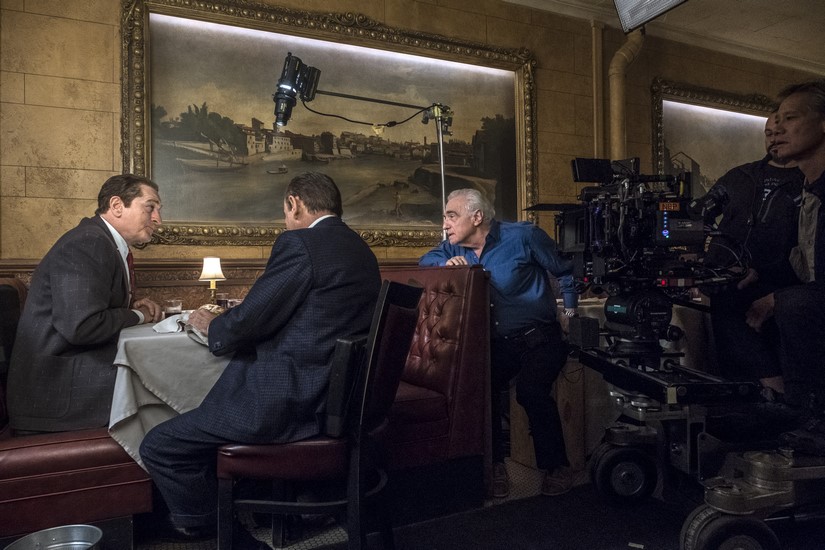
EG: That was a very detailed scene. On this particular project, Marty didn’t want a lot of Foley. He really wanted to use his production track as much as possible. In the case of that scene, it was challenging because it just wasn’t working with what they shot on set. So that particular Foley we worked on quite a bit — these little, tiny sounds of picking up and putting down guns on the bed. Marty would say, “No, that sounds too hollow” or things like that. It was very specific.
The guns in the film aren’t over-the-top sounding — they’re not John Wick-style. They’re quick and not overly brutal. There isn’t a fixation on the weapons…
EG: Absolutely. In other films Marty has done, the guns would be really massive, like Casino. He and I have worked together on the guns in his movies, and he’d want them to be canon like…big. But in this film, it’s a snub nose .38, Saturday night special. It has a very specific report.
Unfortunately, I didn’t get to record any guns for the film but I did have some decent recordings of them from prior recordings I did for other films.
But you’re right; the guns in this film get the job done. We aren’t overly dramatic with them. They weren’t overemphasized or drawn out. It was really straight up. For example, the gun that was used in the very beginning of the movie when he says, “I learned what it meant to paint houses,” and we see the blood splatter onto the wall. In fact, Thelma and I discussed that at length and it wasn’t until the very end of the mix that we found what worked perfectly.
She said, “You know Eugene, I still think we need to hear an impact.” And I said, “You think so? You don’t think that’s going to be too violent?” But we tried something there. I put in a squib (the sound it would make as though it hit the back of his head) and it absolutely helped it. It gave the sequence this da-dump sound, instead of being just a singular impact. It worked. The blood splatter is a little delayed relative to the gunshot itself. So the additional sound helped to sell the visual. It’s funny— sometimes things don’t finalize themselves until the very end. You’re listening to something for six months and it’s fine, but then you find something that works better. It’s fun when you find that.
Watch some behind-the-scenes B-roll footage from The Irishman here
One of the impactful gunshots — because the sound is so naked and it’s such an emotional scene — is when Frank shoots Hoffa. It’s very brutal in that moment (emotionally and physically on your ears), and so exposed that you can hear the slap on the gunshot…
EG: There was no production there. That was strictly sound effects in that particular case. The sound was a .38 recording I had. It was an interior recording that had a natural slap inherent to the sound but I also added a slight room slap to it, too, to give it that empty house feeling.
The scene that I remember sweetening the gun sounds (but it was a really good production recording) was when Frank shoots Crazy Joe (Sebastian Maniscalco) in Umbertos Clam House. The interior and exterior gunshots were production sounds that I sweetened. There’s a really nice effect there, too. You can hear the difference between his shots fired inside the restaurant and those fired outside on the street when Frank shoots him again. That’s one scene where I liked the mix of the production effects and my effects. It came out really nice.
Who captured the production effects? Was that something the production sound mixer captured in addition to the dialogue?
EG: Yeah, and that’s not unusual. In fact, often times the decision will be made by the director and the prop master in charge of ordinances (guns) on whether to use a quarter load, half load, or full load of gunpowder.
In a perfect world, the production sound mixer would capture the sound of that gun in that environment and it would be perfect. You wouldn’t need anything else. Unfortunately, in dealing with their own constraints they do the best they can. Often times, it is a very good sound but maybe it’s mono and I want a little spread to it so I’ll sweeten it with a stereo file. Or, I’ll add a tiny bit of slap.
But in most cases, other than the Hoffa killing, there would’ve been production gunshots that we could use and then sweetened as needed.
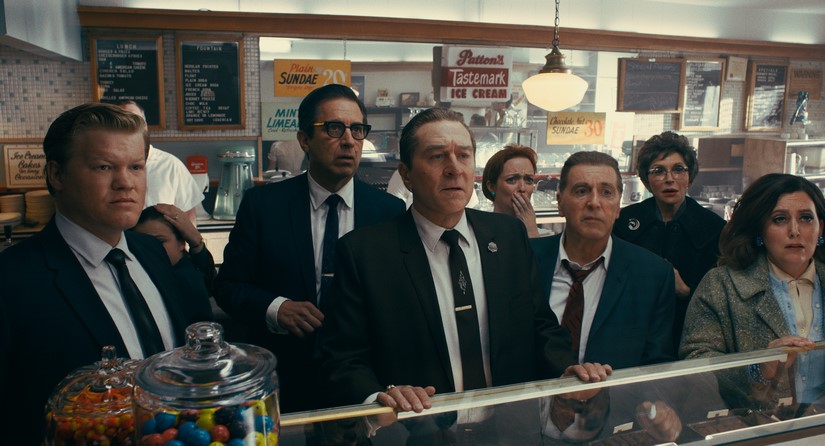
You mentioned there wasn’t a lot of Foley on the film. So it’s mainly production effects?
EG: We did Foley everything throughout the movie, but we wound up going with production as much as possible for a number of reasons. First, they really liked the sound of production and second, they didn’t want anything interfering or artificial. It was all about focus. So by not using Foley, it was like somebody whispering; you lean in closer. When Frank gets on the plane to fly to Detroit to do the deed with Hoffa, all of that was production for his footsteps. We had all the Foley in there but during the mix we stripped it all out to get to this really simple place where it’s his feet on the tarmac and the steps of the plane. We might have had one or two Foley footsteps to fill in places but really it was all production.
The Foley was very subtly detailed and selected by Marty and Thelma.
An example of using Foley (like you mentioned in the gun selection) was when Frank and Jimmy are in the hotel room and they are in their pajamas. They sit down on the bed. There were a couple of critical movements that Thelma was very interested in hearing, just a simple bedsheet, but it had to have the right feeling and texture. Nobody thinks about the cloth rustle as a sound design component, but in movies like this it’s a whole about-face. It’s a whole new way to look at sound. I find it fascinating that after all of these years the challenge wasn’t coming up with cool sounds; it was coming up with the simplest sound that was the most subtle that Marty was going to like and was going to be effective for the scene.
Certain directors are very focused on certain things. It’s hard to compare but I’ve worked with director Ang Lee, who would also have sounds in his mind and wanted THAT exact sound. He told me once on Crouching Tiger, Hidden Dragon that “Eugene I don’t want Uncle Ben’s instant rice. I want you to boil real rice.” That’s the God’s honest truth.
It comes down to those subtleties which are very important to these wonderful artists.
This movie moves so fluidly through time as Frank is recounting his story. Was that a challenge for you sound-wise?
EG: It wasn’t as challenging as you’d think. Visually, you can see the fluidity and it’s the way it’s edited and it was prepped sound-wise. But it wasn’t necessarily challenging. Absolutely, we paid attention to traffic sounds for the period cars for example, to make sure we didn’t have something anachronistic in there. You’re conscious of cars from the 50s having a different muffler sound than those of the 80s. So often times I would build my own backgrounds from my recordings of old cars for the 50s or 60s, to get that low ended mellow sound that would be indicative of the cars of that time.
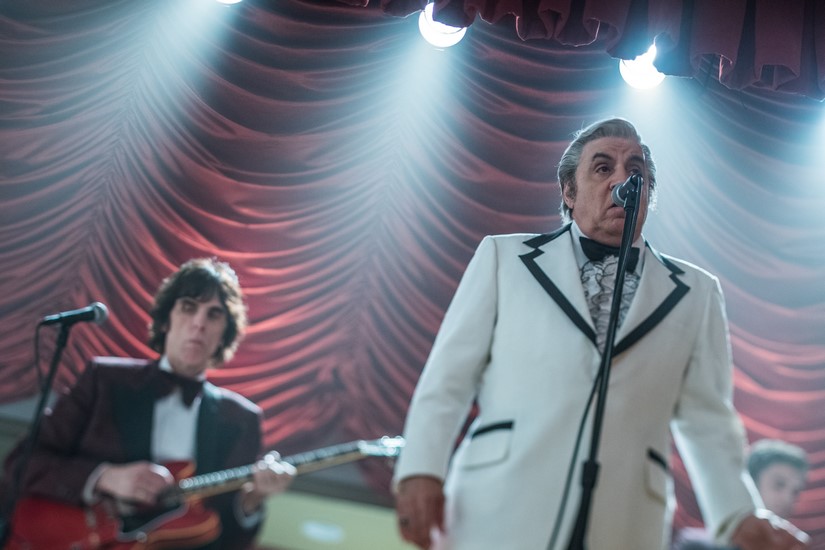
I really like the backgrounds for Frank’s union appreciation dinner. There’s a band playing different songs throughout that long sequence. Was the band on-set actually playing or just miming?
EG: In that scene, Steven Van Zandt (playing Jerry Vale) has an earwig and is lip-synching to playback of the song through his headset. This is one of the first scenes I was given for backgrounds since it was pretty tricky. Thelma wanted to make sure the backgrounds were exactly right, because the drama unfolding is overwhelming — Russell is telling Hoffa that “THIS IS IT.” I used a lot of backgrounds I had from various movies to make the time changes happen with various cuts. Sometimes there’s overlap, sometimes it’s time change. We worked really hard on the background since there was no production sound other than the dialogue and the voices themselves.
What about the backgrounds in other crowd scenes?
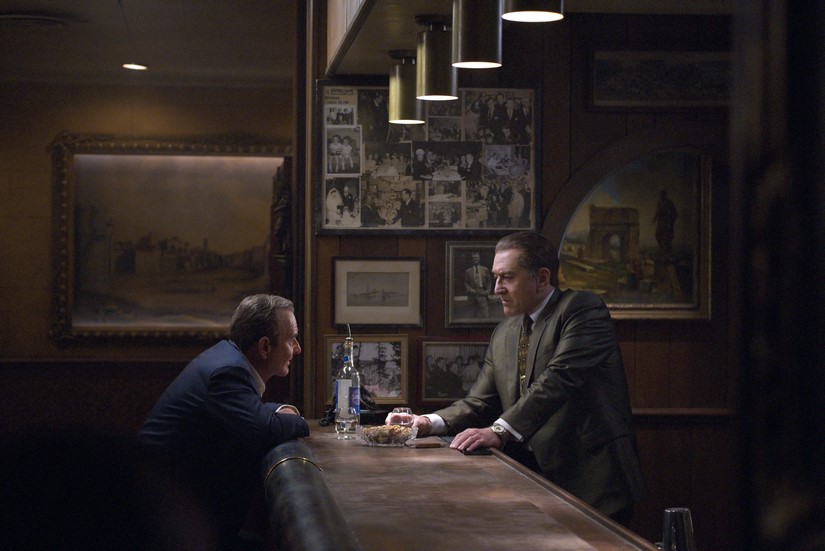
EG: Marty really liked the bar scenes — for example, when Frank meets Skinny Razor (Bobby Cannavale) — those tracks were actually from the set. Marty loved the raucous sound in the bar.
The background actors are talking through the scene. When Marty would say “action” on-set, the background crowd would start doing its thing and that’s very much what he loved the sound of. We definitely sweetened it with group ADR and my backgrounds but they were used very low. Those weren’t as important to him as the production excitement — that sound in that room at that time.
Of course that became a challenge when doing the M&E — how to keep the production going when, in fact, it has dialogue all over it. So Phil [Stockton] had his work cut out for him he did a great job finding a lot of good material that we could use to keep the same excitement and the same feeling for the foreign language versions.
Hear the story behind The Irishman, as told by Martin Scorsese and Robert De Niro in this official Netflix behind-the-scenes podcast
Most of the time the background extras are just miming, so that the production dialogue will be nice and clean. That’s great that Scorsese goes full-on for the crowds… not great for you guys though!
EG: That’s right; most often the background actors are just moving their lips and we’re putting in group ADR in post. But this was just the opposite. Marty loved the noise. But dialogue/music re-recording mixer Tom Fleischman really had to dig into that when mixing, and production sound mixer Tod A. Maitland did a great job of miking the principal actors so when the bartender is talking to Frank and the whole crowd is really cranking you can still hear every word of dialogue which is really a testament to Tom and Phil.
What was the most challenging scene for sound design?
EG: I would say the most fun scene — which I did a lot of work on and then Marty and I dove into further — was the brief title sequence of “I Heard You Paint Houses” near the beginning, which is the intercutting of the tires on the pavement as Frank, Russell and their wives start their road trip. I spent at least a day just developing ideas and sending them to Marty and Thelma. They’d send feedback about particular sounds. Marty wanted each one of those cuts to be frame accurate, with no overlap into the next frame — it almost seemed like an error it was so sharp.
There’s a scene in which Frank and Russell reminisce about a gas station they’re parked near on the highway. It was the gas station where they first met, after Frank’s meat truck broke down. There was also a fun opportunity to create the sound of Frank’s truck breaking down.
They attempted something on location when they shot the scene, where they had the distributor cap in some position where it sounded like a timing chain issue. That was pretty good. I had access to that same truck and I did virtually the same approach to that miss firing — we recorded that fresh — and then I did a fair amount of sweetening, with exhaust chuffing. It was important to sell that break down, because it was all about the resolution. The noisy truck breaks down and it’s quiet. Frank realizes he’s screwed and he doesn’t know where he is.
Mix-wise for Marty, it was all about the resolution to quietness. We would set something up as a busy scene but as it ended the whole thing dissipated into this quiet moment. So as we cut from Frank in the truck to a POV of a car going by quietly, it was all supposed to be very mournful and subtle.
Another scene we worked on quite a bit — which might not make sense to the viewer but makes sense in the process of working with Marty and discovering what is important to him — was after Frank drops off the truck at the dog track in Florida (to a guy named Hunt with big ears), there’s a wide shot of a car driving past a field which leads into the Bay of Pigs newscast that Frank and Russell are watching on TV in the bar. That car-by was really specific to Marty throughout the edit. Thelma told me that I was never getting it right for him. I tried 30 or 40 different car-bys and nothing was working for him. We got into the mix and it was fine (whatever I had was working).
It seems silly to be talking about these as complicated sound design but I learned these little subtleties were hard to come up with. Marty has an idea in his head and it’s getting into that idea to try and understand it. Again, it’s not just an obvious, big explosion; it’s just a car driving past a field. It’s all about this “feeling” more than anything. It’s not about the engine being right for that car; it’s the feeling of that sound of being on a lonely highway with the car going past us. It’s really subtle stuff.
It’s all very subtle but nonetheless it’s our job to achieve this satisfaction or appropriateness. To me, the take away on this job is that, after all of these years, the challenge was what not to do; it was how to be as quiet as possible and still come up with a singular sound that in the real scheme of things is really not a sound design component on the big stage but, in fact, it is to this director on this big movie. It’s still my job to come up with that.
What are you most proud of in terms of sound on The Irishman?
EB: I would change “proud of” to say that I was honored to be a part of Marty’s filmmaking process. There wasn’t any one specific aspect of the sound I was especially proud of, but I satisfied the director’s desire and that is huge.
I really enjoyed creating the backgrounds of the Schuylkill River montage with the guns getting tossed into the water. The mournful background there was a pretty cool thing to build. But to be honest, this film wasn’t like Hugo or Life of Pi or other films where I came up with unique sounds. For this film, I was just honored to be part of the process and grateful that the challenge presented was one that we could meet. We got Marty and Thelma the sound of the movie they wanted and that was a real challenge. I’m honored to be a part of that.
A big thanks to Eugene Gearty for the story behind the sound for The Irishman – and to Jennifer Walden for the interview!