Product Description
A collection of diverse rigid metal sounds like rattles, hits, and other movements, containing everyday metal objects and more exotic ones, like spring drums, Tibetan singing bowls, and more.

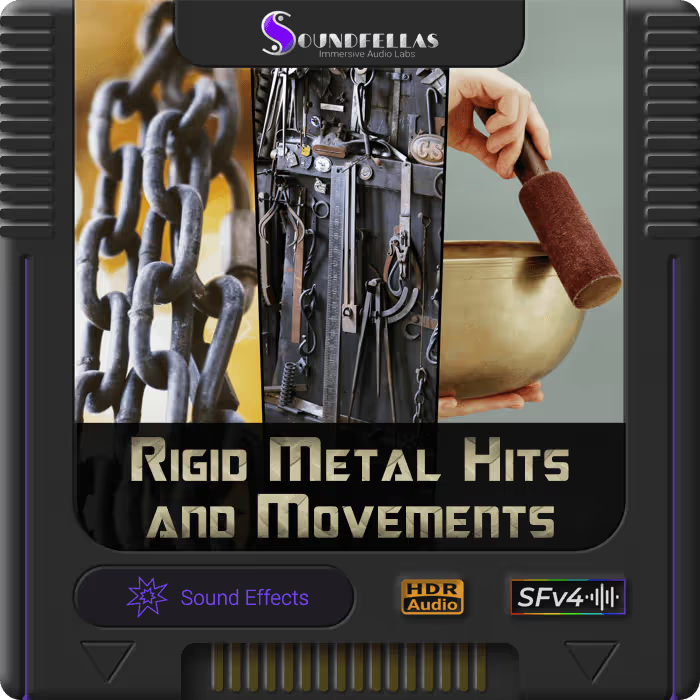
A collection of diverse rigid metal sounds like rattles, hits, and other movements, containing everyday metal objects and more exotic ones, like spring drums, Tibetan singing bowls, and more.
A collection of diverse rigid metal sounds like rattles, hits, and other movements, containing everyday metal objects and more exotic ones, like spring drums and Tibetan singing bowls, suitable for use as Foley, UI elements, and mechanical actions.
This collection captures the distinctive sound of rigidity in metallic objects. The sounds of this library have many uses, from simple metal Foley to user interface sounds and from adding extra sounds in mechanical parts to layering for buffing up other sound effects.
Apart from sound design and special sound effects, music producers can take advantage of the musicality that rigid metal objects feature and use them in samplers and drum machines to enhance the sounds of their tracks.
workshop, mechanical, post-apocalyptic, garage, physics, nature, chain reaction, contraptions, adventure, pinball
element, nature, ingredient, component, metal, metallic, alloy, ore, solid, chain, bowl, spring, spin, scrape, hit, rattle, creak, resonance
The package contains 726 lossless (PCM) wave files (WAV) at 96 kHz / 24-bit resolution with an uncompressed size of 1.1 GB.
Check out the contents and organization of this sound library in the library’s File List.
We take extra care to make it easy to find the sounds you need and intuitively browse the contents. Depending on the theme and content, we use various ways to organize the content. Different content categories and channel formats are organized in folders. Useful content properties are included in the filenames (i.e., Loop, Complex, Diffused, DoplerInversed, etc.). Different types of the same phenomenon are denoted with capital letters, and same-type variations are enumerated with two-digit incremental numbers.