





Tickets are sold on the event website - and if you're interested in participating, get your tickets now because August has nearly sold out!
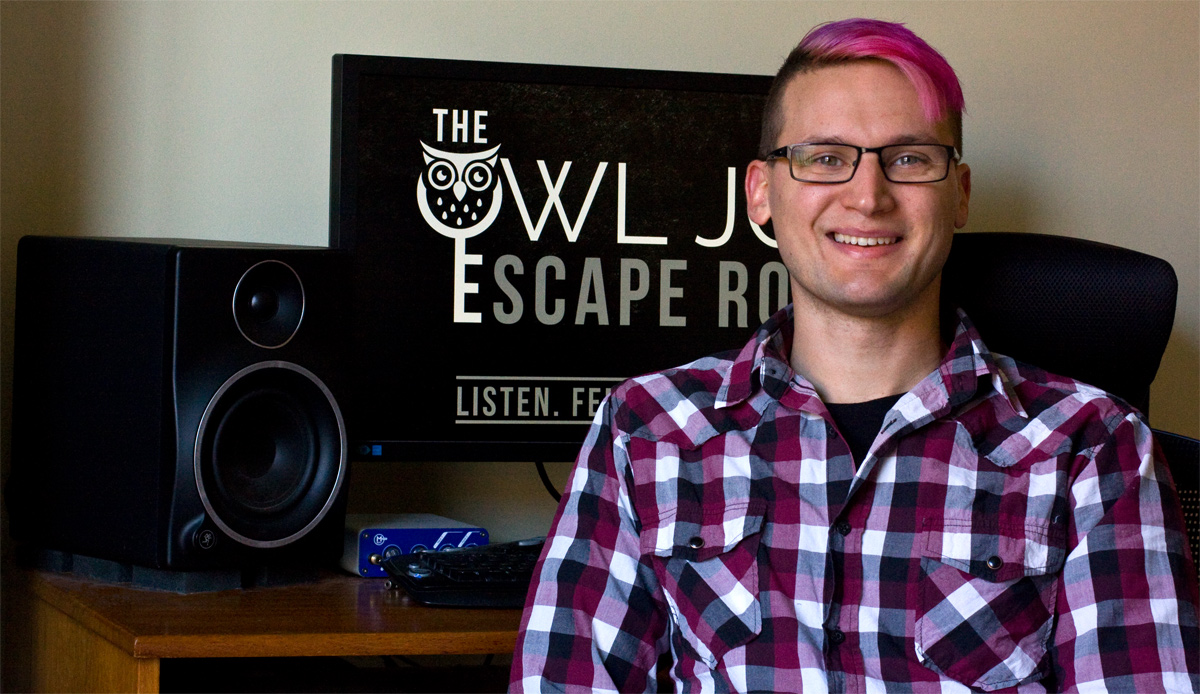
Hello, could you give us a quick pitch of The Owl Job and what people can expect from the experience?
The Owl Job is unique in the escape room world. Like most escape rooms, players are placed in a themed room and have 60 minutes to solve all the puzzles that lead to the exit. However, what makes The Owl Job different is that it’s blind friendly and totally sightless. Players will have to use their ears, their hands and their minds to navigate the space and solve the room.
When did you first become interested in escape rooms?
I’ve been a fan of escape rooms ever since my sister first told me about them years ago. In the first room I ever played we got stuck on a puzzle that was using Morse code. We had found a codebook but we couldn’t see anything that needed translating. So we called for help and the game master told us to stay still and just listen, which is when we realised that the steam valves that sounded broken, were actually whistling in Morse code. It was there the whole time, we just weren’t paying attention. Since then I’ve always been excited whenever escape rooms used audio in unexpected ways.
Is this the first room you’ve created? If so, was its design or story influenced by your other games, like your dice-free RPGs Carnival of Dread or Press Gang?
The biggest lesson was learning that adding complexity doesn’t make for a better puzzle, it just means you’re increasing the likelihood that players will miss something that you thought was obvious.
This is the first “proper” escape room that I’ve created, but my first amateur attempt was turning my kitchen into an escape room. I cooked dinner for my household and told them I’d also made dessert – but that I’d locked it inside a tool chest. I had this whole elaborate setup and honestly, I made some design mistakes that stuck with me. The biggest lesson was learning that adding complexity doesn’t make for a better puzzle, it just means you’re increasing the likelihood that players will miss something that you thought was obvious.
As for the role-playing games, I suppose it comes from a similar place of wanting to craft a story and give players the agency to explore that world in their own way. When I write role-playing game scenarios, they’re often weird worlds with strong horror themes, and although a blind escape room is a rich playground for a horror experience, since this was going to be something new I didn’t want to scare people off right away. In The Owl Job players are burglars breaking into a house in the dead of night. This gives players a familiar location to explore and puts them in a position of power.
Where did the idea for The Owl Job come from? When did you start working on it?
It all started when I went to an exhibition called Dialogue In The Dark. It gives sighted people the experience of navigating familiar spaces without sight, while being guided by a blind host. Afterwards I was talking to our host about escape rooms and she mentioned that she liked the idea of escape rooms, but hadn’t found any that she could play because they all relied too heavily on vision. So I went home certain that someone, somewhere would have made a blind friendly escape room. To my surprise, basically no one has. So I decided that this was a thing that needed to exist – and it needed to be something for both non-sighted and sighted people. When The Owl Job launches this month, it will be almost a year to the day from inception.
Since escape rooms are generally visually driven and seem to use sound to set the mood rather than portray information (though the Morse code puzzle you mentioned is a good example), how do you lead players to discover critical game information in a room that is completely dark?
Employing things like texture, movement, music, temperature, shape … can inform the players about the potential function of a puzzle piece.
We can use a lot of the same tools you’d use for designing an escape room, you just need to code that information differently. For example say you had a puzzle where you had to arrange three blocks in a specific order. We could make that a tactile puzzle by making a small, medium and large block – and the solution is to arrange them by ascending size. Or we could shift the focus to audio, by turning those blocks into bells with a low, medium and high pitch. Or we could even have different size blocks with the bells inside them. And that’s before we start employing things like texture, movement, music, temperature, shape and or any other elements that can inform the players about the potential function of a puzzle piece.
Of course dialogue is a straightforward way of conveying information too. Since we’re inside somebody’s house, I came up with the idea of there being a smart home assistant – an artificial intelligence called Hermes. He’s able to converse with the players and give them clues. Best of all, Hermes is actually embedded in the story itself as a character.
Hermes sounds like an interesting feature! It’s almost reminiscent of Event[0]. How do you and Hermes interact with the players, and how do you control the mix so the sound design is effective without distracting the players while they are solving puzzles?
It was important for players to know that they can also talk back to Hermes and give him commands … without this, players would ignore Hermes and wouldn’t engage in conversation with him beyond the first few minutes.
From my experience as a player, people don’t stay quiet for long, even when listening to clues. For that reason I wrote and re-wrote a lot of the dialogue to keep it as succinct as possible. I’m monitoring a video and audio feed of the room so I can manually trigger Hermes’s dialogue in response to player action. It was important for players to know that they can also talk back to Hermes and give him commands, which is useful if they need him to repeat clues or ask for clarification. So we establish this at the start of the game when Hermes welcomes the players into the home and ask them if they’d like him to put on some music. I found that in early play tests that without this, players would ignore Hermes and wouldn’t engage in conversation with him beyond the first few minutes.
As for the ambient sounds placed around the room, I chose sounds that are naturally calming and not distracting – crickets chirping, a ticking clock and so on. These are also potentially useful tools for helping the player orient themselves around the room. The ticking clock is this nice old fashioned brass clock and I like the idea of players moving this item somewhere else to make an ‘audio waypoint’ for them to return to.
Those are some brilliant design decisions. How did you go about planning the placements of the sound objects and triggers? Also, what venue is it in and what kind of gear are you using?
Hermes has his own speaker that’s just for his dialogue. In fact I placed his speaker in line with the first area that players should investigate, so players will (hopefully) naturally gravitate towards that space. It’s a fairly small room at a rehearsal studio, which was chosen because the room needed to be not so large as to be overwhelming.
It was always going to be important to spread out the speaker placement to create an immersive space, with a couple hidden speakers providing ambient background sounds. From the operations side, I have a desk with a laptop, microphone and iPad all running through an audio interface. The laptop is running QLab which is great for sound effects that occur in a linear order. For triggering Hermes’s dialogue I found the iPad’s touchscreen allowed me to be the most responsive. At present, he has around 80 lines of dialogue. I also have the microphone so that I can talk to players in the room. In most escape rooms when players get stuck they simply radio the game master and ask for a hint. This works fine – but it’s not very immersive. So in this game when players ask for hints they ask Hermes to “call the locksmith” who then speaks to players on speaker phone. I take on the character of the locksmith who is able to identify the “lock” the players are working on and nudge them in the right direction.


How did you go about testing the sound design and overall interactivity? Have you tested with blind and sighted players?
As I saw what puzzles worked, I started playing around with adding story and sound elements around the mechanics, finding ways to weave it all together.
For early play tests I set aside a small storage room in my house and ran incremental tests. At first I just built three puzzle boxes testing different ideas. There was no story and Hermes was just the ghostly, disembodied voice who directed players’ attention from box to box. As I saw what puzzles worked, I started playing around with adding story and sound elements around the mechanics, finding ways to weave it all together. As the tactile puzzles came together I started finding new ways to incorporate sound – both digital speaker sound and the organic sounds certain props made – into the puzzle design. I tried to alternate and layer the puzzle types, to keep things fresh.
I also hired Sightless Kombat, who I found via YouTube, as a consultant to look over the whole thing to get a blind gamer’s perspective. He was great because we didn’t just talk about the game itself, but the pre- and post-game experience.
Do you use haptic feedback in any way?
No, but that’s definitely something that could be useful in other games.
Where did you get most of your inspiration for the design of The Owl Job?
Hermes the smart home assistant is very much my reaction to seeing how current voice recognition technologies are only useful to a point. In this game Hermes warmly welcomes the burglars and offers to help them, addressing each player as the homeowner, Mr Lee. In an early version of the game I had Hermes deliberately mishear the players and say “I’m sorry, did you say set a timer for 60 minutes?” as a way of setting up the 60-minute time limit.
I’ve also taken a lot of inspiration from video game design methods. Often I’ll start players with the simplest version of a puzzle type and let them become familiar with the mechanic, before incrementally re-using similar elements to construct more complex puzzles later on. In this way players go through a tutorial without even being fully aware of it.
What were some of the biggest challenges you faced while creating this experience? Did you come across any situations or reactions you didn’t expect?
Honestly the biggest challenge was finding a wheelchair accessible venue. All too often I’d find the perfect place but it would be up a set of stairs. I wanted to do my best to make this open to as many people as possible but not enough venues are accessible to begin with. It took months, but I’m glad I had people to keep me on track and not compromise on this.
Also as much as I love digital robotic vocals, I ended up pulling back on the sound of Hermes voice and tried not to go overboard with the effects. It was more important that he sound articulate and understandable to players. So instead there’s a fare amount of combining different takes to create a feeling of vocal synthesis. And if Hermes repeats a word within the same sentence, I’ll re-use that same word sample to emphasise the constructed nature of his speech patterns.
Will you be releasing any Squeaky Fish sound libraries with the audio you created for The Owl Job?
No because most of the original recordings for this game are actually voice actor sessions. I wanted to make the experience feel rich and like it wasn’t just one person running the room, so there’s actually a few different voices players will hear throughout the experience.
Where can people sign up to attend The Owl Job or stay updated on the project?
The Owl Job sessions are booked by going through our website. This is an experiment, so I initially only planned for a three day run. But I’ve just added a second run for January 2020.
We also have a mailing list here and our facebook event is here.
Finally, is there anything else you’d like readers to know?
I would love to see more escape rooms embrace the potential in exploring different puzzle types like audio and tactile puzzles.
Sound, like accessibility, is sometimes an afterthought for escape room designers. I would love to see more escape rooms embrace the potential in exploring different puzzle types like audio and tactile puzzles. I think The Owl Job is an example of how making your game more accessible can spawn new creative choices and brings something fresh to the escape room experience. I would love to see other escape room designers take this idea and run with it and make it their own.
A big thanks to Kyle Evans for giving us a look at the brilliant sound design of The Owl Job escape room – and to Adriane Kuzminski for the interview!